
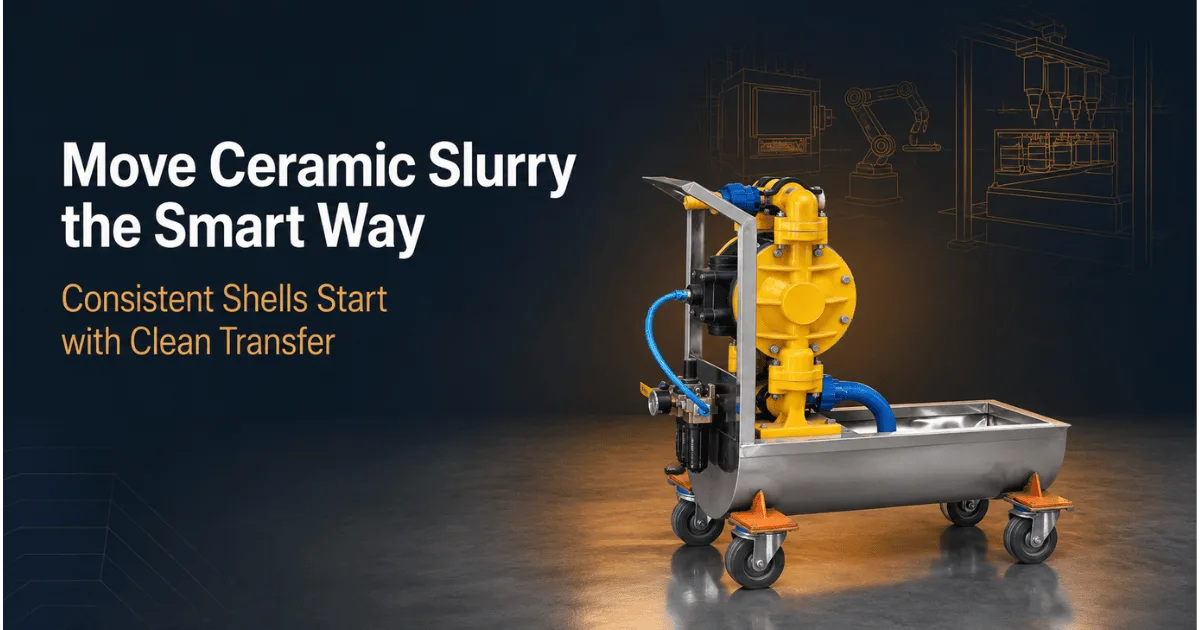
Quick Answer (TL;DR): A slurry transfer pump moves ceramic binder slurry from mix tanks to dip stations without shearing it or letting it settle. As a Slurry Transfer Pump Manufacturer India foundries rely on, Laxminarayan Technologies builds gentle, low-maintenance pumps that hold viscosity steady, cut downtime, and protect shell quality on every coat.
Ninety seconds. That's roughly how fast an unstirred slurry starts to settle and throw off your first coat. Pick the wrong pump and you'll feel it in the reject bin by lunch. As a Slurry Transfer Pump Manufacturer India foundries have trusted since 1986, Laxminarayan Technologies has watched this one problem quietly sink dip lines for four decades. Binder separates. Viscosity drifts. Shells come out thin where they should be thick. Our pumps exist to stop that. They move ceramic slurry gently, keep solids in suspension, and hand your dip station a consistent bath, coat after coat, shift after shift.
What is a slurry transfer pump?
It's a foundry machine that moves abrasive ceramic binder slurry from mixing tanks to dip tanks or holding vessels while keeping the mix homogeneous. It handles high-solids, high-viscosity fluids without excessive shear, settling, or air entrainment.
Why Slurry Handling Quietly Wrecks Shell Rooms
Most shell-room trouble doesn't announce itself. It creeps.
Here's the thing. Slurry is a suspension, not a liquid. Colloidal silica or ethyl-silicate binder holds fine refractory flour in a fragile balance. Push it too hard and you shear it. Let it sit and it settles. Either way, the coat weight on your pattern changes, and coat weight is what decides shell strength.
Cheap pumps make three mistakes:
They shear the binder, so viscosity climbs mid-shift and your Zahn cup readings wander.
They trap air, and trapped air means pinholes and blisters on the shell surface.
They let solids drop out in the line, so the first casting after a break gets a starved coat.
According to Investment Casting Institute practice, coat consistency is the single biggest lever on dimensional accuracy and surface finish in ceramic shell building. Get the slurry wrong and no amount of good wax or good metal saves the part.
What Makes a "Smart" Slurry Transfer Pump in 2026
The word "smart" gets thrown around. We mean something plain: a pump that watches itself so your operators don't have to.
Our 2026 slurry transfer pumps run on gentle positive-displacement action, so the mix moves at low shear. Flow is tuned, not blasted. And we add sensing that actually earns its keep.
Viscosity-aware flow control. The pump reads back-pressure trends and flags a drift before your dip weight goes off.
Soft-start, soft-stop. No hydraulic hammer. That protects both the slurry and the seals.
Dry-run protection. Run a slurry pump dry once and you'll replace parts. Ours simply won't.
CIP-friendly geometry. Clean-in-place ports mean shorter Saturday shutdowns.
Pair the pump with our primary slurry mixers for the prime coat and our secondary slurry mixers for backup coats, and the whole slurry loop stays in spec from tank to pattern. It's one system, not four boxes fighting each other.
How a Slurry Transfer Cycle Runs (Step by Step)
Ask an operator how it works and you'll get the honest version. Here it is.
Prime. The mixer brings the batch to target viscosity. You confirm with a flow cup.
Draw. The transfer pump pulls from the mix tank at low shear, no vortex, no air.
Move. Slurry travels the line to the dip tank or robot bath.
Top-up. The pump holds the dip bath at a set level so coat weight stays flat.
Recirculate. Between dips, gentle recirculation keeps solids suspended.
Clean. End of shift, CIP flushes the line before the binder can gel.
Six steps. Do them right and your shell build is boring. Boring is good in a foundry.
Choosing the Right Pump for Your Slurry Room
No single pump suits every plant. Truth is, it depends on your binder, your solids loading, and how far the tank sits from the dip station. Instead of a spec sheet you'll never read, here's the plain trade-off.
Peristaltic (hose) pumps shine on abrasive, high-solids slurry. Nothing but the hose touches the mix, so wear parts are cheap and swaps are fast. Best for prime coats with heavy flour loading.
Progressive cavity pumps give you steady, low-pulse flow over longer runs. Good when the dip station is across the room and you want tight level control. They cost more up front and reward you in consistency.
Air-operated diaphragm pumps are simple and forgiving. Handy for backup coats and lower-viscosity baths, or where you want a low-cost, easy-service option.
We size and pick for your line, not off a catalogue. That's the difference a manufacturer makes over a reseller.
Real-World Foundry Applications
We've commissioned these pumps across very different floors. A few real cases.
Aerospace turbine blades. Thin trailing edges are unforgiving. Stable prime-coat viscosity kept coat weight inside tolerance and dropped rework on a single-crystal line.
Industrial gas turbine (IGT) parts. Big shells, many coats. Level-controlled transfer kept the last coat as clean as the first, even on long build cycles.
Pump and valve castings. High-volume stainless work where consistency beats speed. Steady flow meant fewer starved coats after breaks.
Automotive turbo and manifold parts. Fast cycle times, tight cost. Low-maintenance pumps kept the line moving without weekend seal changes.
Ceramic-core complex geometries. Delicate cores need gentle handling all the way through. If you also run ceramic core injection, our sister capability at ceramicinjector.com closes that loop.
When you're ready to size a unit, our slurry transfer pump page carries the current models, and it pairs neatly with a properly leveled assembly table for clean sprue and pattern handling upstream.
Challenges and Honest Solutions
No machine fixes everything. Let's be straight about the real pain points.
Viscosity drift over a shift. Binder warms, water evaporates, and the mix thickens. Our answer: closed-loop recirculation plus back-pressure sensing that warns you early, so you correct with additive instead of scrapping shells.
Abrasive wear. Ceramic flour eats components. That's physics. So we build for it, hardened contact paths on progressive cavity units and single-part hose swaps on peristaltic units. You plan the wear instead of chasing it.
Downtime and labour cost. Manual bucket transfer burns people and ruins consistency. Automated transfer, tied into our automated shell-building line, is where the roughly 50% power and roughly 40% labour savings we're known for actually come from. Not marketing. Metered on real floors.
We won't pretend geometry limits or material constraints vanish. They don't. But the slurry side, at least, becomes predictable.
Conclusion
Slurry is where investment casting quietly wins or loses. Move it gently, keep it homogeneous, and your shells behave. As a Slurry Transfer Pump Manufacturer India foundries have trusted since 1986, Laxminarayan Technologies builds ISO 9001 certified pumps, mixers, and full turnkey IC foundry lines that treat the binder with the respect it needs. If your reject rate creeps every time the line restarts, that's a slurry-handling signal. Talk to our engineering team about sizing the right pump for your shell room, and we'll spec it around your process, not ours.
FAQs
What does a slurry transfer pump do in investment casting?
It moves ceramic binder slurry from mixing tanks to dip tanks while keeping refractory solids suspended. Good pumps avoid shear, air entrainment, and settling, which protects coat weight, shell strength, dimensional accuracy, and surface finish across every dip cycle.
Which pump type is best for high-solids foundry slurry?
Peristaltic hose pumps usually suit abrasive, high-solids prime-coat slurry because only the hose contacts the mix, keeping wear parts cheap. Progressive cavity pumps suit long runs needing steady, low-pulse flow and tight dip-level control.
How does automated slurry transfer cut cost?
It removes manual bucket handling, holds viscosity steady, and keeps coat weight consistent. On automated shell-building lines, our customers see roughly 50% power savings and roughly 40% labour savings versus manual slurry rooms, alongside fewer starved-coat rejects.
Why choose Laxminarayan Technologies?
We've built investment casting foundry machinery since 1986, we're ISO 9001 certified, and we supply complete turnkey lines including slurry mixers, transfer pumps, dewax autoclaves, and shell furnaces. We size each pump to your binder, solids loading, and layout.