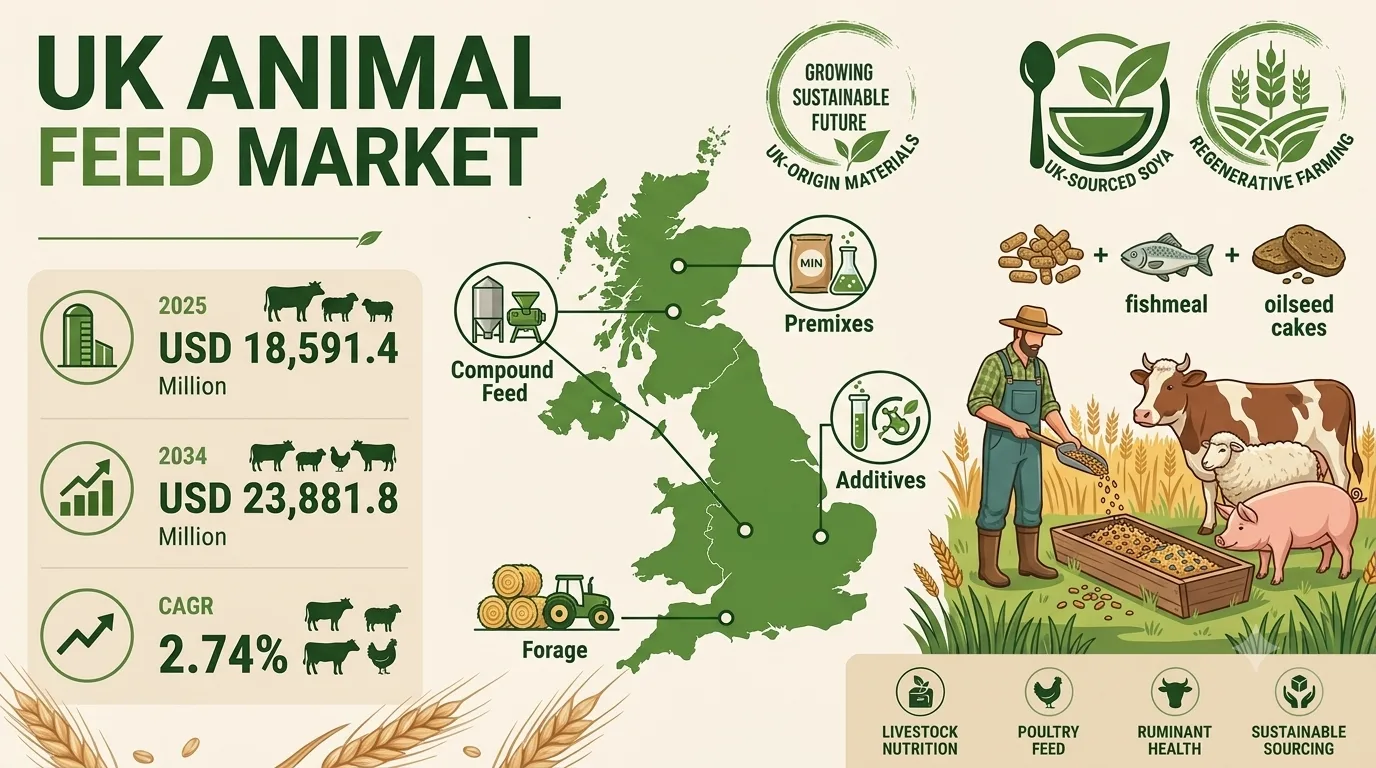
The UK animal feed market is undergoing a significant transformation, driven by a paradigm shift towards sustainable and innovative feed solutions. With mounting concerns over the environmental impact of traditional protein sources like soymeal, the industry is actively embracing alternative ingredients and advanced manufacturing techniques to enhance sustainability, improve animal welfare, and ensure food security. The market size reached USD 18,591.4 Million in 2025 and is projected to reach USD 23,881.8 Million by 2034, exhibiting a compound annual growth rate (CAGR) of 2.74% during 2026-2034. In volume terms, the market attained 14.16 MMT in 2024 and is expected to grow at a CAGR of 3.90% to reach 20.76 MMT by 2034 . The UK has the fifth largest market for pet food and animal feeds regionally, with demand reaching USD 15.5 billion in 2024 . This market is strategically important as it directly supports the nation's livestock, poultry, aquaculture, and pet care sectors.
The UK animal feed market is poised for sustained expansion, driven by a strong push for sustainability, regulatory reforms, and technological innovation. With a projected CAGR of 2.74% through 2034, the market presents significant opportunities for established feed producers and new entrants focused on alternative proteins and value-added, eco-friendly formulations.
UK ANIMAL FEED MARKET SUMMARY
The UK animal feed market encompasses a wide range of products designed to provide essential nutrition for livestock, poultry, aquaculture, and companion animals. The ecosystem includes raw material suppliers (cereals, oilseed meals, and additives), feed manufacturers, distributors, and end-use consumers (farmers, pet owners). Major segments identified in the market include form (pellets, crumbles, mash, and others), animal type (swine, ruminants, poultry, aquaculture, and others), and ingredient (cereals, oilseed meal, molasses, fish oil and fish meal, additives, and others). The poultry segment is a dominant end-use category, and the industry is increasingly focused on shifting from imported soy to domestically grown protein crops like rapeseed, beans, and peas .
PORTER'S FIVE FORCES ANALYSIS – UK ANIMAL FEED MARKET
The competitive dynamics of the UK animal feed market can be analyzed using Porter's Five Forces framework.
- Competitive Rivalry: Moderate and Increasing. The market features a mix of global and domestic players, including AB Agri Ltd, ForFarmers UK Ltd, and Wynnstay Group plc . Competition is driven by product innovation, sustainability credentials, and service offerings. The industry is fragmented, with the top five companies generating 33.8% of total production value in 2024 . Business implication: Companies must differentiate through sustainable sourcing, technological advancement, and strong supply chain relationships.
- Supplier Power (Raw Materials): Moderate. Suppliers of key raw materials like cereals, oilseed meals, and additives have moderate power. Price volatility, climate conditions (e.g., forage shortages in 2025), and geopolitical factors can influence supply and costs . Business implication: Feed producers must manage supply chain risks through diversification, long-term contracts, and strategic sourcing.
- Buyer Power (Farmers & Pet Owners): Moderate to High. Farmers and large-scale agricultural operations can negotiate on price and quality, especially for commodity feeds. However, a growing demand for premium, specialized, and sustainable feed products is creating opportunities for value-added offerings . Business implication: Producers must develop differentiated products and demonstrate clear value to retain customers.
- Threat of Substitutes: Low to Moderate. There are limited substitutes for animal feed in commercial livestock and poultry production. However, advancements in alternative proteins, such as cultivated meat for pet food , and insect-based proteins present a long-term substitute threat for specific segments. Business implication: Continued investment in R&D and innovation is crucial to stay ahead of emerging alternatives.
- Threat of New Entrants: Moderate. Barriers to entry exist due to the capital-intensive nature of production, established supply chains, and regulatory compliance. However, the push for sustainability and innovation is creating niches for specialized and technology-focused new entrants. Business implication: Established players should strengthen their market positions through sustainability leadership and strategic partnerships.
Request for Sample Report: https://www.imarcgroup.com/uk-animal-feed-market/requestsample
MARKET GROWTH DRIVERS:
Several key factors are propelling the expansion of the UK animal feed market. The strong push for sustainability and alternative proteins is a powerful demand driver. The industry is actively moving away from environmentally harmful ingredients like imported soymeal towards more sustainable alternatives. For instance, in February 2025, England and Wales launched a consultation to reintroduce non-ruminant Processed Animal Protein (PAP) into poultry and pig feed, which was previously banned, to diminish emissions and enhance animal agriculture sustainability . Additionally, technological innovation and changing consumer preferences are shaping the market. In February 2025, Meatly launched "Chick Bites," the world's first pet food made from cultivated chicken meat, signaling a paradigm shift towards sustainable protein sources in pet care . Furthermore, the rising demand for premium and specialized feed is supporting market growth. Surging interest in premium specialist feed among farmers, which enhances animal health, fertility, and weight, is increasing the value of sales . Adverse weather conditions, including a record dry spring in 2025, have also heightened farmers' need for feed as an alternative food source .
UK ANIMAL FEED MARKET SEGMENTATION
Segmentation analysis provides a detailed view of the UK animal feed market by category:
- Form Insights: Pellets, Crumbles, Mash, Others.
- Animal Type Insights: Swine (Starter, Finisher, Grower), Ruminants (Calves, Dairy Cattle, Beef Cattle, Others), Poultry (Broilers, Layers, Turkeys, Others), Aquaculture (Carps, Crustaceans, Mackerel, Milkfish, Mollusks, Salmon, Others), Others.
- Ingredient Insights: Cereals, Oilseed Meal, Molasses, Fish Oil and Fish Meal, Additives (Antibiotics, Vitamins, Antioxidants, Amino Acids, Feed Enzymes, Feed Acidifiers, Others), Others.
- Regional Insights: London, South East, North West, East of England, South West, Scotland, West Midlands, Yorkshire and The Humber, East Midlands, Others.
COMPETITIVE LANDSCAPE
The UK animal feed market features a fragmented competitive landscape with a mix of global and strong domestic players. Key companies operating in the market include:
- AB Agri Ltd
- ForFarmers UK Ltd
- Wynnstay Group plc
- Cargill
- Archer Daniels Midland (ADM)
- Nutreco
- De Heus
- Purina Animal Nutrition
- Alltech
- Croda International Plc
- BioMar UK Ltd
- Skretting UK
- Trouw Nutrition GB
- BOCM Pauls Ltd
Strategic developments are shaping the competitive arena, notably SugaRich's acquisition of McGuinness Feeds Ltd in May 2025 to strengthen its market presence . 2 Sisters Food Group is also accelerating a major shift away from imported soy, redeveloping its poultry feed to replace nearly a quarter of imported soymeal with British-grown oilseed rape, beans, and peas, injecting £50 million annually into the agricultural economy . The industry is fragmented, with the top five companies generating 33.8% of total production value in 2024 .
REGIONAL ANALYSIS:
Regional dynamics within the UK animal feed market are shaped by varying levels of agricultural activity and livestock concentration. Scotland is emerging as a key region, with major players like 2 Sisters Food Group calling on Scottish arable farmers to grow more protein crops for poultry feed . The South East, East of England, and the West Midlands have strong agricultural bases, contributing to significant feed consumption. London and other metropolitan areas are key hubs for pet food consumption and distribution. The North West and Yorkshire and The Humber also have significant livestock and poultry operations, supporting feed demand.
RECENT INDUSTRY DEVELOPMENTS
May 2026: Infrastructure Australia released the 2026 Infrastructure Priority List, confirming the national public infrastructure pipeline at AUD 242 billion across 2024‑25 to 2028‑29, representing a 14% increase from 2024 reporting.
May 2026: 2 Sisters Food Group calls on Scottish arable farmers to grow more rapeseed, beans, and peas to meet rising demand for poultry feed, accelerating a major shift away from imported soy .
February 2026: The AHDB forecasts total cereals used for animal feed in the UK to remain strong at 13.3 million tonnes for the 2025/26 marketing year, driven by tight forage stocks and supportive livestock margins .
February 2026: The Animal Feed Production industry's revenue in the UK is expected to swell at a CAGR of 4.6% over the five years through 2025-26 to £8.3 billion, supported by premium specialist feed and heightened activity in ruminant markets .
September 2025: The UK animal feed market is forecast to reach 16 million tons in volume and $34.9 billion in value by 2035, driven by steady demand for feed preparations .
May 2025: SugaRich strengthened its position in the UK animal feed market through the acquisition of McGuinness Feeds Ltd, enhancing its market presence and role in sustainable feed solutions .
February 2025: England and Wales launched a consultation on livestock feed regulations, proposing the inclusion of non-ruminant Processed Animal Protein (PAP) in poultry and pig feed to align with European standards and enhance sustainability .
Key Aspects Required for the UK Animal Feed Market
- Market Performance: USD 18,591.4 Million in 2025, with a projected trajectory to USD 23,881.8 Million by 2034.
- Market Outlook: A 2.74% CAGR through 2034 indicates steady growth across livestock, poultry, aquaculture, and pet food segments.
- Growth Drivers: Sustainability and alternative proteins (e.g., PAP, cultivated meat, domestic protein crops); technological innovation in feed formulation and processing; rising demand for premium and specialized feed; regulatory reforms supporting sustainable practices.
- Competitive Landscape: A fragmented market with moderate and increasing competition, featuring global giants and domestic specialists. Top players include AB Agri Ltd, ForFarmers UK Ltd, and Wynnstay Group plc .
- Value Chain Analysis: From raw material sourcing (cereals, oilseed meals, additives) through feed manufacturing and distribution to end-use consumption in livestock, poultry, aquaculture, and pet care.
- Industry Trends: Shift towards sustainable and eco-friendly ingredients; increasing adoption of alternative proteins; innovation in pet food (e.g., cultivated meat); regulatory reforms for processed animal proteins; growing demand for premium and functional feed.
- Strategic Recommendations: Focus on sustainable sourcing and alternative proteins; invest in technological innovation for feed efficiency and novel ingredients; develop value-added, specialized feed products; build strong relationships with farmers, retailers, and regulatory bodies.
Note: If you need any specific information that is not covered currently within the scope of the report, we will provide the same as a part of customization.
Request Customization: https://www.imarcgroup.com/request?type=report&id=40393&flag=E
Write this before about us --
- Report Format, Delivery, and Customization Details
- Report Format Mode: PPT, PDF, and Excel
- Report Delivery Mode: Online Delivery, Physical Delivery
- Report Delivery Time: Report Delivered Over Email within 24 to 48 hours. If requested by the client, a physical copy will be delivered within three to ten days.
- Report Confirmation Mode: Yes via Email
- Report Customization Mode: Yes via Email / Call
- Report Table of Content: Yes
- Report List of Figures: Yes
- Report Methodology Mode: Yes
- Request For Sample Report: Yes