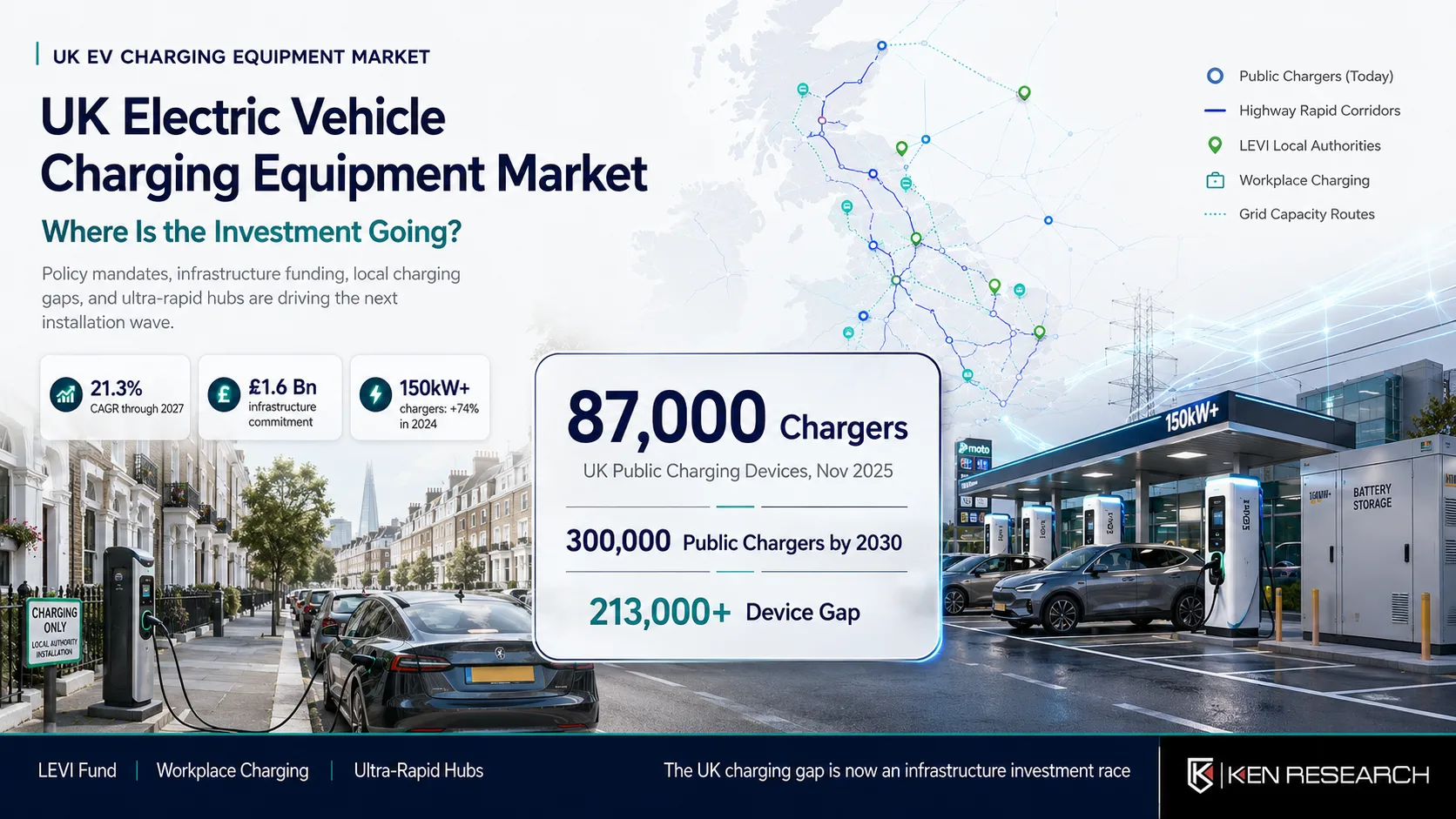
The UK's public EV charging network reached 87,000 devices by November 2025, up from 59,670 in April 2024, growing 37% during 2024 alone, per OZEV and Zapmap data published by the UK Department for Transport. The UK EV Charging Equipment Market is expected to grow at an annual rate of 21.3% through 2027, per Ken Research estimates, driven by the government's legally binding Zero Emission Vehicle (ZEV) Mandate and a £1.6 billion investment commitment under the Electric Vehicle Infrastructure Strategy. The ZEV Mandate, introduced as law on 3 January 2024, requires 22% of new car sales to be zero-emission in 2024, rising to 80% by 2030 and 100% by 2035, per the House of Commons Library. The government's stated target of 300,000 public chargers by 2030 makes the gap between today's 87,000 and the 2030 requirement the defining commercial opportunity in the UK EV charging equipment market for the rest of this decade. The UK Electric Vehicle Charging Equipment Market report by Ken Research covers market sizing, segmentation by charger type and entity, competitive landscape, and outlook to 2027.
Key Insights: UK Electric Vehicle Charging Equipment Market
- Public charging network reached 87,000 devices by November 2025, growing 37% during 2024, per OZEV/Zapmap via UK Department for Transport
- Government target: 300,000 public chargers by 2030, leaving a gap of over 213,000 devices from current levels
- ZEV Mandate legally requires 22% zero-emission new car sales in 2024, 80% by 2030, 100% by 2035, per House of Commons Library
- UK EV Charging Equipment Market forecast to grow at 21.3% CAGR through 2027, per Ken Research
- £1.6 billion committed under the Electric Vehicle Infrastructure Strategy, per Department for Transport, covering public chargepoints, LEVI fund, and workplace charging
- Home chargepoints estimated to need to reach 6 million by 2030, up from 170,000 currently installed through OZEV grant schemes
- 150kW+ ultra-rapid devices grew 74% in 2024 alone, per Zapmap, as the network shifts to faster charging
- Scotland surpassed its target of 6,000 public charge points in October 2024, two years ahead of schedule, per Transport Scotland
- Key players: bp Pulse, Pod Point, GridServe, Osprey Charging, Osprey-Siemens partnership, ChargePoint, EVBox
Where Is the £1.6 Billion Going?
The UK government's £1.6 billion EV infrastructure commitment is being deployed across three distinct channels, each targeting a different segment of the charging gap the country must close before 2030.
The £450 million Local Electric Vehicle Infrastructure (LEVI) fund targets on-street charging for households without driveways. In London alone, 56% of households lack off-street parking, per London Assembly Research, making on-street provision structurally critical for the capital's EV transition. The first LEVI-funded installations began in September 2025, with over 100,000 local chargepoints expected from the programme long-term. Progress has been slower than planned: by October 2024, only 10 of 78 projects had been approved, per published planning data.
Three investment segments shaping the UK Electric Vehicle Charging Equipment Market:
- Rapid charging fund redirection: The original £950 million Rapid Charging Fund, planned for motorway service stations, was cancelled after private investment quadrupled the rapid and ultra-rapid charging network between 2021 and 2024 without public subsidy. The £400 million was redirected toward on-street residential charging. This reflects a market structure where private investment is carrying the rapid charging buildout while public funds target underserved residential and community segments.
- Workplace charging expansion: OZEV grants cover 75% of total costs, up to £350 per socket for businesses, with a higher rate of £2,500 per socket for state-funded educational establishments. Over 1,400 sockets have been installed at UK schools and colleges through this scheme. Workplace charging is projected to reach 1.4 million chargepoints by 2030, per OZEV estimates, driven by EV fleet adoption and legislation requiring businesses with car parks of over 20 spaces to install chargepoints.
- Ultra-rapid network acceleration: The 150kW+ device category grew 74% in 2024, outpacing all other speed categories. CPOs including bp Pulse, Osprey Charging (in its Siemens partnership), and GridServe are leading rapid and ultra-rapid deployment. The commercial rationale is straightforward: higher power means faster turnover per bay, stronger revenue per chargepoint, and greater appeal for en-route drivers on long-distance journeys.
Competitive Landscape of the UK Electric Vehicle Charging Equipment Market
Charge Point Operators (CPOs) hold the largest entity share in the UK Electric Vehicle Charging Equipment Market, per Ken Research. bp Pulse leads by public network scale, followed by Pod Point (now bp-owned), GridServe, and Osprey Charging. The CPO model is consolidating: major energy companies and oil majors are acquiring or building charging networks as a long-term revenue diversification strategy aligned with the ICE vehicle phase-out deadline of 2030. For regional comparison, the Netherlands Electric Vehicle Charging Equipment Market shows how a market with higher current charger density than the UK is navigating the same rapid-to-ultra-rapid technology transition, offering a useful near-term benchmark for where the UK market is heading.
Conclusion
The UK Electric Vehicle Charging Equipment Market sits at a structural inflection point where policy mandates are unambiguous, investment is committed, and the gap between current infrastructure and 2030 requirements is too large to close without sustained acceleration. 87,000 public devices against a 300,000 target leaves over 213,000 to install in under five years. The ZEV Mandate's annual escalation, combined with the 2030 ban on new petrol and diesel car sales confirmed in January 2025, means the demand curve for charging equipment is locked in by regulation. The operators who secure grid capacity, CPO contracts, and local authority partnerships now will capture the installation pipeline as it accelerates through 2027 and beyond. The UK Electric Vehicle Charging Equipment Market Outlook to 2027 maps the full competitive and investment trajectory.
FAQs
1. How many public EV chargers does the UK have and how many does it need?
The UK had approximately 87,000 public charging devices by November 2025, per OZEV and Zapmap data cited by the Department for Transport, growing 37% during 2024 alone. The government's stated target is 300,000 public chargers by 2030, leaving a gap of over 213,000 devices to be installed in under five years. Separately, home chargepoints need to reach an estimated 6 million by 2030 from the 170,000 currently installed through OZEV grant schemes, per published government estimates. For full infrastructure sizing detail, the UK Electric Vehicle Charging Equipment Market Analysis by Ken Research covers market sizing and installation forecasts in full.
2. What is the UK ZEV Mandate and why does it matter for the UK Electric Vehicle Charging Equipment Market?
The Zero Emission Vehicle Mandate became law on 3 January 2024, requiring car manufacturers to ensure 22% of their new car sales are zero-emission in 2024, rising to 80% by 2030 and 100% by 2035, per the House of Commons Library. Non-compliance fines can reach £15,000 per non-compliant car and £18,000 per non-compliant van. The mandate creates a legally binding demand escalator for EV adoption, which in turn drives charging equipment demand. Every percentage point increase in the ZEV mandate target translates directly into more EVs on UK roads requiring charging infrastructure.
3. How is the UK government's £1.6 billion EV infrastructure investment being deployed?
The £1.6 billion is split across three channels. The £450 million LEVI fund targets on-street residential charging for households without driveways, with first installations beginning September 2025. OZEV workplace charging grants cover 75% of costs up to £350 per socket for businesses and £2,500 per socket for educational establishments. The original £950 million Rapid Charging Fund was cancelled after private investment rendered it unnecessary for motorway rapid charging, with the £400 million redirected to on-street residential provision instead.
4. Which charger types are growing fastest in the UK Electric Vehicle Charging Equipment Market?
Ultra-rapid chargers rated at 150kW and above grew 74% in 2024, the fastest growth of any charger category, per Zapmap data. This reflects both the technology transition toward faster charging and the commercial model shift toward higher-revenue-per-bay rapid charging hubs. Slower destination chargers also grew, driven by hotel, leisure centre, and retail car park installations. The total public network growth of 37% in 2024 reflects broad-based acceleration across all charger types, with ultra-rapid leading by growth rate and slower chargers leading by absolute volume installed.
5. Who are the key players in the UK Electric Vehicle Charging Equipment Market?
bp Pulse leads the UK Electric Vehicle Charging Equipment Market by public network scale, followed by Pod Point (a bp subsidiary), GridServe, Osprey Charging, and ChargePoint. CPOs hold the largest entity share, per Ken Research. The Osprey-Siemens collaboration, announced specifically to accelerate rapid charger commissioning, illustrates the trend toward industrial partnerships that combine charging network operators with equipment manufacturers. The market is moderately consolidated at the top tier but has significant participation from smaller regional operators and local authority-backed networks being built through the LEVI fund.