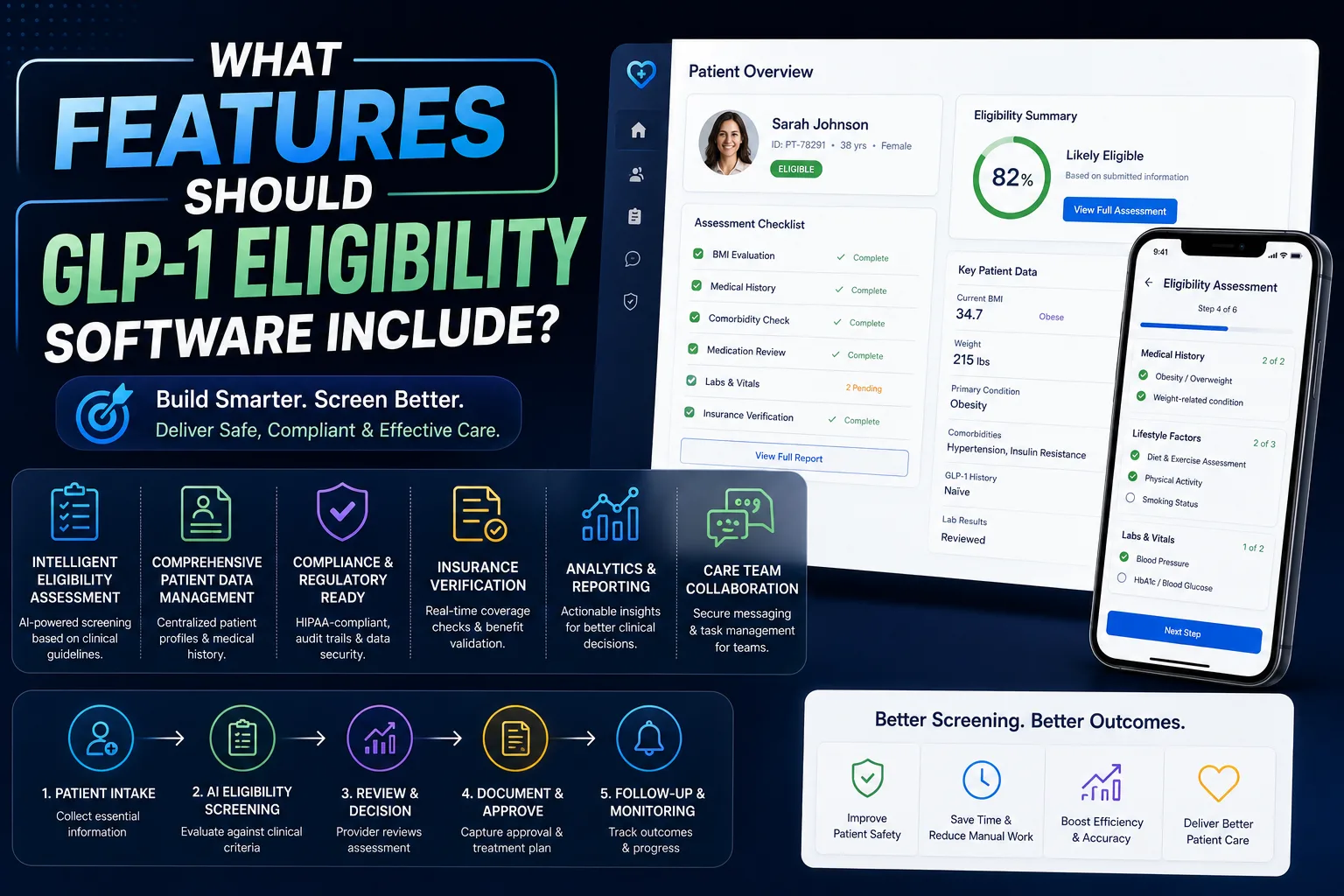
The rapid rise of GLP-1 medications has transformed how healthcare providers approach obesity management, diabetes treatment, and metabolic health. Medications such as semaglutide and tirzepatide have generated unprecedented demand from both patients and clinicians. As a result, healthcare organizations are facing a significant administrative burden when determining which patients qualify for treatment, whether insurance plans will cover the medication, and what documentation is required to obtain approval. This is where GLP-1 eligibility software becomes an essential part of modern healthcare operations.
At its core, GLP-1 eligibility software acts as a decision-support platform that helps healthcare providers quickly identify suitable candidates for treatment. Rather than manually reviewing medical records, insurance requirements, laboratory values, and patient histories, providers can rely on automated workflows to streamline the process. The software reduces administrative overhead, minimizes human error, and accelerates patient access to therapy. In a healthcare environment where speed, accuracy, and compliance matter, these systems serve as a bridge between clinical decision-making and operational efficiency.
Why Healthcare Organizations Need Automated Eligibility Screening
Healthcare practices often manage hundreds or thousands of patients who may be interested in GLP-1 therapies. Manually evaluating every patient consumes valuable staff time and creates opportunities for mistakes. Automated eligibility screening allows providers to quickly identify patients who meet clinical criteria while filtering out those who do not qualify. This improves efficiency and ensures that clinical resources are focused on the patients most likely to benefit.
The Growing Demand for GLP-1 Therapies
The popularity of GLP-1 medications has expanded beyond traditional diabetes management into weight management and metabolic health programs. With increased demand comes increased complexity. Providers must navigate varying payer requirements, changing clinical guidelines, and patient expectations. Eligibility software helps organizations manage this growth without overwhelming staff or compromising care quality.
Core Patient Eligibility Assessment Features
The foundation of any GLP-1 eligibility platform should be its ability to perform accurate and comprehensive patient assessments. Without strong eligibility logic, even the most advanced software will struggle to deliver meaningful results. The system should evaluate multiple clinical variables simultaneously and generate clear recommendations for healthcare professionals. Think of it as a sophisticated filter that turns complex patient information into actionable insights.
Clinical eligibility evaluation should incorporate factors such as body mass index (BMI), diabetes status, cardiovascular risk factors, existing medications, laboratory results, and documented medical history. The software should also account for contraindications and potential safety concerns. This level of analysis ensures that recommendations are clinically appropriate rather than based on a single variable. By combining multiple data sources, the platform creates a more complete picture of patient suitability.
Clinical Criteria Evaluation
A high-quality platform should automatically evaluate established treatment criteria and compare patient information against evidence-based guidelines. The software should continuously update eligibility logic as treatment recommendations evolve.
Comorbidity Identification
Many patients seeking GLP-1 treatment present with additional health conditions such as hypertension, sleep apnea, insulin resistance, or cardiovascular disease. Identifying these conditions strengthens clinical decision-making and may influence insurance approval outcomes.
Insurance Verification and Coverage Analysis
One of the biggest barriers to GLP-1 treatment is insurance coverage. A patient may be clinically eligible for therapy but unable to access treatment due to coverage limitations, formulary restrictions, or prior authorization requirements. This makes insurance verification one of the most valuable components of eligibility software. Providers need immediate visibility into coverage details so they can set realistic expectations and avoid delays.
Advanced eligibility platforms should connect directly with payer databases and benefits verification systems. These integrations enable real-time confirmation of patient coverage and identify specific requirements before a prescription is submitted. Instead of discovering issues after a claim denial, healthcare teams can proactively address potential obstacles. This not only improves efficiency but also enhances patient satisfaction by reducing uncertainty and frustration.
FeatureBenefitReal-time coverage checksFaster treatment decisionsFormulary analysisIdentifies preferred medicationsCost estimationImproves patient transparencyPrior authorization guidanceReduces denial ratesBenefits verificationSaves administrative timeReal-Time Benefits Verification
The software should instantly verify insurance eligibility, prescription benefits, and medication coverage status. This feature eliminates unnecessary manual phone calls and paperwork.
Prior Authorization Readiness
Many GLP-1 therapies require extensive documentation. Eligibility software should automatically collect relevant information and prepare prior authorization packages for submission.
Data Integration Capabilities
No healthcare software can operate effectively in isolation. GLP-1 eligibility platforms must integrate seamlessly with existing systems to provide accurate and comprehensive assessments. Data integration reduces duplication, eliminates manual entry errors, and improves workflow efficiency. When information flows freely between systems, providers gain a more complete understanding of each patient.
Electronic Health Record (EHR) integration is particularly important. Clinicians should not be required to switch between multiple applications to access patient data. Instead, eligibility software should retrieve relevant information automatically and present recommendations within existing workflows. Integration with laboratory systems, pharmacy platforms, and payer databases creates a unified ecosystem that supports informed decision-making.
Electronic Health Record (EHR) Connectivity
EHR integration enables automatic access to diagnoses, medication histories, laboratory results, and clinical notes. This reduces administrative effort and improves data accuracy.
Laboratory Data Integration
Many treatment decisions depend on laboratory values. Eligibility software should automatically incorporate relevant test results into the assessment process.
Workflow Automation Features
Automation is where GLP-1 eligibility software delivers its greatest operational value. Healthcare organizations are under constant pressure to improve productivity while maintaining high-quality care. Automation helps achieve both objectives by eliminating repetitive tasks and standardizing complex processes. Instead of relying on manual checklists and spreadsheets, organizations can use intelligent workflows that guide users through each step.
Automated patient screening should continuously evaluate patient populations and identify individuals who may qualify for treatment. The system can flag opportunities, generate outreach lists, and notify care teams when action is needed. Automated workflows also reduce bottlenecks by ensuring that required documentation is completed in a timely manner. This keeps patients moving through the treatment journey without unnecessary delays.
Automated Patient Screening
The platform should scan patient populations and identify potential candidates based on predefined eligibility criteria.
Task Management and Alerts
Automated reminders, deadlines, and workflow notifications help staff stay organized and ensure that no critical tasks are overlooked.
Compliance and Security Requirements
Healthcare organizations handle highly sensitive patient information, making security a non-negotiable requirement. Any GLP-1 eligibility platform must be designed with compliance and privacy at its core. A single data breach can damage patient trust, create legal liabilities, and result in significant financial penalties. Security should therefore be embedded into every layer of the software architecture.
The platform should include encryption, role-based access controls, secure authentication methods, and ongoing monitoring capabilities. Access to patient information should be limited to authorized personnel, and every action should be recorded for accountability purposes. Strong compliance measures not only protect patients but also support organizational credibility. Providers need confidence that the technology they use meets regulatory requirements and industry best practices.
HIPAA-Compliant Data Protection
Encryption, secure storage, access controls, and compliance monitoring are essential for safeguarding protected health information.
Audit Trails and Documentation
Comprehensive audit logs help organizations track user activity, maintain compliance, and demonstrate accountability during audits.
Analytics and Reporting Functions
Data is one of the most valuable assets in healthcare, but only when it can be transformed into meaningful insights. GLP-1 eligibility software should include robust reporting and analytics capabilities that help organizations understand performance, identify trends, and optimize operations. These tools allow leadership teams to move beyond anecdotal observations and make evidence-based decisions.
Analytics can reveal how many patients qualify for therapy, how many receive approvals, and where bottlenecks occur within the workflow. Organizations can monitor denial rates, evaluate provider performance, and identify opportunities for process improvement. Financial reporting features are equally important because GLP-1 programs often involve significant reimbursement considerations. By combining clinical and operational data, analytics tools provide a comprehensive view of program effectiveness.
Population Health Insights
Organizations should be able to identify trends across patient populations and measure treatment eligibility at scale.
Financial and Operational Reporting
Reporting dashboards should track approval rates, revenue opportunities, workflow efficiency, and resource utilization.
Patient Engagement Capabilities
Successful GLP-1 programs extend beyond eligibility determination. Patients need education, communication, and ongoing support throughout their treatment journey. This is why patient engagement features have become increasingly important within eligibility software platforms. Engaged patients are more likely to complete required documentation, adhere to treatment plans, and achieve positive outcomes.
Digital intake tools simplify information collection and reduce administrative workload. Patients can complete questionnaires electronically before appointments, allowing providers to review information in advance. Educational resources can explain treatment expectations, potential side effects, and lifestyle considerations. Follow-up communication tools help maintain engagement after therapy begins, creating a more connected and supportive care experience.
Digital Intake and Questionnaires
Patient-friendly intake forms streamline data collection and improve the quality of information used for eligibility assessments.
Education and Follow-Up Tools
Educational content, reminders, and communication channels help patients stay informed and engaged throughout treatment.
Future-Proof Features for Scalability
Healthcare technology evolves rapidly, and organizations need software that can adapt to future demands. Scalability should be a central consideration when evaluating GLP-1 eligibility solutions. A platform that works well for a single clinic today should also support multi-location operations, larger patient populations, and expanding service lines tomorrow.
Artificial intelligence and predictive analytics are increasingly influencing healthcare decision-making. Future-ready eligibility platforms should leverage these technologies to identify patterns, recommend actions, and improve operational efficiency. Scalability also extends to infrastructure, user management, and integration capabilities. Organizations should select solutions that can grow alongside their clinical and business objectives without requiring major system replacements.
AI-Assisted Decision Support
AI can help identify qualifying patients, predict approval outcomes, and provide evidence-based recommendations to clinicians.
Multi-Clinic and Enterprise Deployment
Enterprise-grade platforms should support multiple locations, centralized reporting, standardized workflows, and large-scale patient populations.
Conclusion
Choosing the right GLP-1 eligibility software requires more than simply automating patient screening. The most effective solutions combine clinical assessment tools, insurance verification, workflow automation, compliance safeguards, analytics, and patient engagement capabilities into a single integrated platform. When these features work together, healthcare organizations can reduce administrative burden, accelerate treatment access, and improve patient outcomes.
As demand for GLP-1 therapies continues to grow, providers need technology that supports both clinical excellence and operational efficiency. A comprehensive eligibility platform acts as a strategic asset, helping organizations navigate complex requirements while delivering a better experience for patients and staff alike. The healthcare organizations that invest in scalable, intelligent, and secure eligibility solutions will be best positioned to succeed in the evolving landscape of metabolic and obesity care.
FAQs
1. What is GLP-1 eligibility software?
GLP-1 eligibility software is a healthcare technology platform that helps providers determine whether patients qualify for GLP-1 medications based on clinical, insurance, and operational criteria.
2. Why is insurance verification important in GLP-1 programs?
Insurance verification helps identify coverage requirements, reduce claim denials, and accelerate patient access to treatment.
3. Can GLP-1 eligibility software integrate with EHR systems?
Yes. Most advanced solutions include EHR integration to automatically retrieve patient information and improve workflow efficiency.
4. What security features should GLP-1 eligibility software include?
Key security features include HIPAA compliance, data encryption, access controls, audit logs, and secure authentication mechanisms.
5. How can AI improve GLP-1 eligibility assessments?
AI can automate patient screening, predict authorization outcomes, identify treatment opportunities, and support evidence-based decision-making.