comes from a private well, bacteria are one of the risks you can't see, smell, or taste. UV water treatment is one of the simplest ways to deal with them. It adds no chemicals, doesn't change the taste, and uses about as much electricity as a light bulb.
But UV has a reputation it doesn't always live up to, usually because it's installed on water that isn't ready for it. Here's how it works, what it can and can't do, and what it needs to protect your home reliably.
How UV disinfection works
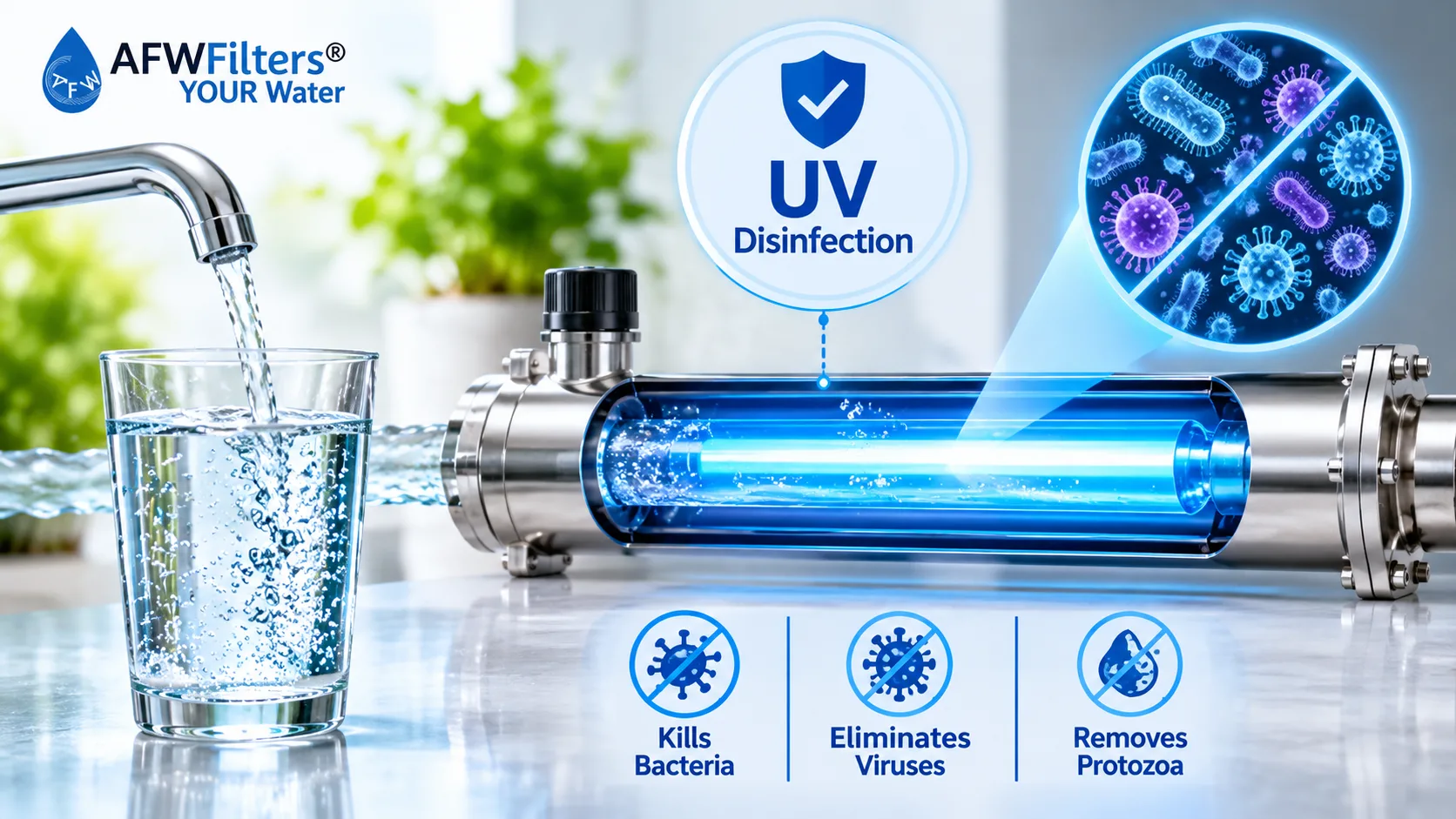
A UV system is a stainless steel chamber with a special lamp inside a clear quartz sleeve. As water flows past, ultraviolet light damages the DNA of bacteria, viruses, and protozoa so they can't reproduce or make you sick. The water is treated in seconds and leaves the chamber unchanged in taste, smell, and chemistry.
That's why UV disinfection systems are a common final stage on well water. They're also used in larger settings: the Los Angeles Aqueduct Filtration Plant, for example, uses UV as part of its treatment.
What UV can't do
UV disinfects. It doesn't filter. An ultraviolet water filter, as it's often called, won't remove:
- Sediment, sand or cloudiness
- Iron, manganese or hardness
- Chemicals such as arsenic, nitrate, lead, or PFAS
- Tastes and odors
It also has no lasting effect once water leaves the chamber, unlike chlorine. So if bacteria get into the plumbing after the UV unit, it won't treat them.
If a test shows bacteria, find and fix the source too, such as a damaged well cap, a cracked casing, or surface water draining toward the wellhead. A health department or well contractor can help, often with shock chlorination before UV is installed.
Why water quality before UV matters
UV only works if light reaches every microbe. Cloudy water shields bacteria from the light, and minerals like iron and hardness coat the quartz sleeve, gradually blocking it.
The Connecticut Department of Public Health's UV guidelines for groundwater systems set maximum levels for water entering a UV unit:
ParameterMaximum before UVIron0.3 mg/LManganese0.05 mg/LHardness120 mg/L (as calcium carbonate)Turbidity1.0 NTUWater above those levels needs pre-treatment first, usually a sediment filter, an iron filter, a softener, or a combination. That's why UV almost always goes last in a treatment train.
What certification to look for
Not all UV water systems are rated for the same job. A public health fact sheet from Greene County, Ohio explaIf your waterins the difference:
- NSF/ANSI 55 Class A systems must deliver at least 40 mJ/cm² of UV dose. They're intended to disinfect water against bacteria, viruses, and protozoan cysts such as Giardia and Cryptosporidium.
- Class B systems deliver a lower dose (16 mJ/cm²) and aren't intended as the primary disinfection for unsafe water.
Class A systems include a UV sensor and an alarm or automatic shutoff if the dose drops too low. The same fact sheet notes that automatic shutoff is the preferred setup, so untreated water can't flow through unnoticed.
Sizing a UV system
A UV unit has to treat every gallon at your home's peak flow, which is when the most fixtures run at once. If water flows too fast, it doesn't spend long enough in the chamber to get a full dose.
Size by gallons per minute, not by home size alone. Allow for showers, the washing machine, and irrigation running together. When in doubt, size up. A slightly larger unit gives a margin as the lamp ages.
Keeping UV working
UV maintenance is simple but easy to forget:
- Replace the lamp every year. A UV lamp loses strength over time. The Greene County fact sheet puts its effective disinfecting life at about one year, even if it still glows.
- Clean the quartz sleeve when you change the lamp, or more often if your water leaves deposits.
- Watch the sensor and alarm, and don't ignore warnings.
- Disinfect the plumbing after installing a new system or after any lapse in treatment, since bacteria can linger in pipes.
- Retest the water at least once a year to confirm the system is doing its job.
Choosing a system
Start with a water test that includes bacteria, iron, manganese, hardness, and turbidity. Fix what needs fixing upstream, then choose a Class A unit sized to your peak flow.
Suppliers that sell both pre-treatment and UV make it easier to plan the whole setup at once. AFW Filters, for example, carries UV disinfection systems alongside sediment filters, iron filters, and softeners. You can compare UV water treatment options by flow rate to find a unit that matches your home's demand.
UV disinfection water treatment is one of the most effective, low-maintenance ways to protect well water from bacteria and viruses, as long as the water reaching it is clean and clear. Test first, pre-treat what needs it, choose a Class A system sized for peak flow, and change the lamp every year.