"We offer UX design services" is one of the most common lines on any design vendor's homepage and one of the least specific. Ask ten different studios what's actually included in their UX design services, and you'll get ten different answers: some mean wireframes and mockups, others mean full research-to-prototype packages, and a few mean little more than visual polish on an existing screen.
If you're evaluating vendors, it's worth understanding what a comprehensive service actually looks like before comparing quotes because two proposals with wildly different prices might be quoting completely different scopes of work.
What Should Genuinely Comprehensive UX Design Services Include?
Comprehensive UX design services should cover the full arc from user research to validated, developer-ready design not just the visual layer.
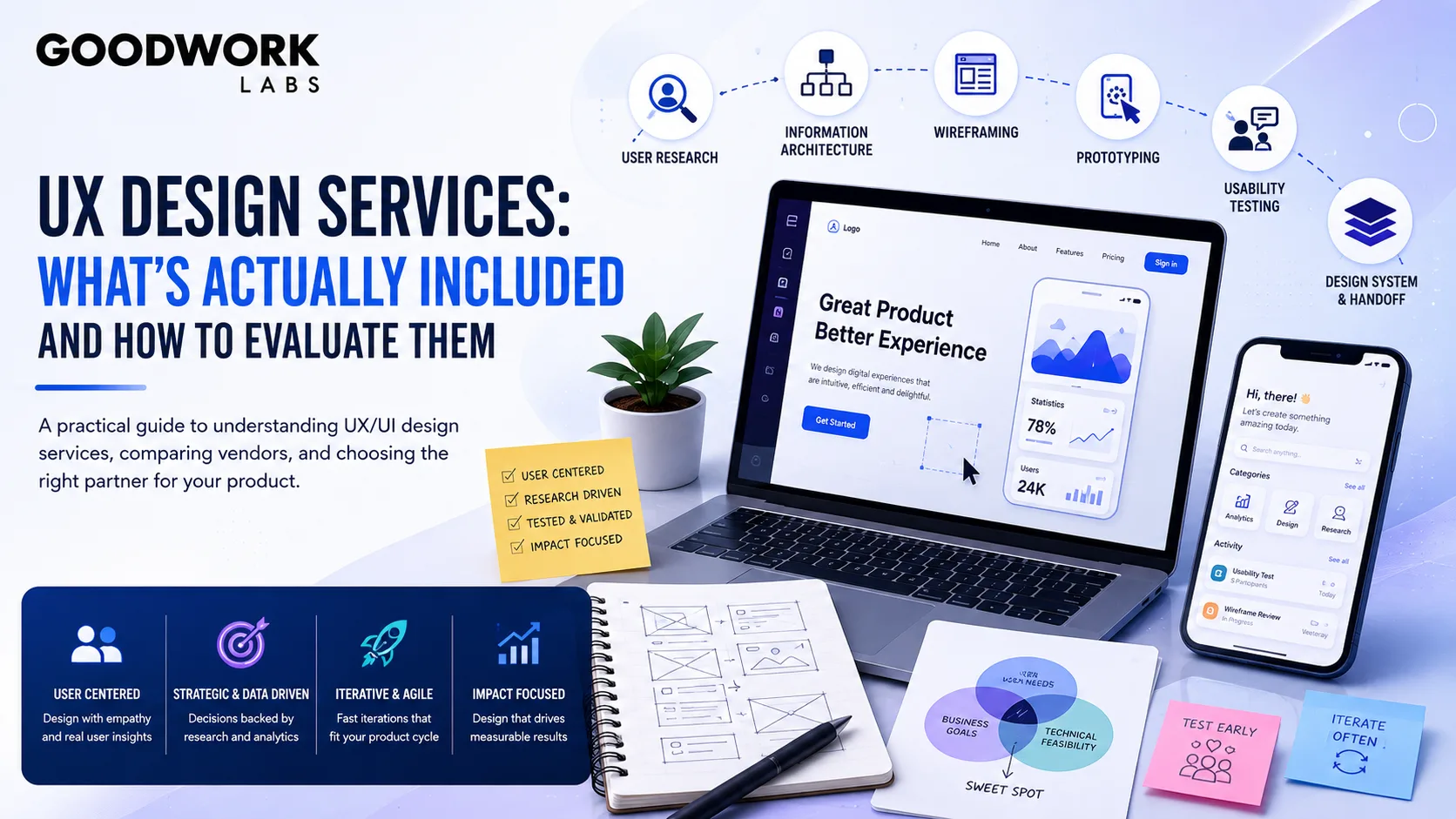
A complete engagement typically includes: user research (interviews, surveys, or analytics review), competitor and heuristic analysis, information architecture, wireframing, interactive prototyping, usability testing, and a final design system ready for development handoff. Many vendors skip straight to wireframes or high-fidelity mockups without any research phase which often means the resulting design solves problems nobody validated in the first place. If a proposal doesn't mention research or testing at all, that's usually a sign the "design" being delivered is closer to decoration than a genuine user-experience process.
How Do UI/UX Design Services Differ From Pure UX Consulting?
UI/UX design services combine the strategic, research-driven work of UX with the visual execution of UI meaning you get both the "does this work" and the "does this look right" outputs in one engagement.
Pure UX consulting often stops at wireframes, personas, and journey maps, leaving the visual design and final interface build to another team. UI/UX design services, by contrast, typically carry the project all the way through to pixel-accurate, brand-aligned screens ready for engineering. This matters for teams that don't have a separate visual/UI design function in-house a combined UI/UX offering avoids the gap between "structurally sound but unstyled" and "beautiful but untested" deliverables that can occur when these are split across two vendors.
Why Are Businesses in Bangalore Specifically Looking for UI/UX Design Services There?
Bangalore's density of startups and product companies has created strong demand for UI/UX design services in Bangalore that understand fast-paced, iterative product cycles rather than traditional, slower-moving agency workflows.
Product teams in Bangalore are often working in sprint cycles tied closely to engineering releases, which means design services here tend to be evaluated on turnaround speed and iteration ability just as much as final quality. Vendors who can embed into a two-week sprint cadence, join daily standups, and turn around design iterations quickly tend to be favored over agencies built around slower, milestone-based delivery models more common in traditional branding or marketing work.
How Should You Evaluate the Quality of UX Design Services Before Buying?
Evaluate quality by asking for evidence of research rigor, requesting to see a full project artifact set (not just final screens), and checking whether past clients saw measurable product improvements.
A practical exercise: ask a shortlisted vendor to walk you through one past project end-to-end from the initial research findings, through the decisions that research led to, to the final measurable impact (conversion lift, reduced support tickets, improved task completion). Vendors offering genuinely strong UX design services can usually narrate this chain clearly. Vendors offering surface-level work often struggle past the "here's the final screen" stage because there was no real research-to-decision chain behind it.
It's also worth asking how testing is handled. Usability testing doesn't need to be expensive or complex even five user sessions can surface major issues before a product ships. If a vendor's services skip testing entirely, that risk gets passed on to you post-launch, usually in the form of confused users and higher support volume.
What Does Pricing Typically Look Like Across Different Service Models?
Pricing for UI/UX design services generally falls into three models: fixed-scope project pricing, monthly retainers, and dedicated resource/pod pricing each suited to a different kind of engagement.
Fixed-scope pricing works well for a defined deliverable, like redesigning a single app flow. Retainers suit ongoing product teams that need continuous design support across multiple features and releases. Dedicated pod pricing where you essentially get a designer or small team working exclusively on your product tends to suit fast-growing startups needing sustained design capacity without the overhead of a full in-house hire. None of these is objectively "better"; the right model depends on whether your design needs are a one-time project or an ongoing function.
What Scoping Mistakes Do Most Buyers Make?
The most common mistake is treating UX design services as a single flat-rate line item instead of a set of distinct phases that can be scoped independently.
Buyers often assume "design" means one bundled deliverable, then get surprised when a vendor's quote only covers wireframes, or when research turns out to be a separate add-on rather than included by default. The fix is straightforward: ask any vendor to itemize their UI/UX design services proposal phase by phase research, IA, wireframes, visual design, prototyping, testing, and handoff rather than accepting a single bundled number. This also makes it far easier to compare two very different-looking quotes, since you can line up phase against phase instead of guessing why one proposal costs three times another.
A second common mistake is skipping the handoff conversation entirely. Even excellent design work can fail in implementation if the development team receives static images instead of an organized, annotated design system. Before signing, confirm exactly what handoff format is included Figma files with developer mode access, a documented component library, or something less structured since this detail often determines how smoothly design translates into a shipped product.
Final Thoughts
The phrase UX design services covers a much wider range of work than most homepages let on. Before comparing vendors on price alone, get specific about scope: is research included? Is testing included? Does the engagement end at a Figma file, or does it carry through to a development-ready design system? Getting clarity on UI/UX design services scope upfront especially if you're comparing UI/UX design services in Bangalore against options elsewhere will make the eventual comparison a lot more like-for-like, and save you from underscoped surprises later in the project.