
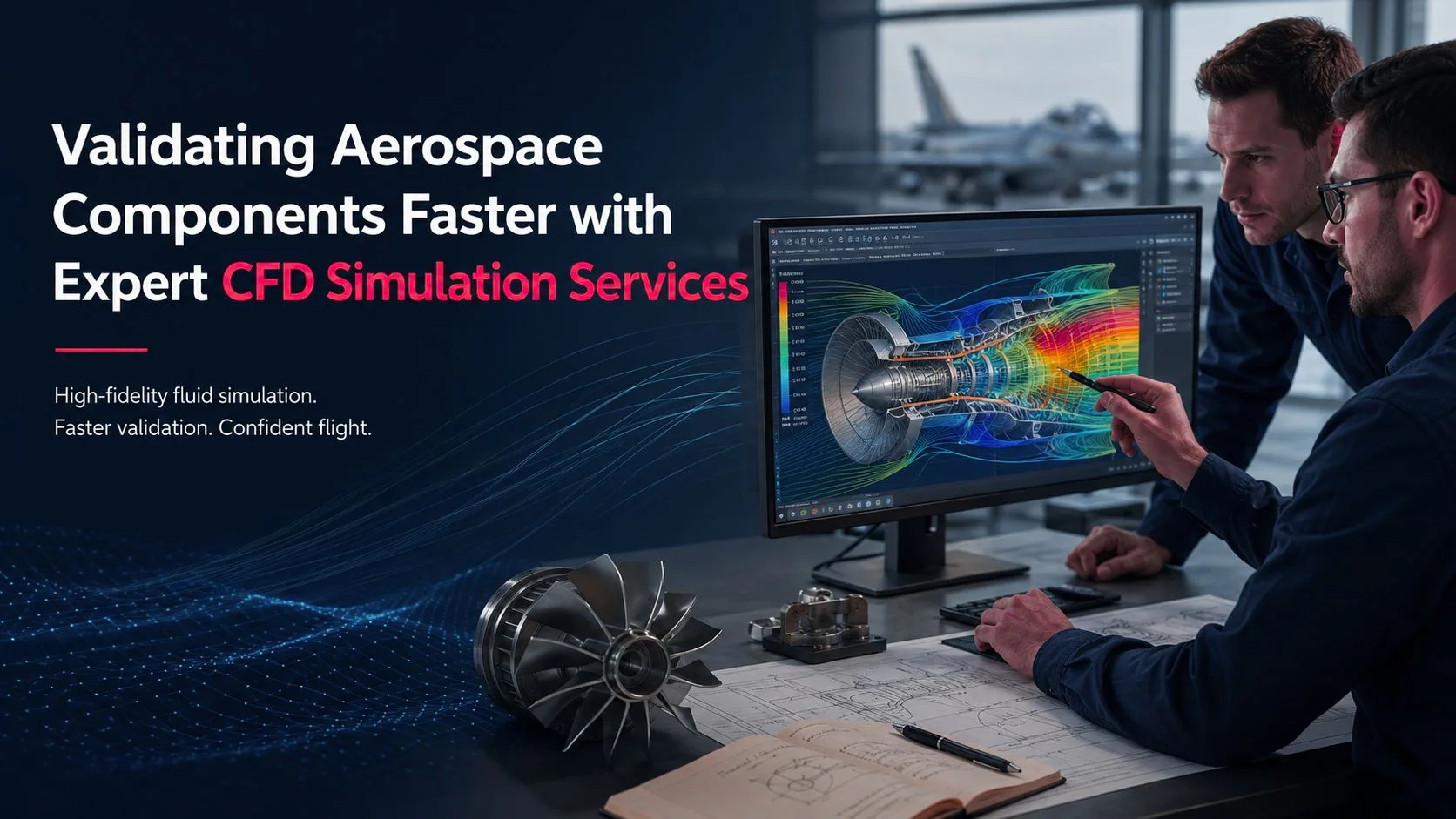
Aerospace component validation faces unprecedented pressure. Engineering leaders in the defense and commercial aviation sectors must balance radical efficiency gains with ultra-strict regulatory compliance. Historically, verifying complex aerodynamic profiles or engine thermal systems meant enduring lengthy physical prototyping and wind-tunnel testing phases. Today, the race for flight-ready designs requires shifting these verification efforts upstream. Achieving this agility requires reliable, high-fidelity modeling. While internal engineering teams understand core design principles, executing advanced physics computations requires sophisticated environments. To optimize this process, enterprises are increasingly deploying specialized CFD simulation services to streamline verification, uncover design flaws early, and dramatically compress development schedules.
The Validation Bottleneck in Modern Aerospace Engineering
What is the primary factor delaying the certification of critical aerospace components? It is the bottleneck created by isolated design data, manual model preparation, and over-allocated on-premise compute infrastructure.
When systems engineering leaders develop advanced propulsion systems or control surfaces, fluid-structure interactions present severe complexity. Managing multi-physics phenomena such as compressible supersonic flows, transient shock waves, and conjugate heat transfer requires significant computational horsepower and tailored software architectures. Traditional desktop setups cannot scale to execute these multi-million cell meshes smoothly. Furthermore, when these simulation models are isolated from the rest of the product lifecycle, version control errors multiply. For true efficiency, modern aerospace programs require integrated software engineering solutions that connect live geometric changes directly to automated analysis workflows, preventing valuable time from being wasted on repetitive model setup.
Driving Velocity with Advanced CFD Simulation Services
What do professional CFD simulation services provide to high-consequence engineering teams? They deliver immediate access to elite computational fluid dynamics analysts, advanced adaptive meshing algorithms, and high-performance computing clusters that drastically compress virtual validation timelines.
By leveraging dedicated CFD simulation services, aerospace organizations bypass the lengthy setup phases that often stall internal engineering groups. Professional analysts utilize specialized tools to automate complex tasks, such as creating moving meshes for turbomachinery or tracking multiphase flows in fuel delivery networks. Consider an external wing assembly optimization project: rather than building multiple physical mockups and waiting for wind-tunnel scheduling slots, external CFD simulation services can run hundreds of virtual design iterations in parallel. This allows engineering directors to evaluate aerodynamic drag and boundary layer separation profiles in real time, selecting the optimal configuration before physical tooling ever begins.
Strategic Insights for High-Fidelity Fluid Modeling
To extract the highest value from external partners, engineering enterprises must establish a robust framework for data exchange. This includes providing clean CAD geometries, well-defined operational envelopes, and explicit boundary conditions. Utilizing high-fidelity CFD simulation services means your team can explore transient fluid behavior under extreme conditions, such as high-altitude flameouts or intense thermal spikes, which would be impossible or incredibly dangerous to replicate in a physical laboratory setting.
Optimizing the Engineering Pipeline via an Operational Audit Process
How can aerospace enterprises ensure their simulation workloads directly translate into faster time-to-market? True optimization begins with an objective operational audit process to analyze how data flows between design engineers, analyst groups, and compliance teams.
Deploying advanced simulation tools without analyzing current operational habits often leads to automated inefficiencies. A structured audit ensures that your organization identifies specific communication breakdowns and toolchain disconnects. To maximize efficiency, consider the following actionable strategies during your deployment framework:
- Establish a Unified Digital Thread: Connect CAD, Product Lifecycle Management (PLM), and simulation data models to ensure that any design modification automatically triggers a warning or an updated analysis run.
- Standardize Data Ingestion Protocols: Streamline file preparation rules to reduce the hours simulation engineers spend cleaning up geometry, deleting internal components, or closing microscopic gaps.
- Define Actionable Validation Thresholds: Set clear performance parameters before simulation begins, allowing engineering leads to make definitive pass-fail decisions rapidly.
Common Simulation Pitfalls to Guard Against
While scaling your validation capacity through external CFD simulation services offers substantial benefits, implementation failures often occur due to common strategic missteps. Organizations looking to maximize their simulation efficiency should avoid these critical errors:
- Over-Simplifying Boundary Conditions: To save compute time, teams sometimes use idealized, steady-state assumptions that fail to capture destructive transient fluid behaviors or localized turbulence.
- Siloing Analysis at the End of Development: Treating fluid dynamics analysis as a final checking mechanism rather than an upfront design driver leads to costly re-engineering cycles if a flaw is discovered late.
- Neglecting Coupled Multi-Physics Realities: Fluid flow in aerospace systems rarely exists in a vacuum. Ignoring how thermal gradients or structural stresses interact with fluid vectors results in a fragmented view of component reliability.
Leveraging Specialized Expertise for Regulatory Success
Navigating complex regulatory frameworks like FAA or military airworthiness certification requires comprehensive, traceable validation records. For many mid-sized to large enterprises, keeping pace with evolving multi-physics code updates and managing localized compute clusters introduces immense operational strain.
Outsourcing specialized analysis workloads to verified experts allows internal teams to focus on core design innovation while accelerating audit readiness. Organizations looking to de-risk their development cycles frequently turn to advanced Aerospace and Defense CFD Simulation Services from 3HTi to scale their virtual testing infrastructure. By relying on a specialized partner, engineering leaders can access state-of-the-art moving mesh capabilities, multi-phase fluid tracking, and high-performance computing resources without expanding internal capital expenditures. This programmatic support ensures that complex aerospace systems are fully validated against worst-case environmental conditions smoothly and efficiently.
Conclusion: Securing Flight Readiness with High-End Simulation
A strategic integration of professional CFD simulation services changes virtual validation from an expensive bottleneck into a significant competitive driver. By eliminating localized compute restrictions, avoiding common simplification pitfalls, and establishing an optimized data pipeline via an operational audit process, aerospace organizations achieve unprecedented pre-launch velocity. The future of aerospace engineering belongs to companies that validate digitally with absolute precision and partnering with expert simulation analysts is the definitive path to achieving it.
Frequently Asked Questions (FAQs)
Q1: How do CFD simulation services shorten aerospace component certification timelines?
They replace slow, expensive physical wind-tunnel testing with high-fidelity virtual iterations. This enables engineering teams to analyze aerodynamic drag, thermal dissipation, and fluid stresses in parallel, identifying critical flaws before manufacturing begins.
Q2: What types of software engineering solutions integrate best with fluid simulation workflows?
Automated PLM and CAD integration tools work best. These systems sync live geometry updates directly to simulation parameters, ensuring analysts always use the latest engineering data, which prevents manual model rebuilding errors.
Q3: Why is an operational audit process necessary before outsourcing simulation workloads?
An operational audit process maps your existing dataflows to find communication bottlenecks. This ensures that external analysis partners receive clean, properly prepared CAD files, maximizing project speed and reducing redundant setup costs.
Q4: Can virtual fluid dynamics simulation completely replace physical testing in aerospace?
No, physical testing remains mandatory for final regulatory certification. However, advanced simulation minimizes the number of physical prototypes required by ensuring that the final physical component is already highly optimized and pre-validated.
Q5: What is the difference between steady-state and transient CFD models?
Steady-state models evaluate time-independent fluid flows, which is computationally economical. Transient models simulate time-varying behaviors, such as turbulence or rapid pressure changes, providing the deep insights necessary for safety-critical aerospace validation.
Q6: How do simulation services handle coupled multi-physics problems like conjugate heat transfer?
Expert analysts utilize advanced solvers that compute fluid vectors and solid material thermal properties concurrently. This coupled approach accurately predicts how hot exhaust gases interact with turbine blades, preventing localized structural failures.
Q7: What technical data must an aerospace firm provide to start a CFD project?
Teams must provide clean 3D CAD assemblies, detailed material properties, and specific operational boundary conditions, such as fluid velocity, temperature, and environmental pressure limits, to ensure model accuracy.