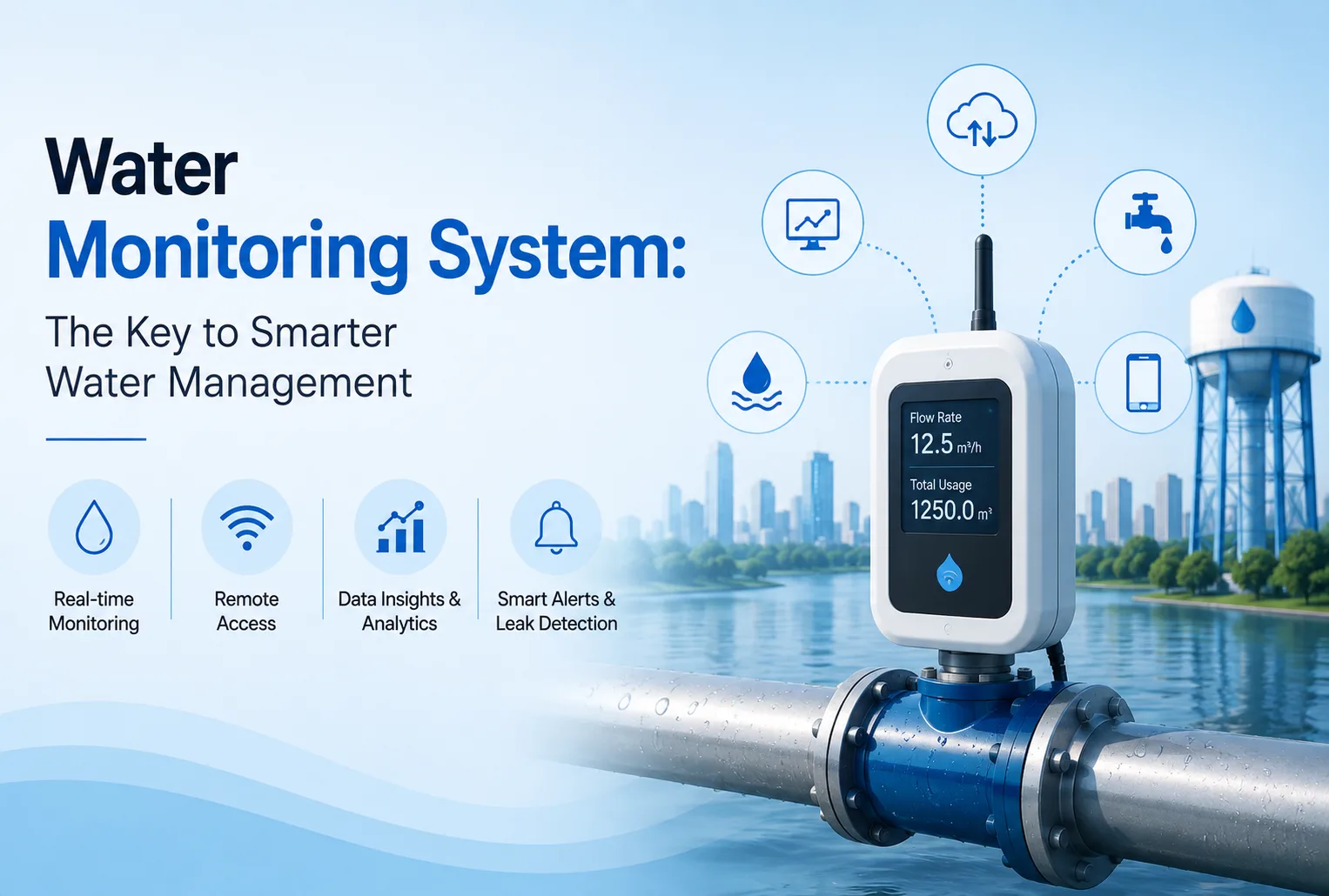
Water is a vital resource for every home, business, industry, and community. However, increasing demand, water wastage, leakage, inefficient infrastructure, and limited visibility into consumption are making water management more challenging. Many organizations still depend on manual meter readings and periodic inspections, which can make it difficult to identify problems quickly. A Water Monitoring System provides a smarter approach by using connected technology to measure, monitor, and understand water usage in real time.
Modern water monitoring is no longer limited to checking a meter and recording a number. Today, sensors, smart meters, IoT connectivity, cloud platforms, dashboards, automation, and data analytics can work together to provide a complete view of water infrastructure. These technologies help organizations understand how water is being consumed, identify unusual patterns, detect potential leaks, and make better decisions.
What Is a Water Monitoring System?
A water monitoring system is a technology-based solution designed to collect and monitor information related to water consumption and infrastructure.
Depending on the application, a monitoring system can track:
- Water consumption
- Flow rate
- Tank levels
- Pipeline pressure
- Water quality
- Pump performance
- Motor operation
- Energy consumption
- Leakage indicators
The information collected from sensors and meters can be sent to a centralized platform. Users can then access the data through a dashboard and monitor their water infrastructure without depending entirely on physical inspections.
The main purpose is to provide accurate and timely information so that water managers can identify problems and take action before they become major issues.
Why Water Monitoring Is Important
Water wastage is not always visible. A leaking pipe inside a wall, a faulty valve, an overflowing tank, or continuous water flow during non-operating hours may go unnoticed for a long time.
Without regular monitoring, these issues can lead to unnecessary water loss and higher operating costs.
Effective monitoring helps organizations understand where water is being used and whether consumption is within expected levels.
For example, a commercial building may normally consume a predictable amount of water during working hours. If the system detects continuous consumption overnight, facility managers can investigate the situation.
This type of visibility can help organizations move from reactive water management to proactive water management.
How Modern Water Monitoring Works
A modern monitoring system typically combines several technologies.
Sensors and meters collect information from the physical water infrastructure. Communication technologies transmit the information to a cloud or centralized platform. Software processes the data and presents it through an easy-to-understand dashboard.
The process can be summarized as:
Sensors and Meters → Connectivity → Cloud Platform → Dashboard → Alerts → Action
Each component plays an important role.
Sensors collect information, connectivity transfers the data, the platform stores and analyzes it, and the dashboard helps users understand what is happening.
When unusual conditions are identified, the system can send alerts so that the responsible team can respond quickly.
Real-Time Water Monitoring
Real-time monitoring is one of the biggest advantages of modern water technology.
Traditional water meters may provide consumption readings at specific intervals. Smart monitoring systems can provide much more frequent information, giving users better visibility into current conditions.
This allows facility managers to monitor water usage throughout the day.
For example, if water consumption suddenly increases, an alert can prompt the team to investigate. The issue could be caused by a leak, equipment problem, unusual consumption, or another operational change.
Real-time information reduces the delay between identifying a problem and taking action.
Detecting Water Leakage
Leakage is one of the major causes of water wastage.
A small leak may appear insignificant, but continuous leakage can result in substantial water loss over time. In large buildings, industrial facilities, and residential communities, finding the source of a leak manually can be difficult.
A connected monitoring system can help identify unusual flow or consumption patterns.
For example, if water continues to flow during a period when consumption should be very low, the system can generate an alert.
Early leak detection can help organizations:
- Reduce water wastage
- Lower water-related expenses
- Protect buildings and equipment
- Improve maintenance response
- Prevent small problems from becoming major issues
Monitoring does not eliminate the need for physical inspection, but it can help maintenance teams know where and when to investigate.
Monitoring Water Consumption
Understanding consumption is essential for improving water efficiency.
A monitoring system can collect historical and current consumption information. This allows organizations to compare usage across different days, weeks, months, locations, or facilities.
For example, a company managing multiple buildings can compare consumption between sites and identify locations with unusually high usage.
This information can support targeted conservation efforts rather than applying the same solution everywhere.
Organizations can also use historical data to measure the results of water-saving initiatives.
Monitoring Water Tank Levels
Water tanks are common in residential communities, commercial buildings, hotels, hospitals, and industrial facilities.
Manual tank-level checking can be inconvenient and may not always prevent overflow. A level sensor can continuously monitor the amount of water in a tank and provide information to the monitoring platform.
When the water level reaches a defined point, the system can send an alert or trigger an automated action where appropriate.
This can help prevent:
- Tank overflow
- Unnecessary water wastage
- Dry-running pumps
- Manual monitoring effort
- Irregular water availability
When tank monitoring is combined with pump automation, water distribution can become more efficient and predictable.
Monitoring Water Quality
Water quantity is only one part of effective water management. Water quality is equally important for many applications.
Depending on the requirements, sensors can monitor parameters such as pH, TDS, conductivity, chlorine, turbidity, and other relevant indicators.
Continuous or frequent monitoring can help identify changes in water quality more quickly.
This can be especially valuable in industrial facilities, water treatment plants, commercial properties, and other locations where water quality needs to be carefully managed.
The right sensors and monitoring parameters should always be selected according to the specific application and regulatory requirements.
Smart Monitoring for Pumps and Motors
Pumps and motors play a critical role in many water systems. Their performance can affect both water availability and energy consumption.
Monitoring equipment performance can help organizations understand operating conditions and identify unusual behavior.
For example, changes in operating patterns, energy consumption, or water flow may indicate that equipment requires inspection.
Connected monitoring can also support better scheduling and automation, helping pumps operate according to actual water requirements.
This can reduce unnecessary operation and contribute to improved equipment efficiency.
The Role of IoT in Water Monitoring
The Internet of Things, or IoT, is an important part of modern water monitoring.
IoT enables meters, sensors, pumps, and other devices to communicate with software platforms.
Instead of keeping information isolated at individual locations, connected devices can send data to a centralized system.
This creates better visibility across the entire water network.
IoT-based monitoring can be particularly useful for organizations managing multiple buildings or facilities because users can view information remotely from a single platform.
Cloud-Based Monitoring and Remote Access
Cloud technology makes water information easier to access and manage.
With a cloud-based platform, authorized users can view dashboards remotely rather than depending on a computer located at the monitored facility.
This can be useful for facility managers, operations teams, maintenance staff, and decision-makers.
For organizations with multiple locations, cloud-based monitoring can bring information from different sites into one place.
Remote monitoring can also improve response times because teams can receive alerts without being physically present at the location.
Turning Data Into Useful Insights
A monitoring system generates data, but data alone is not enough.
The real value comes from understanding what the information means.
Data analytics can help organizations identify trends, compare consumption, detect abnormal behavior, and evaluate performance.
For example, if water consumption gradually increases over several months, managers can investigate the reason. It may be related to higher occupancy, equipment problems, leakage, seasonal changes, or other factors.
Historical data also provides a baseline for comparison.
When an organization introduces a conservation measure, it can compare consumption before and after implementation to understand whether the measure has delivered measurable results.
Applications Across Different Industries
Water monitoring technology can be used in many environments.
Residential Communities
Apartment complexes and gated communities can monitor water consumption, tank levels, pumps, and distribution systems. This can help reduce wastage and improve water availability.
Commercial Buildings
Offices, hotels, shopping centers, and hospitals can monitor water consumption across different areas and identify unusual usage.
Industrial Facilities
Industries can track water used for production, cooling, cleaning, treatment, and other processes. Monitoring can help identify opportunities for efficiency improvements.
Government and Public Infrastructure
Public water systems can use monitoring technology to improve visibility into distribution networks and infrastructure performance.
Educational Institutions
Schools, colleges, and universities can monitor water consumption across buildings and identify areas where conservation measures may be needed.
The system can be customized according to the size, infrastructure, and objectives of each organization.
Benefits of Implementing a Water Monitoring System
A properly designed monitoring system can provide several benefits.
1. Better Visibility
Organizations can understand their water usage more clearly through centralized information.
2. Faster Problem Detection
Unusual consumption and flow patterns can trigger alerts and help teams respond earlier.
3. Reduced Water Wastage
Identifying leaks, overflow, and unnecessary consumption can support better resource conservation.
4. Lower Operational Costs
Reducing wasted water and improving equipment operation can potentially lower operating expenses.
5. Reduced Manual Work
Automated data collection can reduce the need for frequent physical meter readings.
6. Better Decision-Making
Historical and real-time information can support more informed operational decisions.
7. Improved Sustainability
Efficient water consumption contributes to broader environmental and sustainability goals.
Challenges to Consider
Implementing connected water monitoring requires careful planning.
Organizations should consider the existing infrastructure, number of monitoring points, sensor requirements, communication availability, data security, scalability, maintenance, and user requirements.
The monitoring platform should also present information clearly. A system that produces large amounts of complicated data may not be useful if users cannot easily understand it.
Choosing reliable hardware and a suitable technology partner is therefore important.
Why KarIoT Can Support Smarter Water Monitoring
KarIoT provides IoT-based smart water management solutions that help organizations gain better visibility into their water infrastructure. Its solutions can support monitoring of water consumption, flow, tank levels, pressure, water quality, and energy usage.
The platform can also support remote monitoring, automated alerts, data analysis, and reporting. These capabilities can help organizations reduce manual monitoring and respond more quickly to unusual water conditions.
KarIoT solutions can be applied across residential communities, commercial buildings, industrial facilities, government projects, and high-rise properties.
By combining connected sensors, monitoring technology, and data-driven insights, KarIoT helps organizations move toward a more efficient and proactive approach to water management.
The Future of Water Monitoring
Water monitoring is moving toward greater automation, connectivity, and intelligence.
Future systems are likely to combine IoT, artificial intelligence, predictive analytics, automation, and advanced sensor technology.
Instead of simply reporting what happened, smart systems can increasingly help organizations understand why something happened and what action may be required.
Predictive analytics could identify potential equipment problems before failure. AI could recognize unusual consumption patterns. Automated controls could adjust pumps and valves according to real-time conditions.
These developments can make water management more responsive and efficient.
Final Thoughts
Effective water management begins with visibility. Organizations cannot improve what they cannot measure or understand.
A modern monitoring system provides the information needed to understand water consumption, detect unusual activity, identify potential leaks, monitor tank levels, track equipment, and support better decisions.