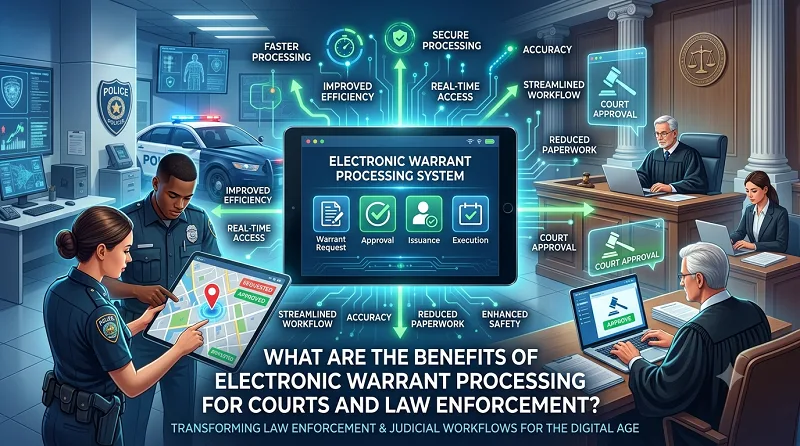
Warrant processing has traditionally involved paperwork, phone calls, manual data entry, physical signatures, and coordination between courts and law enforcement agencies. When a warrant is time-sensitive, even a small administrative delay can create unnecessary challenges.
Electronic Warrant Processing modernizes this workflow by allowing authorized users to prepare, review, approve, issue, and manage warrants digitally. An e-warrant system can connect the people involved in the warrant lifecycle through a secure electronic workflow, helping reduce manual work while improving visibility and accountability.
For courts and law enforcement agencies looking to modernize operations, the value goes beyond simply replacing paper. A well-designed electronic process can help create a faster, more organized, and more transparent way to handle warrant-related documents.
What Is Electronic Warrant Processing?
Electronic warrant processing is the digital preparation, submission, review, authorization, issuance, and management of warrants through a secure electronic workflow rather than relying primarily on paper-based processes.
An e-warrant system can provide authorized users with a centralized environment where warrant information and related documents move through defined stages. Depending on the system and jurisdiction, participants may include law enforcement personnel, prosecutors, judges, clerks, and other authorized court staff.
Instead of manually moving documents between offices, an electronic workflow can help users:
- Create warrant applications electronically.
- Attach supporting information and documentation.
- Submit the application to the appropriate reviewer.
- Route it to an authorized judicial officer.
- Record approvals, rejections, or requests for changes.
- Distribute the finalized warrant to authorized personnel.
- Maintain relevant records and activity histories.
The exact workflow should reflect applicable laws, court rules, agency policies, and security requirements.
Why Are Courts and Law Enforcement Moving Toward Electronic Warrant Processing?
Courts and law enforcement agencies handle large amounts of information, often under strict deadlines. Paper-based processes can introduce unnecessary administrative steps, particularly when personnel work across different locations or outside conventional office hours.
Electronic warrant processing addresses this challenge by digitizing the workflow and creating a structured path for information to move between authorized participants.
The most important advantages include speed, accuracy, visibility, security, and accountability.
What Are the Main Benefits of Electronic Warrant Processing?
Electronic warrant processing can help courts and law enforcement agencies improve operational efficiency, reduce administrative burdens, and create a clearer record of warrant activity.
1. Faster Warrant Processing
One of the biggest advantages is the ability to move information electronically instead of physically transporting documents or relying on multiple manual communication methods.
When a warrant application is ready for review, an electronic workflow can route it to the appropriate person without requiring staff to print, scan, fax, or physically deliver paperwork.
This can be particularly useful when a matter requires timely judicial review.
Potential benefits include:
- Faster submission and routing
- Reduced waiting caused by physical document transfer
- Quicker communication between authorized users
- Better support for time-sensitive workflows
- Less administrative coordination
Speed should not come at the expense of proper judicial review. The goal is to remove avoidable administrative delays while preserving required safeguards.
2. Reduced Paperwork and Manual Data Entry
Paper-based warrant processes often require information to be entered, copied, scanned, or transferred between different documents.
A digital workflow can reduce repetitive administrative work by allowing authorized users to enter information electronically and reuse appropriate data within the workflow.
This may help reduce:
- Duplicate data entry
- Paper filing
- Printing and scanning
- Manual document transfers
- Physical storage requirements
Reducing repetitive tasks can also allow court and law enforcement personnel to spend more time on higher-value responsibilities.
3. Improved Accuracy and Fewer Administrative Errors
Manual processes can create opportunities for errors. A misplaced document, incomplete field, incorrect transcription, or outdated version can complicate warrant processing.
An e-warrant system can use structured forms, required fields, validation rules, and standardized workflows to help users identify incomplete information before submission.
For example, a properly configured system may help ensure that:
- Required information is provided.
- Documents are attached to the appropriate record.
- Users follow the correct workflow.
- Status information remains visible.
- Authorized parties work from the appropriate version.
Technology cannot eliminate every error, but it can reduce many preventable administrative mistakes.
4. Better Visibility Into Warrant Status
A major operational challenge with manual processes is knowing where a document currently sits.
An electronic system can provide status information throughout the workflow. Authorized users may be able to determine whether an application is awaiting review, requires additional information, has been approved, or has reached another defined stage.
This visibility can reduce unnecessary calls and follow-ups.
For court administrators and supervisors, it may also provide a clearer picture of workflow volume and potential bottlenecks.
5. Stronger Accountability and Audit Trails
Accountability is particularly important when sensitive legal documents are involved.
A properly designed electronic warrant platform can maintain an audit trail showing relevant actions performed within the system. Depending on system configuration and applicable requirements, this may include information about submissions, reviews, approvals, modifications, or other workflow events.
An audit trail can help organizations understand:
- Who performed an action
- When an action occurred
- What stage a warrant reached
- Which users accessed or processed information
- Whether changes occurred during the workflow
These records can support operational oversight and help organizations demonstrate adherence to established procedures.
6. Improved Collaboration Between Courts and Law Enforcement
Warrant processing often involves multiple organizations or departments. Electronic workflows can provide a shared process for authorized participants while maintaining appropriate access controls.
Instead of relying on disconnected communication channels, users can work within a structured workflow.
This can improve coordination between:
- Law enforcement officers
- Investigators
- Prosecutors
- Judges
- Court clerks
- Authorized administrative personnel
Better collaboration does not mean everyone should have unrestricted access. Effective systems should apply role-based permissions and limit sensitive information to authorized users.
7. Support for Remote and After-Hours Workflows
Modern courts and law enforcement agencies may need to operate across multiple locations and schedules.
A secure electronic workflow can make it easier for authorized personnel to participate in warrant processing without being physically located in the same office.
This can be valuable when:
- Personnel are working remotely.
- A judicial officer is reviewing matters outside normal office hours.
- Agencies operate across multiple locations.
- Physical document delivery would create unnecessary delays.
Availability should always be balanced with authentication, security, privacy, and jurisdiction-specific requirements.
Electronic vs. Paper-Based Warrant Processing
FactorPaper-Based ProcessElectronic ProcessDocument transferPhysical or manual transmissionDigital routingStatus visibilityOften dependent on calls or manual checksCan provide workflow statusData entryFrequently repetitiveCan use structured digital formsDocument storagePhysical files and archivesDigital recordsAuditabilityMay require manual documentationCan maintain electronic activity recordsCollaborationOften location-dependentCan support authorized remote collaborationAdministrative workloadHigher manual involvementGreater workflow automation potentialScalabilityCan become difficult as volume growsDesigned workflows can support larger volumes
The right solution depends on the jurisdiction, agency requirements, existing technology infrastructure, and legal framework. Digitizing a poorly designed process does not automatically make it efficient.
How Does an E-Warrant System Work?
Although implementations differ, most electronic warrant workflows follow a series of controlled stages.
Step 1: Prepare the Application
An authorized user enters the required warrant information into a secure digital form.
Step 2: Add Supporting Information
Relevant affidavits, documents, attachments, or other required materials can be associated with the application.
Step 3: Submit for Review
The application is electronically routed to the appropriate reviewer or judicial authority according to the configured workflow.
Step 4: Review and Decision
The authorized reviewer evaluates the information and takes the appropriate action, such as approving the warrant, rejecting it, or requesting additional information.
Step 5: Record the Decision
The system records the relevant workflow event and maintains the associated documentation according to applicable retention requirements.
Step 6: Distribute the Finalized Information
Authorized personnel can receive or access the appropriate warrant information through the designated system or integration.
Step 7: Maintain the Record
The completed transaction and relevant activity history can be retained for future reference, subject to applicable law and organizational policy.
Conclusion
Electronic warrant processing can transform a traditionally paper-heavy workflow into a more streamlined digital process. For courts and law enforcement agencies, the benefits can include faster administrative processing, fewer manual errors, better status visibility, improved collaboration, stronger auditability, and more efficient use of staff resources.
An e-warrant system is most effective when technology, workflow design, security, and legal requirements work together. The objective isn't simply to make warrants digital; it's to create a reliable process that helps authorized professionals handle sensitive information efficiently while preserving appropriate review and accountability.
For organizations considering modernization, the best starting point is to examine the current warrant workflow, identify avoidable delays, define security and compliance requirements, and then select a solution capable of supporting those needs. Done thoughtfully, electronic warrant processing can become an important part of a more connected and efficient justice system.