
Hair loss affects both men and women and can be influenced by genetics, lifestyle, age, and other factors. Hair transplantation is a commonly used hair restoration option for people experiencing significant thinning or baldness.
Two widely used techniques are FUE (Follicular Unit Extraction) and FUT (Follicular Unit Transplantation). Although both aim to restore natural-looking hair, they differ in how hair follicles are extracted, scarring, recovery, and suitability. Understanding these differences can help patients discuss the most appropriate option with a qualified hair specialist.
What Is Hair Transplantation?
Hair transplantation is a minimally invasive procedure in which healthy hair follicles are moved from a donor area, usually the sides or back of the scalp, to areas affected by hair loss.
The transplanted follicles are generally resistant to the balding process and can continue to grow after transplantation. The final outcome depends on factors such as donor hair quality, hair loss pattern, surgical technique, and individual healing.
What Is FUE Hair Transplant?
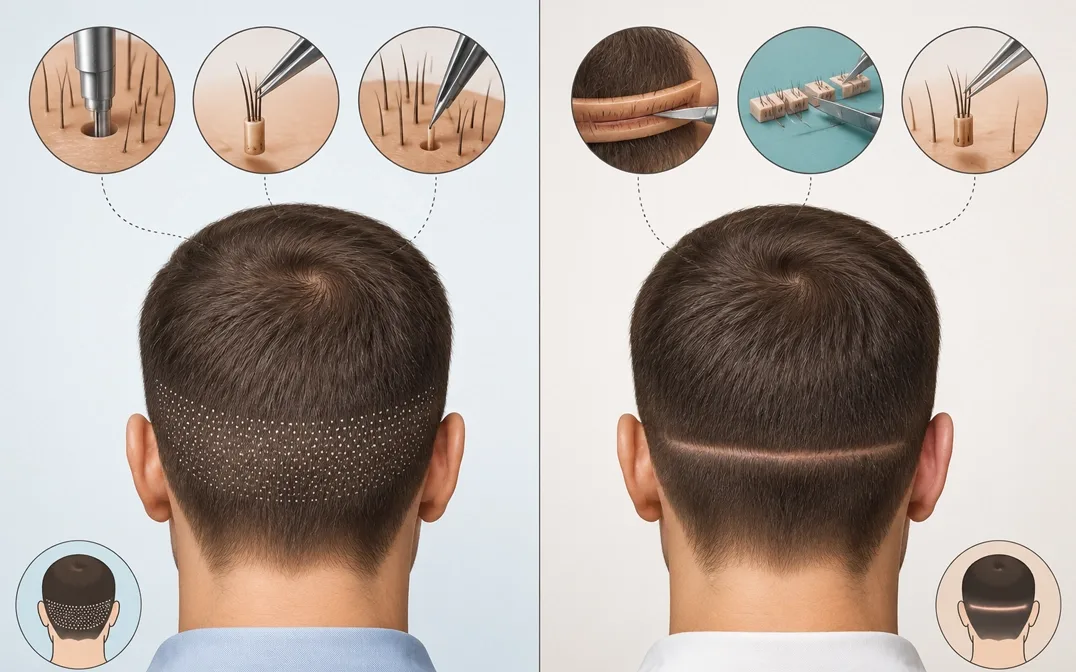
Follicular Unit Extraction (FUE) involves extracting individual hair follicles from the donor area using a small punch tool. The follicles are then implanted into thinning or bald areas.
Because follicles are extracted individually, FUE does not require the removal of a strip of scalp.
Advantages of FUE
- Minimal visible dot-like scarring
- Generally faster recovery
- Suitable for people who prefer shorter hairstyles
- Less invasive donor-area extraction
- Can provide natural-looking results when appropriately performed
Limitations of FUE
- Can take longer when a large number of grafts are required
- Requires considerable precision and surgical expertise
- May be more expensive in some cases
What Is FUT Hair Transplant?
Follicular Unit Transplantation (FUT) involves removing a thin strip of scalp from the donor area, usually at the back of the head. The strip is divided into individual follicular units, which are then transplanted into areas experiencing hair loss.
FUT can be useful when a large number of grafts are needed in a single session.
Advantages of FUT
- Allows a higher number of grafts in one session
- Can be more cost-effective in some cases
- May be suitable for advanced hair loss requiring greater coverage
Limitations of FUT
- Leaves a linear scar in the donor area
- Requires a longer healing period
- May cause temporary tightness or discomfort
- May be less suitable for people who prefer very short hairstyles
FUE vs FUT: Key Differences
FactorFUEFUTExtractionIndividual folliclesStrip of scalpScarringSmall dot-like scarsLinear scarRecoveryGenerally fasterGenerally longerGraft capacitySuitable for many casesUseful when a large number of grafts are neededShort hairstylesGenerally more suitableLinear scar may be visibleCostCan be higher in some casesCan be more cost-effective for larger sessionsBoth techniques can produce natural-looking results when appropriately selected and performed by an experienced professional.
Which Hair Transplant Procedure Is Right for You?
There is no single procedure that is best for everyone. The choice between FUE and FUT may depend on:
- Extent and pattern of hair loss
- Age and future hair-loss expectations
- Donor hair density and quality
- Number of grafts required
- Preferred hairstyle
- Recovery expectations
- Individual medical suitability
A consultation with a qualified hair specialist doctor in Bangalore can help assess these factors and determine an appropriate hair restoration approach.
Role of a Hair Specialist
A specialist plays an important role in evaluating the cause and pattern of hair loss, assessing donor hair, designing the hairline, and selecting the appropriate hair transplant procedure.
Before treatment, the scalp and medical history are evaluated. During the procedure, local anesthesia is generally used, followed by follicle extraction and implantation.
Hair Transplant Recovery and Results
Some temporary swelling, redness, or discomfort may occur after the procedure. Transplanted hair may initially shed, which can be a normal part of the process.
According to the source material, new hair growth generally begins around 3–4 months, while more complete results may become visible around 9–12 months. Recovery and growth timelines can vary between individuals.
Common Hair Transplant Myths
Myth: Hair transplants always look unnatural.
Modern techniques can produce natural-looking hairlines and density when appropriately planned.
Myth: Only men undergo hair transplantation.
Women may also be candidates for hair restoration depending on their hair-loss pattern and donor hair.
Myth: Results are immediate.
Hair growth takes time and develops gradually over several months.
Myth: Hair transplantation is extremely painful.
Local anesthesia is generally used during the procedure to manage discomfort.
Conclusion
Both FUE and FUT hair transplantation are established approaches to hair restoration, but each has different advantages and limitations. FUE generally involves individual follicle extraction and less noticeable scarring, while FUT can provide a larger number of grafts in a single session.
The most suitable option depends on hair-loss pattern, donor availability, treatment goals, and individual circumstances. Consulting an experienced hair specialist doctor in Bangalore can help patients understand their options and choose an appropriate hair restoration treatment.