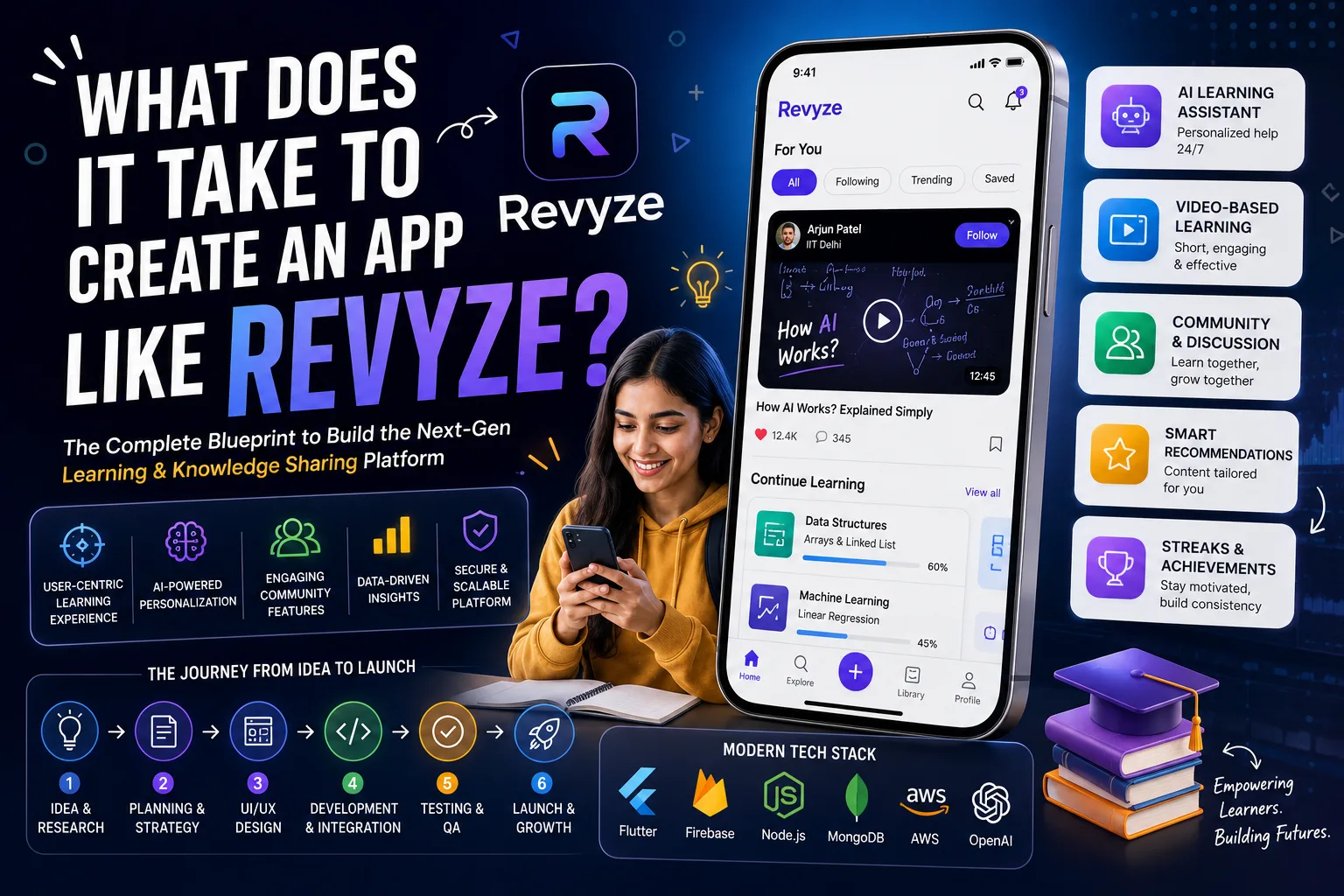
The rise of digital learning platforms has completely transformed the way students consume educational content. Apps like Revyze represent a new generation of learning platforms that blend education with social media engagement. Instead of forcing students to sit through lengthy lessons or traditional online courses, these platforms package educational information into short, engaging, and highly shareable formats. The idea is simple but powerful: meet learners where they already spend their time and make studying feel less like a chore and more like an interactive experience.
Creating an app like Revyze requires much more than simply uploading educational videos. The real value lies in combining learning, community interaction, personalization, and mobile-first experiences into a single ecosystem. Users are not just consuming content; they are participating, sharing, discussing, and discovering new learning resources through recommendations and peer engagement. This social layer is what often separates modern educational apps from conventional e-learning systems.
From a business perspective, the model is built around engagement. The more time users spend watching educational content, interacting with peers, and discovering new topics, the more valuable the platform becomes. This creates opportunities for subscriptions, partnerships with schools, premium content, and educational sponsorships. Understanding this foundation is the first step toward building a successful learning platform that can compete in today's crowded education technology market.
What Makes Revyze Different?
Traditional educational apps usually focus on structured courses and lengthy modules. Platforms similar to Revyze focus on bite-sized educational experiences. Students can quickly learn concepts, review topics before exams, and discover explanations created by other learners or educators. This format aligns with modern content consumption habits, where users expect fast, engaging, and personalized experiences.
Why Students Love Social Learning
Social learning taps into a fundamental human behavior: learning through interaction. When students can see how others explain concepts, share study techniques, and discuss challenging topics, the learning process becomes more relatable. Instead of feeling isolated, learners become part of a collaborative ecosystem that encourages participation and continuous growth.
Market Research Before Development
Every successful application begins with extensive research. Before writing a single line of code, founders need to understand the educational technology market, user expectations, and emerging trends. Many startups fail because they jump directly into development without validating whether there is a real demand for their solution.
Research should focus on understanding the pain points students experience. Are they struggling with exam preparation? Do they find traditional educational platforms boring? Are they looking for peer-generated content? These questions help identify opportunities that can shape the platform's unique value proposition. Surveys, interviews, and focus groups can provide valuable insights into user behavior and expectations.
Competitor analysis is equally important. Educational apps, social learning platforms, tutoring marketplaces, and video-based learning tools should all be examined carefully. Understanding their strengths and weaknesses allows developers to identify gaps in the market. Sometimes the biggest opportunity comes not from creating an entirely new concept but from improving an existing model and delivering a better user experience.
Identifying Your Target Audience
Your audience could include high school students, university learners, exam candidates, or lifelong learners. Each group has different motivations, content preferences, and engagement patterns. Defining the audience early influences everything from design decisions to feature prioritization.
Studying Competitors
Analyzing competitors helps identify industry standards and user expectations. Study their onboarding processes, recommendation systems, engagement metrics, and monetization strategies to uncover opportunities for differentiation.
Core Features of an App Like Revyze
Building an app like Revyze requires a carefully selected feature set that balances educational value with user engagement. One of the biggest mistakes founders make is trying to include too many features in the first version. Instead, focus on core functionalities that directly support learning and interaction.
The platform should include user profiles, content creation tools, personalized feeds, search functionality, notifications, and social engagement features. Educational content must be easy to create, upload, discover, and consume. Since users increasingly expect seamless mobile experiences, navigation should feel intuitive and frictionless.
A recommendation engine plays a major role in content discovery. Just as entertainment platforms recommend movies and videos, educational apps need intelligent algorithms that suggest relevant study materials. This personalization increases engagement and encourages users to return regularly. Additional features such as bookmarking, learning streaks, quizzes, and progress tracking can further improve retention and educational outcomes.
User Registration and Profiles
Users should be able to register quickly using email, phone numbers, or social logins. Profiles can showcase learning interests, achievements, completed topics, and contributions to the community. Personalization begins with collecting relevant user preferences during onboarding.
Short-Form Educational Content
Short-form videos are often the centerpiece of modern educational platforms. Students prefer concise explanations that can be consumed quickly between classes or during study breaks. Content creators should have access to tools for recording, editing, captioning, and publishing educational materials directly within the app.
AI-Powered Recommendations
Artificial intelligence helps users discover relevant content based on viewing history, engagement patterns, academic interests, and behavioral signals. Personalized recommendations improve retention while creating a more satisfying learning experience.
Social Engagement Features
Community engagement drives growth and retention. Users who interact with others tend to spend more time on the platform and return more frequently.
Likes, Comments, and SharesThese features encourage participation and create feedback loops for content creators. Valuable educational content naturally gains visibility through community interaction.
Follow and Discovery SystemsFollowing educators, classmates, or subject experts creates personalized learning networks. Discovery features help users find new creators and educational topics aligned with their interests.
Technology Stack Selection
Choosing the right technology stack can significantly impact development speed, scalability, and long-term maintenance costs. Modern educational apps require reliable infrastructure capable of supporting thousands or even millions of users while delivering content quickly and efficiently.
For mobile development, teams often choose between native development and cross-platform frameworks. Native apps generally provide better performance but require separate development efforts for iOS and Android. Cross-platform frameworks such as Flutter or React Native enable faster development while maintaining a high-quality user experience. The choice depends on budget, timeline, and technical requirements.
Backend infrastructure must support user authentication, content management, recommendation systems, analytics, and social interactions. Scalability is especially important because educational platforms often experience sudden traffic spikes during examination periods. Cloud-based architectures allow resources to expand dynamically based on demand, ensuring consistent performance even under heavy usage conditions.
ComponentPopular OptionsMobile FrontendFlutter, React Native, Swift, KotlinBackendNode.js, Python, JavaDatabasePostgreSQL, MongoDBCloud PlatformAWS, Google Cloud, AzureAuthenticationFirebase Auth, Auth0AnalyticsGoogle Analytics, MixpanelFrontend Technologies
The frontend directly influences user satisfaction. Fast loading times, smooth animations, and responsive interactions contribute to a premium learning experience.
Backend Infrastructure
A strong backend manages user data, content delivery, notifications, recommendation algorithms, and security. Well-designed APIs ensure seamless communication between the application and server.
Cloud and Storage Solutions
Educational apps often handle large amounts of video content. Cloud storage solutions enable reliable content hosting while supporting rapid global delivery through content delivery networks.
UI and UX Design Strategy
Design is often the difference between an app that users abandon after a week and one they use every day. Educational apps must strike a balance between functionality and simplicity. Students want quick access to information, not complex interfaces filled with unnecessary options.
A student-centric design starts by understanding user workflows. What happens when a student opens the app? How quickly can they find relevant content? How easily can they interact with creators and peers? Every design decision should support these objectives. Clean navigation, intuitive icons, and minimal distractions create a more focused learning environment.
Visual hierarchy also matters. Educational content should remain the primary focus while secondary actions remain accessible without overwhelming users. Gamification elements such as badges, streaks, and achievements can increase motivation when implemented thoughtfully. The goal is to encourage learning behavior without turning the platform into a distraction.
Student-Centric Design Principles
Students value speed, clarity, and accessibility. Interfaces should prioritize educational content while reducing unnecessary friction throughout the learning journey.
Accessibility and Performance
Accessibility ensures that users with diverse abilities can fully engage with the platform. Fast performance, readable typography, and responsive layouts contribute to a positive experience across devices.
Development Process
Developing an app like Revyze requires a structured process that transforms ideas into a reliable product. Most successful startups begin with a Minimum Viable Product (MVP), focusing only on the most essential features needed to validate demand. This approach reduces costs and accelerates market entry.
The MVP phase typically includes user authentication, content feeds, video uploads, engagement features, and basic recommendations. Once users begin interacting with the platform, real-world feedback reveals which features matter most. Instead of relying on assumptions, development decisions become data-driven.
Testing is critical throughout the development lifecycle. Functional testing verifies that features work correctly, while performance testing ensures the platform remains stable under load. Security testing is especially important because educational platforms often collect sensitive user information. Continuous monitoring and iterative improvement help maintain quality as the user base grows.
MVP Development
An MVP minimizes risk while maximizing learning opportunities. It allows founders to test assumptions before committing significant resources to advanced functionality.
Testing and Quality Assurance
Comprehensive testing improves reliability, protects user data, and enhances overall user satisfaction. Quality assurance should remain an ongoing process rather than a final project phase.
Cost of Building an App Like Revyze
One of the most common questions entrepreneurs ask is how much it costs to build an educational social-learning platform. The answer depends on factors such as complexity, team location, development approach, and feature requirements. A simple MVP can cost significantly less than a fully featured enterprise-grade application.
Development expenses typically include product strategy, UI/UX design, frontend development, backend engineering, testing, cloud infrastructure, and ongoing maintenance. Video processing capabilities, recommendation engines, and AI-driven personalization can substantially increase costs due to their technical complexity.
The development team composition also affects budget requirements. A typical project may involve product managers, UI/UX designers, frontend developers, backend engineers, QA specialists, and DevOps professionals. Depending on the region and expertise level, costs can vary dramatically.
Development StageEstimated Cost RangeDiscovery & Planning$5,000 - $20,000UI/UX Design$10,000 - $40,000MVP Development$40,000 - $150,000Advanced Features$50,000 - $300,000+Annual Maintenance15% - 25% of development costDevelopment Cost Breakdown
The final budget depends largely on scope. Founders who prioritize essential features first often achieve better returns because they can validate demand before expanding functionality.
Monetization Opportunities
A sustainable business model is essential for long-term success. While user growth is important, profitability ultimately determines whether the platform can continue evolving and serving learners. Educational social platforms have several viable monetization options.
Subscription models remain one of the most effective strategies. Users can access premium content, advanced analytics, personalized study plans, or exclusive educational resources for a monthly fee. Freemium models work particularly well because they allow users to experience value before upgrading.
Partnerships with schools, universities, tutoring companies, and educational publishers can create additional revenue streams. Sponsored educational content, certification programs, and recruitment partnerships also present opportunities. The key is ensuring monetization aligns with user needs rather than disrupting the learning experience.
Subscription Models and Partnerships
Recurring subscription revenue provides predictable income, while strategic partnerships help expand reach and credibility. Combining both approaches often creates a balanced and resilient business model.
Scaling and Future Growth
Once product-market fit is achieved, the focus shifts toward scaling. Growth introduces new challenges, including infrastructure demands, content moderation, recommendation accuracy, and international expansion. Successful scaling requires proactive planning rather than reactive problem-solving.
Artificial intelligence will likely play an increasingly important role in educational platforms. Personalized learning paths, automated content categorization, intelligent tutoring systems, and predictive analytics can dramatically improve learning outcomes. These technologies allow platforms to deliver highly customized educational experiences at scale.
Data analytics also becomes a strategic asset. Understanding user behavior helps identify engagement patterns, content performance, and retention opportunities. Insights gathered from analytics can guide product development and marketing decisions. Expansion into new subjects, languages, and geographic regions further strengthens growth potential and creates opportunities to reach millions of learners worldwide.
AI, Analytics, and Expansion
Future-ready educational platforms invest heavily in personalization and data-driven decision-making. The combination of AI and analytics enables smarter learning experiences while supporting sustainable business growth.
Conclusion
Creating an app like Revyze requires a combination of educational insight, technological expertise, thoughtful design, and strategic business planning. The platform must do more than deliver content—it must create an engaging ecosystem where learning feels interactive, personalized, and socially connected. Success depends on understanding user needs, selecting the right technology stack, building an intuitive experience, and continuously improving based on feedback and analytics.
The most successful educational platforms are those that make learning both effective and enjoyable. By focusing on strong core features, scalable infrastructure, intelligent personalization, and meaningful community engagement, entrepreneurs can build a product capable of transforming how students learn in the digital age. Whether launching a startup or expanding an existing educational brand, the opportunity to innovate in social learning remains enormous.
FAQs
1. How long does it take to build an app like Revyze?
A basic MVP usually takes 3–6 months, while a feature-rich platform with AI recommendations and advanced analytics may require 9–18 months.
2. What is the most important feature in a Revyze-like app?
Personalized educational content discovery is often the most important feature because it directly influences engagement and retention.
3. Can a startup build a Revyze-like platform on a limited budget?
Yes. Many startups begin with an MVP focused on essential features and gradually expand based on user feedback and revenue growth.
4. Which technologies are best for developing educational apps?
Flutter, React Native, Node.js, Python, PostgreSQL, AWS, and Google Cloud are among the most popular technologies used today.
5. How can an educational app generate revenue?
Common monetization methods include subscriptions, premium content, educational partnerships, certifications, sponsorships, and enterprise licensing.