
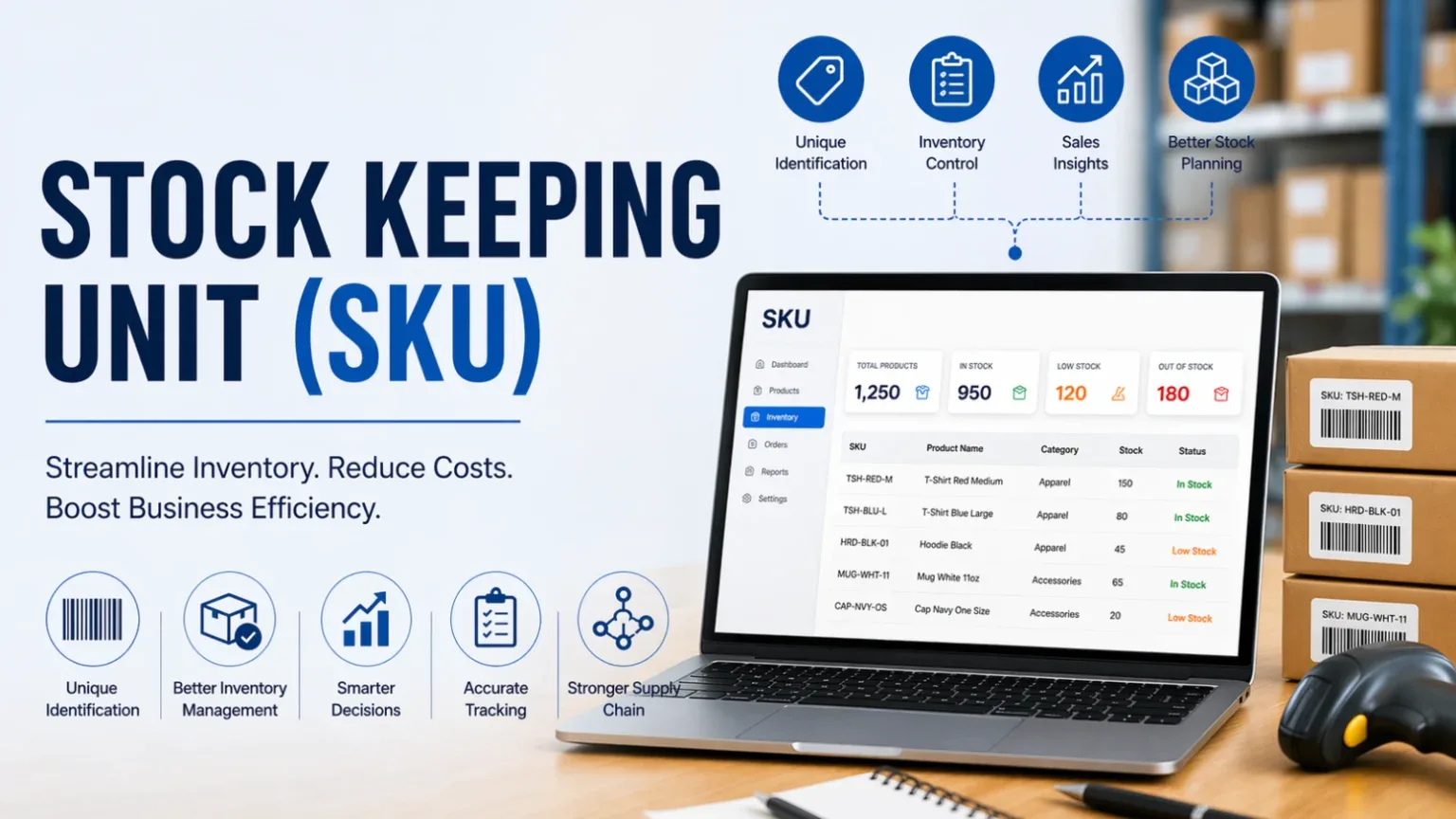
Effective inventory management is perhaps one of the most crucial factors for the success of a retail or eCommerce venture. Lack of proper inventory management may lead to several issues like stock-outs, over-stocking, and delayed shipments. The importance of a Stock Keeping Unit (SKU) is thus very critical.
A SKU is a code used by organizations to organize and manage their inventory more efficiently. If you operate an online store or a retail store, it is crucial that you understand the concept of a SKU.
What Is a SKU?
Stock Keeping Unit (SKU) is an alphanumeric code generated by a company for its own use to differentiate and monitor its individual items or item varieties. The SKU is usually unique and indicates the specific attributes like category, color, size, brand, or style of a product.
The SKU differs from the barcode or Universal Product Code (UPC). The former is not only internal but also custom made based on the company's needs.
For instance, an apparel store may give the SKU number TSH-RED-M to refer to a red t-shirt in medium size. The latter refers to a product and conveys the information regarding the product without referring to long product descriptions.
Consequently, by generating unique SKUs for all products, businesses are able to monitor their inventory and product performance easily.
Why SKU Is Important for Inventory Management?
The use of an optimized SKU system offers much more advantages than simple identification of products. It is the basis of efficient inventory management and smooth operation of the business.
First, through SKU, businesses get the information about the current stock available. With its help, they can see which items are popular and which need re-stocking. In such a way, there will be no shortages and extra stocks.
Second, with accurate tracking of products, it is possible to better forecast the demand for them and have the optimal inventory at all times during the year.
One more significant advantage is improved customer service. Workers will be able to find needed items quicker, give customers correct information and process orders more efficiently.
Nowadays, many companies try to integrate their SKU system with artificial intelligence-based software that helps manage the inventory. Through automated stock tracking and analysis of purchasing tendencies, they can make better decisions and save money on operations.
In modern conditions, an effective SKU system is crucial for inventory management.
How to Create an Effective SKU System?
The development of an effective SKU format should be planned carefully and consistently to ensure that the SKU will be easily scalable and understood by employees.
First, you should identify the characteristics that are important for your goods, including:
- Category
- Brand/manufacturer
- Size/dimensions
- Color/style
- Model/version
Then, you should put them into a proper order. For example, a shoe store can develop the following SKU: SH-NIKE-BLK-09, where SH means category, NIKE – brand, BLK – color and 09 – size.
In case you develop your SKU format, you should follow the best practices below:
- Codes should be short and readable.
- Format of the SKU should be consistent for all products.
- Special characters which might lead to system errors shouldn’t be used.
- All SKU codes should be unique and not duplicated.
- The SKU format should be reviewed and updated from time to time.
Consistent SKU format makes product tracking much easier.
SKU vs UPC: What's the Difference?
However, most individuals refer to SKU and UPC as synonymous, which is not entirely correct since their functions are entirely different.
SKU refers to an internal numbering system designed by the company for tracking and analyzing their inventory. This code is unique to the firm and will differ from one retailer to another.
UPC (Universal Product Code), however, is assigned externally and is constant to all retailers who stock that particular product. They are mostly used for scanning barcodes.
Simply put, UPC is used in identifying products internationally, while SKU is helpful in managing inventory within firms.
Most retailers make use of these two systems concurrently; UPC facilitates the easy processing of sales transactions, whereas SKU helps in analyzing inventory management.
Sum Up
Stock Keeping Units (SKUs) are more than just a simple product code. In fact, SKUs have been developed as an inventory management tool for businesses in order to organize products effectively and efficiently.
Starting from preventing inventory errors to aiding in accurate demand forecasting, SKUs hold great importance in today’s world of retail and eCommerce. With the help of other technologies such as AI-based inventory management and smart inventory management systems, businesses can automate their processes and derive valuable insights.
Given the increasing level of competition in today’s times, having a well-organized SKU system cannot be taken as an option anymore.