
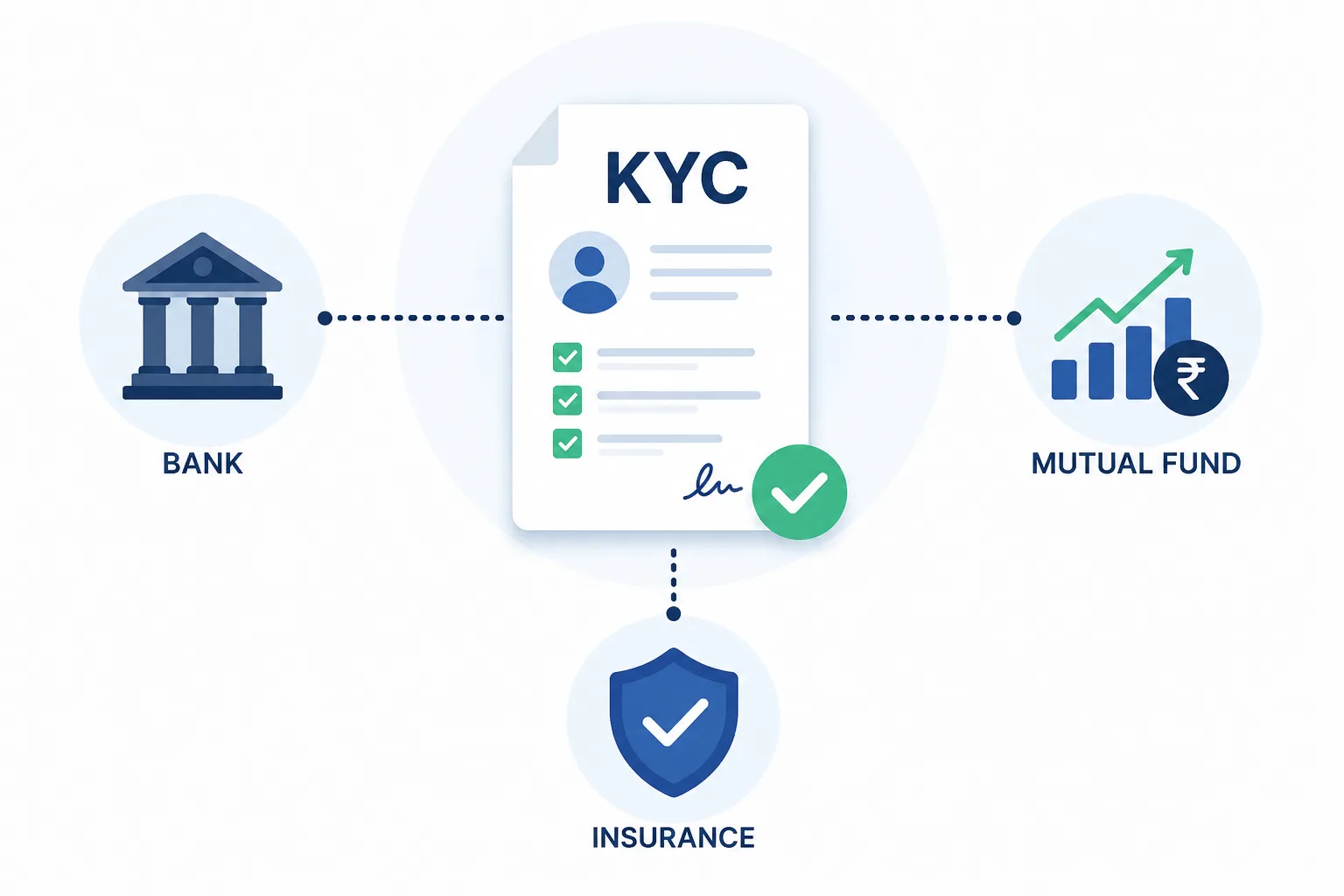
Every time you open a new bank account, buy a mutual fund, or apply for insurance in India, you fill out the same KYC form all over again — same PAN, same Aadhaar, same address proof, different institution. CKYC was built to end that repetition, and yet most people who've benefited from it have never actually heard the term. Here's what it is, how it works, and why it matters whether you're an individual investor or a financial institution trying to onboard customers faster.
What Does CKYC Mean?
CKYC stands for Central Know Your Customer. It's a centralized repository that stores the KYC records of every individual and entity that has done KYC with a financial institution in India — banks, insurers, mutual funds, non-banking financial companies (NBFCs), and other regulated entities.
Instead of each institution keeping its own siloed copy of your KYC documents, CKYC creates a single, standardized record that any registered institution can pull up using a unique reference number. Complete your KYC once, and in theory, you never have to repeat the paperwork with another regulated entity again.
Who Manages CKYC? Understanding CERSAI's Role
The Central KYC Registry is managed by CERSAI — the Central Registry of Securitisation Asset Reconstruction and Security Interest of India. CERSAI was originally set up to maintain a registry of security interests over property (to curb loan fraud), but it was later given the additional mandate of operating CKYC on behalf of the financial sector regulators: RBI, SEBI, IRDAI, and PFRDA.
CERSAI operates the CKYC Registry (CKYCRR) — the technical infrastructure that stores, indexes, and serves KYC records to authorized financial institutions.
How the CKYC Process Actually Works
Here's the practical flow, whether you're opening an account for the first time or providing your details as a returning customer.
Step 1: First-time KYC submission
When you do KYC with any regulated financial institution for the first time — say, opening a mutual fund folio — you submit the standard KYC documents: proof of identity, proof of address, a photograph, and your PAN details, usually via the KYC Identification Number (KIN) application process or an equivalent onboarding form.
Step 2: The institution uploads your record to CKYCRR
The financial institution, acting as the reporting entity, digitizes and uploads your KYC data to the CKYC Registry within the regulatory timeline (typically within 10 days of account opening, as mandated by the RBI's Master Direction on KYC).
Step 3: You receive a 14-digit KYC Identification Number
CERSAI generates a unique KIN (KYC Identification Number) — a 14-digit code tied to your record. This number becomes your reusable KYC credential across the financial system.
Step 4: Subsequent institutions fetch your existing record
The next time you approach a different bank, NBFC, or insurer, you simply provide your KIN or your PAN. The institution runs a CKYC search, retrieves your existing verified record, and — if nothing has changed — can onboard you without asking for fresh documents.
If any of your details have changed since your last KYC (new address, updated phone number), you'll need to do a KYC update, which also gets reflected centrally.
Why CKYC Was Introduced
Before CKYC, India's financial KYC landscape was fragmented. Each regulator — RBI for banks, SEBI for securities, IRDAI for insurance — ran its own KYC framework, and institutions under each regulator maintained independent records. A customer investing in mutual funds, holding a bank account, and buying insurance would typically complete KYC three separate times, submitting the same documents to three different systems.
This created friction for customers and duplicated effort, cost, and fraud risk for institutions. The government and financial regulators introduced CKYC (formalized through amendments to the Prevention of Money Laundering Rules and rolled out from 2016 onward) to:
- Eliminate repetitive KYC across financial institutions
- Reduce onboarding time and paperwork for customers
- Create a single source of truth for identity verification
- Strengthen anti-money laundering (AML) oversight by giving regulators visibility into a customer's financial relationships across institutions
- Cut compliance and operational costs for banks and NBFCs
CKYC vs Aadhaar eKYC: What's the Difference?
These two are often confused, but they serve different purposes.
Aadhaar eKYC is a verification method — it uses your Aadhaar number and biometric or OTP authentication to instantly confirm your identity at the point of onboarding.
CKYC is a centralized record-keeping system — it stores the outcome of your KYC (however it was originally verified, whether via Aadhaar, PAN, or physical documents) so it can be reused later.
In practice, the two work together: many institutions use Aadhaar-based eKYC to complete the initial verification quickly, and the resulting record then gets uploaded to CKYCRR for future reuse across the system.
Benefits of CKYC by Stakeholder
For individual customers
- No repeated document submission across institutions
- Faster account opening — often within minutes if a CKYC record already exists
- One KIN to quote instead of carrying physical documents everywhere
For financial institutions
- Lower customer acquisition and onboarding costs
- Faster turnaround time (TAT) for new account openings
- Reduced KYC-related fraud through a shared, regulator-backed data source
- Easier compliance reporting to RBI, SEBI, IRDAI, or PFRDA
For regulators
- A consolidated, searchable view of KYC data across the financial system
- Better tools for detecting suspicious patterns tied to money laundering or identity fraud
- Standardization of KYC formats across sectors that previously operated independently
Is CKYC Mandatory in India?
Yes. Under RBI's Master Direction on KYC and the Prevention of Money Laundering (Maintenance of Records) Rules, regulated entities are required to upload KYC records to CKYCRR and to check the registry before onboarding a new customer, to avoid duplicate KYC collection wherever a valid record already exists.
How to Check or Update Your CKYC Record
If you want to know whether your KYC record exists centrally, you can:
- Ask your bank or financial institution to run a CKYC search using your PAN
- Retrieve your KIN from any KYC acknowledgment slip you may have received previously
- Submit a KYC update form (available with most banks and RTAs) if your address, phone number, or other details have changed
Institutions typically handle the CKYCRR interface on the customer's behalf — individuals don't usually access the registry directly.
The Bottom Line
CKYC is one of the quieter pieces of financial infrastructure in India — you rarely think about it, but it's the reason your second, third, and fourth KYC has gotten progressively less painful. As more institutions integrate directly with CKYCRR through automated CKYC API rather than manual uploads, the gap between "regulatory requirement" and "seamless customer experience" continues to close. For anyone building or evaluating onboarding flows in Indian BFSI, understanding how CKYC fits alongside Aadhaar eKYC and Video KYC isn't optional — it's foundational.