
Keyword Cannibalization Is Killing Your Rankings: Here's the Fix
You’re publishing new content, targeting valuable keywords, and working hard to improve your Google rankings—but your website still isn’t getting the traffic you expected. The problem may not be a lack of content. It could be that your own pages are competing with each other.
This is known as keyword cannibalization.
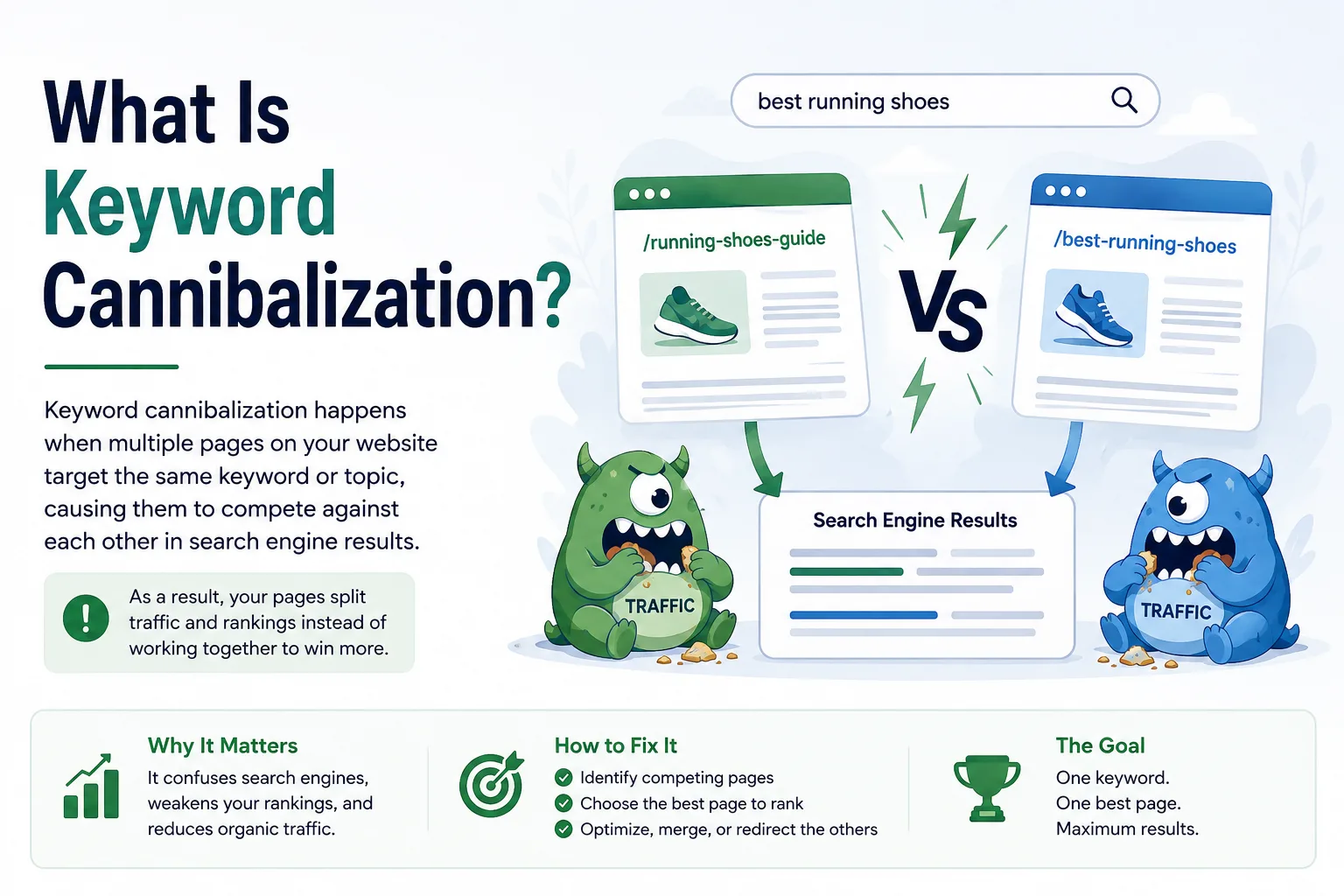
Keyword cannibalization happens when multiple pages on the same website target the same or very similar search intent. When this happens, search engines may struggle to determine which page should rank for a particular query.
What Is Keyword Cannibalization?
Imagine you have three articles:
- Beginner’s Guide to SEO
- SEO Basics Explained
- What Is SEO?
All three articles may target people who want to learn SEO. Although their titles are different, their purpose and content may be very similar.
Instead of having one strong page targeting the topic, your website has multiple pages competing for the same search opportunity.
Keyword cannibalization is not a Google penalty, but it can make your SEO strategy less effective.
Why Does It Hurt Rankings?
When several pages target similar search intent, ranking signals can become divided. One page may have stronger backlinks, another may have better content, while another may have more internal links.
As a result, Google may switch between URLs, and traffic can become distributed across multiple pages instead of building authority around one strong resource.
However, simply ranking multiple pages for similar keywords doesn't always mean you have cannibalization. The most important factor is search intent.
For example, articles about “solo travel in Himachal Pradesh,” “Himachal Pradesh travel budget,” and “best villages in Himachal Pradesh” may share keywords but answer completely different questions.
How to Fix Keyword Cannibalization
Start by identifying pages that have overlapping search intent. Once you find them, decide whether they should be combined or differentiated.
If two or more pages provide almost the same information, consider consolidating them into one comprehensive resource. Where appropriate, redirect the old URLs to the stronger page and update internal links.
If the pages serve different audiences, make their purposes clearer. For example, one page could focus on SEO for beginners while another targets advanced SEO strategies.
Strong internal linking can also help. Link supporting articles to your main resource so users and search engines can understand the relationship between your pages.
Final Thoughts
Keyword cannibalization isn't about publishing too much content. It's about publishing content without a clear purpose.
Before creating a new article, check your existing pages and ask: “Does this page answer a different question?”
When every page has a clear role and unique search intent, your content can work together instead of competing against itself. That can create a stronger, more organized SEO strategy and give your important pages a better opportunity to rank.
Also Read:- What Is Keyword Stuffing? (And Why It Can Harm Your SEO More Than Help)
This article was originally published on Biztal Box . This Medium publication is a republished version of the original article.
Read the original article: What Is Keyword Cannibalization?