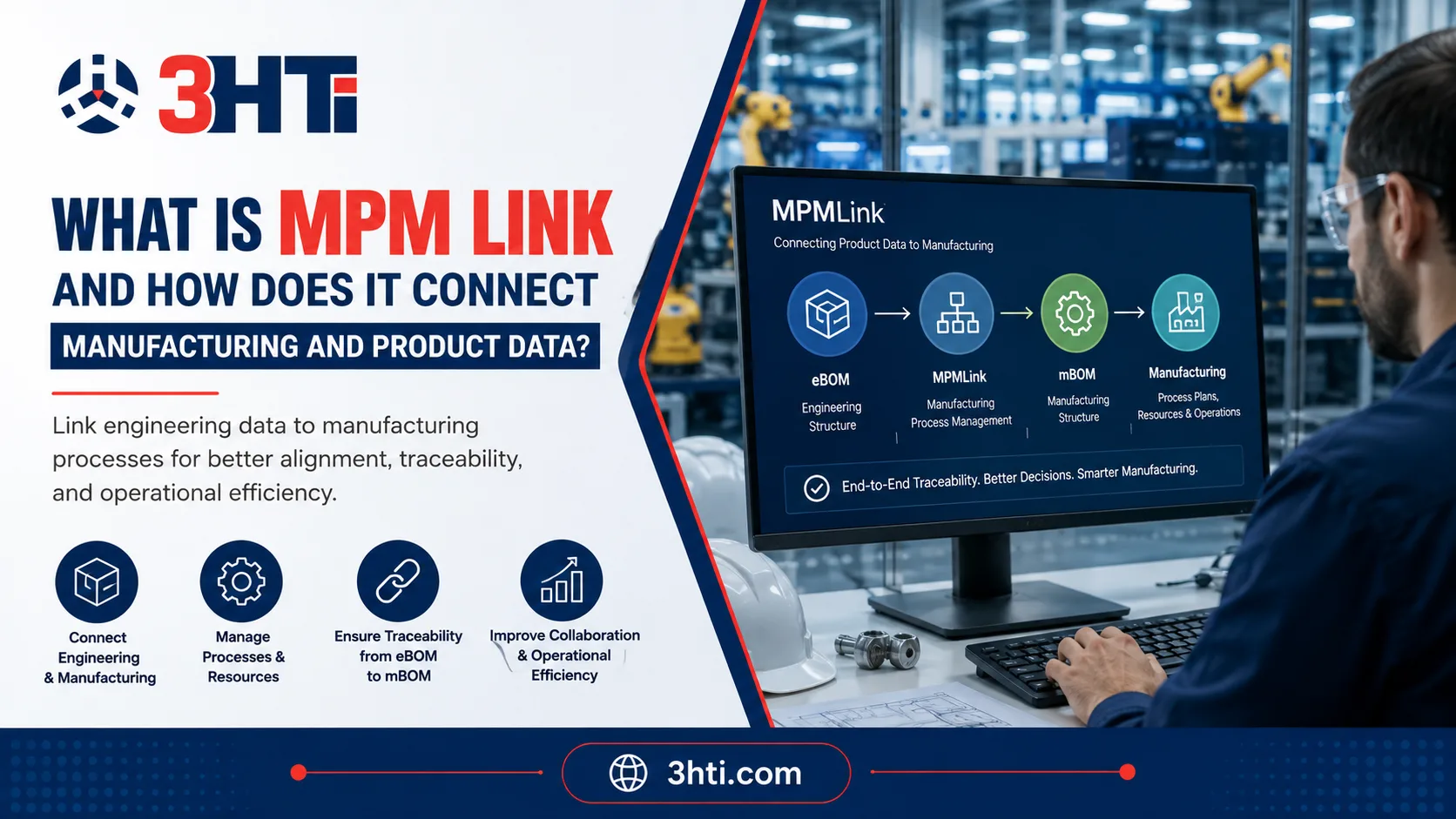
Software engineering solutions increasingly have to connect engineering definitions with the way products are actually manufactured. That is where MPMLink—PTC Windchill's Manufacturing Process Management capability—fits into the product lifecycle. MPMLink connects engineering product structures with manufacturing bills of materials (mBOMs), process plans, manufacturing resources, and work instructions, creating a controlled relationship between what a product is and how it is built.
For manufacturers managing complex products, the important question is not simply whether engineering and manufacturing systems exchange data. It is whether changes remain traceable, product structures stay synchronized, and manufacturing teams can work from the correct product definition.
Key Takeaways
- MPMLink connects engineering and manufacturing data within Windchill's PLM environment.
- It can support transformation from an engineering BOM (eBOM) into a manufacturing BOM (mBOM) while maintaining relationships between the structures.
- Manufacturing teams can associate processes, operations, resources, tooling, and work instructions with product information.
- Its value is particularly relevant when engineering changes frequently affect manufacturing processes or product configurations.
- MPMLink complements, rather than replaces, systems such as ERP and MES.
What Is MPMLink?
MPMLink is PTC Windchill's Manufacturing Process Management capability for connecting product engineering information with manufacturing processes. It is designed to help manufacturers manage how products are planned and built while maintaining relationships with product data.
The distinction between engineering and manufacturing data is important.
An eBOM generally represents the product from an engineering perspective: the parts and structures required to define the designed product. An mBOM represents how those components are organized for manufacturing. The two structures may not be identical because manufacturing can require different groupings, assemblies, consumables, operations, or plant-specific considerations.
MPMLink provides a controlled environment for managing this relationship rather than forcing manufacturing engineers to recreate engineering information manually.
How Does MPMLink Connect Product and Manufacturing Data?
The basic relationship can be viewed as:
Engineering Product Definition → eBOM → mBOM → Process Plan → Manufacturing Resources → Work Instructions
MPMLink can derive an mBOM from an eBOM and maintain traceability between engineering and manufacturing views. Manufacturing engineers can then use the product structure to develop process plans and associate appropriate resources.
This creates an important distinction from simple file exchange.
If an engineer changes a component, the question is not merely whether the updated CAD file reaches manufacturing. The organization also needs to understand whether the change affects:
- The manufacturing BOM
- Assembly operations
- Work instructions
- Tooling
- Workstations
- Production resources
- Inspection or process requirements
A connected PLM model makes these relationships easier to manage and assess.
Why Is eBOM-to-mBOM Traceability Important?
The eBOM and mBOM represent different perspectives of the same product. Losing the relationship between them can create unnecessary reconciliation work and increase the risk of manufacturing from outdated information.
PTC describes MPMLink as supporting traceability between product and manufacturing data, including the ability to assess impacts when changes occur upstream in product design or downstream in manufacturing.
Consider an industrial equipment manufacturer that changes a component within a multi-level assembly. The engineering change may appear straightforward in CAD, but manufacturing could need to modify the assembly sequence, tooling allocation, work instructions, or plant-specific process plan.
With disconnected systems, identifying every affected manufacturing artifact can become a manual investigation. With linked product and process structures, the relationships provide a stronger basis for impact analysis.
What Manufacturing Information Can MPMLink Manage?
MPMLink extends beyond BOM management. PTC identifies manufacturing data such as manufacturing parts, processes, tools, workstations, and manufacturing process plans as part of its manufacturing process management capabilities.
This enables organizations to associate product information with the practical steps required to manufacture it.
For example, a manufacturing engineer may need to define:
- Which components are consumed by an operation.
- In what sequence operations occur.
- Which workstation performs the operation.
- What tooling or resources are required.
- Which work instructions apply.
- Which product or process revision is approved for production.
The result is a more structured connection between product definition and production planning.
How Does MPMLink Differ From ERP and MES?
MPMLink should not be viewed as a replacement for ERP or MES. Each system serves a different role within the manufacturing technology stack.
PLM / Windchill manages product information, engineering structures, revisions, configurations, and lifecycle processes. MPMLink focuses on manufacturing process management, connecting engineering product definitions with manufacturing structures, process plans, resources, and related manufacturing information. ERP handles enterprise business processes such as purchasing, inventory, financial transactions, and resource planning. MES focuses on production execution and shop-floor operations.
A simplified relationship is:
CAD → PLM/Windchill → MPMLink → ERP/MES
CAD defines the product. PLM manages the product information and lifecycle. MPMLink connects the product definition with manufacturing planning. ERP manages enterprise-level business and resource transactions, while MES manages execution on the production floor.
The exact architecture varies by manufacturer, but separating these responsibilities helps organizations determine where product data should originate, how it should be governed, and which system should consume it.
Where Does MPMLink Fit Into Digital Transformation?
Manufacturing digital transformation is increasingly concerned with maintaining digital continuity between engineering, manufacturing, and the shop floor. PTC describes MPM as a PLM-based discipline that creates a digital thread connecting engineering, manufacturing operations, and production.
This has implications beyond software integration.
For organizations developing software product engineering solutions, engineering and manufacturing data may need to remain connected as products become more software-intensive, configurable, and globally distributed. A change to a product definition can have consequences across mechanical, electrical, software, manufacturing, quality, and service domains.
That makes data relationships—not simply data volume—the important architectural consideration.
Organizations evaluating broader transformation initiatives can also examine digital transformation services as part of an overall technology and process strategy.
What Should Manufacturers Evaluate Before Implementing MPMLink?
MPMLink can be valuable, but implementation should begin with business processes rather than software configuration.
Manufacturers should evaluate:
1. BOM complexity
Determine how many engineering and manufacturing structures exist and where they intentionally differ.
2. Change-management maturity
Define how engineering changes propagate into manufacturing processes and approvals.
3. Manufacturing variability
Consider whether different plants require site-specific process plans, resources, or work instructions.
4. Integration architecture
Document how PLM, CAD, ERP, MES, and other systems exchange information.
5. Data governance
Establish ownership, revision rules, lifecycle states, access controls, and approval responsibilities.
6. User roles
Engineering, manufacturing engineering, production, quality, and supply-chain stakeholders may require different views of the same product data.
This process-first approach is particularly important for large manufacturers because technically successful integration does not automatically produce operational consistency.
Conclusion
MPMLink connects product definition with manufacturing definition by linking engineering structures, manufacturing BOMs, process plans, resources, and related manufacturing information within the Windchill environment. Its central purpose is to reduce the disconnect between designing a product and defining how that product will be manufactured.
For manufacturers evaluating software engineering solutions or broader PLM architectures, the key consideration is not simply whether MPMLink can connect systems. The more important question is whether the organization's product, process, change, and data-governance models are mature enough to maintain meaningful digital continuity from engineering through manufacturing.
FAQs
Is MPMLink part of Windchill?
Yes. MPMLink is PTC's Manufacturing Process Management capability within the Windchill PLM environment. It connects engineering and manufacturing information, including product structures, manufacturing BOMs, process plans, resources, and work instructions.
What is the difference between an eBOM and an mBOM?
An eBOM represents a product from the engineering perspective, while an mBOM represents how its components are organized for manufacturing. They can differ structurally because manufacturing requires production-specific organization, processes, resources, and planning.
Does MPMLink replace an MES?
No. MPMLink focuses on manufacturing process management and planning, while MES focuses on production execution. PTC describes MPM as a bridge between engineering and manufacturing that can also support PLM-to-MES integration.
Can MPMLink support manufacturing process plans?
Yes. MPMLink supports manufacturing process planning and allows manufacturing data such as operations, resources, workstations, and process information to be associated with product structures.
Why is eBOM-to-mBOM traceability important?
Traceability helps manufacturers understand how engineering changes affect manufacturing structures and processes. It provides a basis for impact assessment and helps maintain alignment between the approved product definition and manufacturing definition.