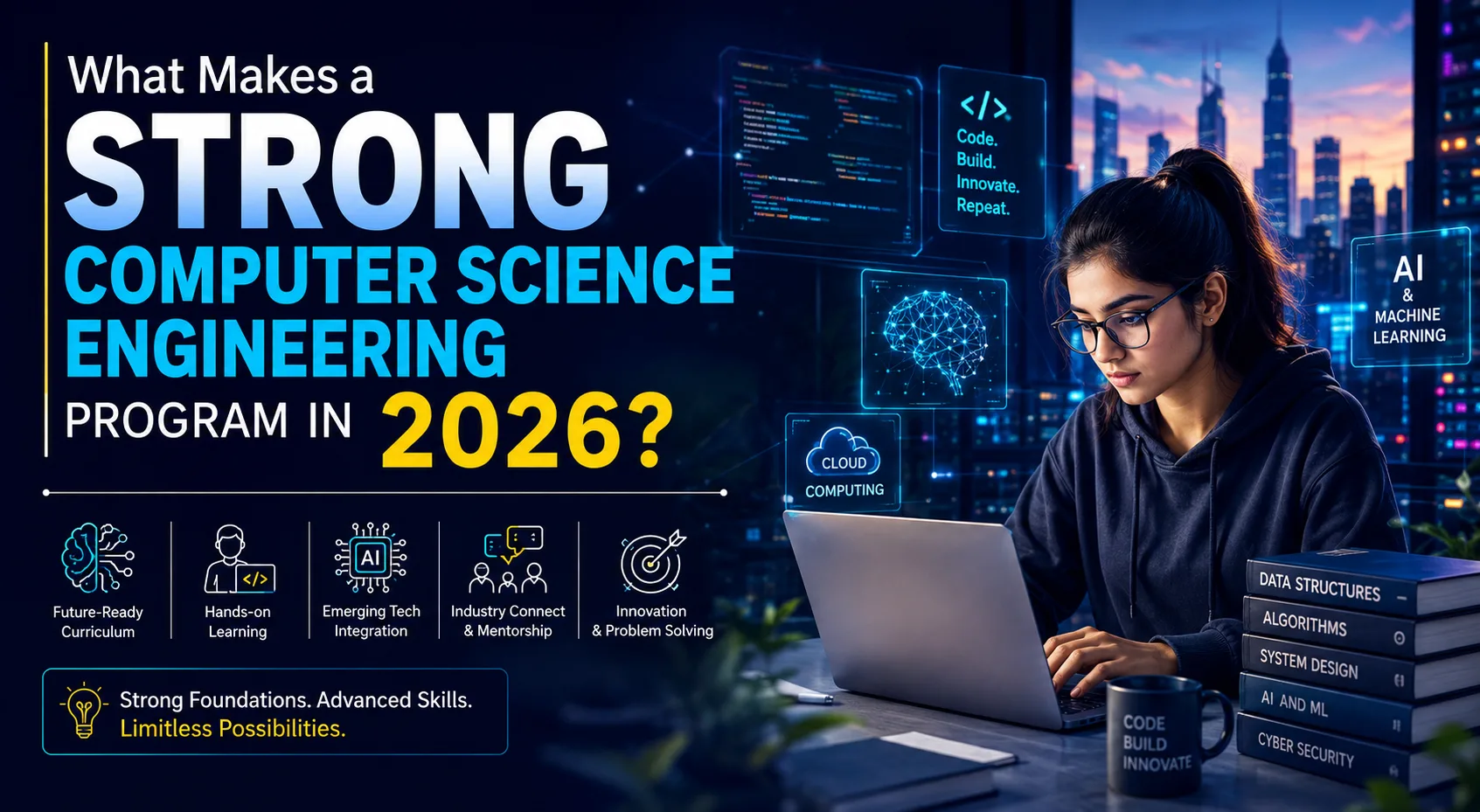
Computer Science Engineering continues to evolve as technology becomes an integral part of almost every industry. Software, artificial intelligence, cloud platforms, cybersecurity, data systems, and digital services are creating demand for professionals with strong technical foundations.
However, choosing a CSE program requires more thought than simply selecting a college with a computer science department. Students should understand what makes a program academically relevant and practically useful.
Strong Fundamentals Come First
Programming trends change frequently, but fundamental computer science concepts remain important.
A well-structured program should provide students with a foundation in areas such as:
- Programming
- Data structures
- Algorithms
- Operating systems
- Database systems
- Computer networks
- Software engineering
- Computer architecture
These subjects help students develop the logical thinking required for more advanced technologies.
Students researching B.Tech Computer Science Engineering Colleges in UP should therefore examine the complete curriculum instead of focusing only on popular specializations such as artificial intelligence.
Practical Programming Matters
Knowing programming concepts theoretically is different from being able to build software.
Students should have regular opportunities to write programs, solve problems, develop applications, participate in coding activities, and work on projects.
Practical learning also teaches students how to debug errors, understand documentation, collaborate with other developers, and improve their solutions.
Exposure to Emerging Technologies
Modern CSE education can benefit from exposure to areas such as artificial intelligence, machine learning, cloud computing, cybersecurity, data analytics, Internet of Things, and distributed systems.
Students do not necessarily need to specialize in all these areas. Instead, they should develop enough awareness to identify the fields they may want to explore more deeply.
This becomes particularly useful when students begin choosing electives and project topics.
Projects Build Professional Skills
Academic projects can provide an important bridge between classroom concepts and real-world applications.
A student might develop:
- A web application
- A mobile application
- A data analytics dashboard
- An automation tool
- A machine-learning prototype
- A cybersecurity project
Projects demonstrate how different technical concepts work together.
Students should ideally maintain documentation of their projects and use them to build a professional portfolio.
Internships Provide Industry Context
An internship can help students understand professional development environments.
During an internship, students may encounter version-control systems, project management tools, testing procedures, team meetings, client requirements, and professional documentation.
This experience can make the transition from college to employment easier.
Faculty and Learning Environment Matter
Students should also examine faculty expertise and teaching methods.
A strong learning environment encourages questions, experimentation, research, technical discussions, and collaboration.
Faculty members who guide students through projects and research can also help learners understand areas beyond the standard syllabus.
Compare Colleges on More Than Placement Numbers
Placement statistics often receive significant attention during college selection. While career outcomes are important, students should consider them alongside academic factors.
When comparing the Best B Tech CSE College in Uttar Pradesh, students can examine:
- Curriculum relevance
- Faculty qualifications
- Coding culture
- Laboratory facilities
- Internship opportunities
- Industry interaction
- Project-based learning
- Career guidance
- Student clubs
These factors can provide a broader picture of the educational experience.
Communication Skills Are Also Important
Technical ability alone may not be enough for a successful technology career.
Engineers frequently need to explain ideas, document projects, participate in meetings, present solutions, and work with people from different backgrounds.
Therefore, students should develop written and verbal communication alongside technical skills.
Continuous Learning Is Essential
Technology professionals rarely stop learning after graduation.
New programming frameworks, development tools, security practices, and AI technologies continue to emerge. Students should therefore develop the habit of learning independently.
Online documentation, technical communities, projects, certifications, and professional events can support continuous development.
Building a Career Roadmap
Students can divide their undergraduate journey into stages:
First year: Focus on programming fundamentals and mathematics.
Second year: Develop stronger technical knowledge and begin small projects.
Third year: Explore specialization areas and pursue internships.
Final year: Complete substantial projects and prepare for employment or higher education.
This approach creates gradual progress rather than leaving career preparation until graduation.
Conclusion
A strong computer science program should combine fundamentals, practical learning, current technologies, projects, internships, and professional skills.
Students should compare institutions carefully and select a program that provides opportunities to develop both technical competence and independent learning ability.