Small poultry farms often face a different challenge from large commercial fertilizer producers. They may have a steady supply of chicken manure, but the daily volume is not large enough to justify a high-capacity industrial production line. At the same time, simply storing or transporting loose manure can create additional labor and management costs.
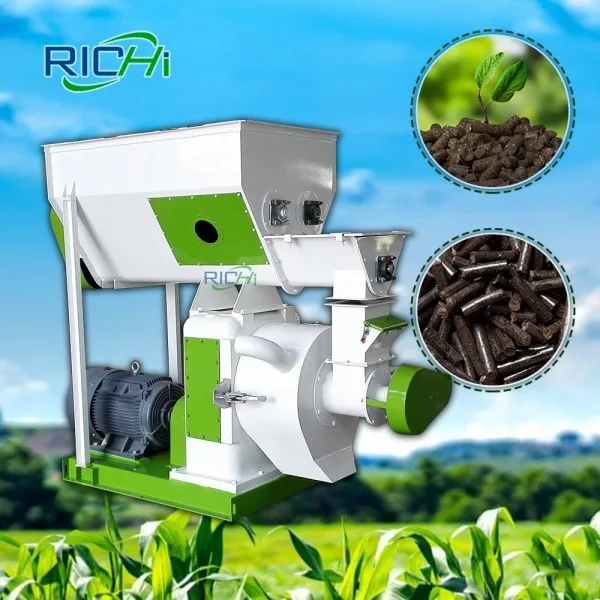
For these farms, a small chicken manure pellet machine for sale can provide a practical way to convert poultry waste into compact fertilizer pellets. The key is choosing equipment that matches the actual amount of manure available rather than selecting a machine based only on its advertised specifications.
Why Pelletize Chicken Manure?
Fresh chicken manure is difficult to handle because it contains considerable moisture and has an irregular structure. Loose manure also occupies a relatively large storage volume and can be inconvenient to transport.
Pelletizing changes the physical form of the material. After suitable pretreatment, the manure is compressed into relatively uniform cylindrical pellets. This can make the finished fertilizer easier to package, transport, store, and apply.
For farms that already have regular access to poultry manure, pelletizing can also create an opportunity to produce fertilizer for their own fields or for local agricultural markets.
Does a Small Machine Need a Complete Production Line?
Not every small farm requires a highly automated system. The configuration should depend on the condition of the raw material and the amount of fertilizer that needs to be produced.
If the manure contains excessive moisture, drying may be necessary before pelletizing. Screening can remove foreign materials, while crushing can help create a more uniform particle size.
After preparation, the material enters the pelletizing section. Depending on the formula, other organic materials may be mixed with the manure before pelletizing.
After pellets are formed, cooling and screening may be added to improve the quality of the finished product. A simple packaging system can then be used for bagged fertilizer.
Therefore, a small project can start with the essential equipment and add automation or auxiliary machines as production grows.
What About Other Organic Fertilizer Materials?
Small farms do not always process only chicken manure. Depending on local agricultural activities, they may also have access to livestock manure, crop residues, or other organic materials.
For example, a cow dung pellet machine for farm applications can be used for processing another common livestock waste material. Although the general pelletizing concept is similar, cow dung and chicken manure have different moisture and fiber characteristics, so the actual equipment configuration should be based on the material being processed.
Some producers may also combine different organic materials to create a more consistent feedstock. In this situation, a mixer becomes particularly useful because it helps distribute different ingredients more evenly before pelletizing.
How Should a Small Farm Calculate Capacity?
Capacity should be based on daily manure availability and the number of working hours.
Suppose a farm collects several tons of suitable manure each day. Instead of selecting an industrial system, the owner can calculate how much material needs to be processed per hour based on the planned working schedule.
It is also important to leave some operating margin. Equipment does not normally operate continuously at its theoretical maximum because cleaning, feeding adjustments, maintenance, and material changes take time.
A slightly higher capacity can therefore provide useful flexibility without requiring an excessively large investment.
What Other Factors Affect the Choice?
Moisture is one of the first factors to evaluate. If the incoming manure is very wet, drying may represent a significant part of the project cost and energy consumption.
The desired pellet diameter should also be specified before purchasing the equipment. Different agricultural applications may require different pellet sizes.
Available electricity, factory space, storage conditions, and packaging requirements should also be considered. Small farms often have limited space, so compact equipment and a straightforward material flow can be more practical than a complicated industrial layout.
An experienced pelletizer supplier can help evaluate the raw material, expected output, and auxiliary equipment before recommending a suitable configuration.
For farmers researching small-scale organic fertilizer processing, check this site out for more ideas on equipment selection and manure recycling.
Ultimately, a successful small manure pellet project does not depend on buying the biggest machine. It depends on creating a balanced system that matches the farm's waste supply, processing conditions, available investment, and future production plans.