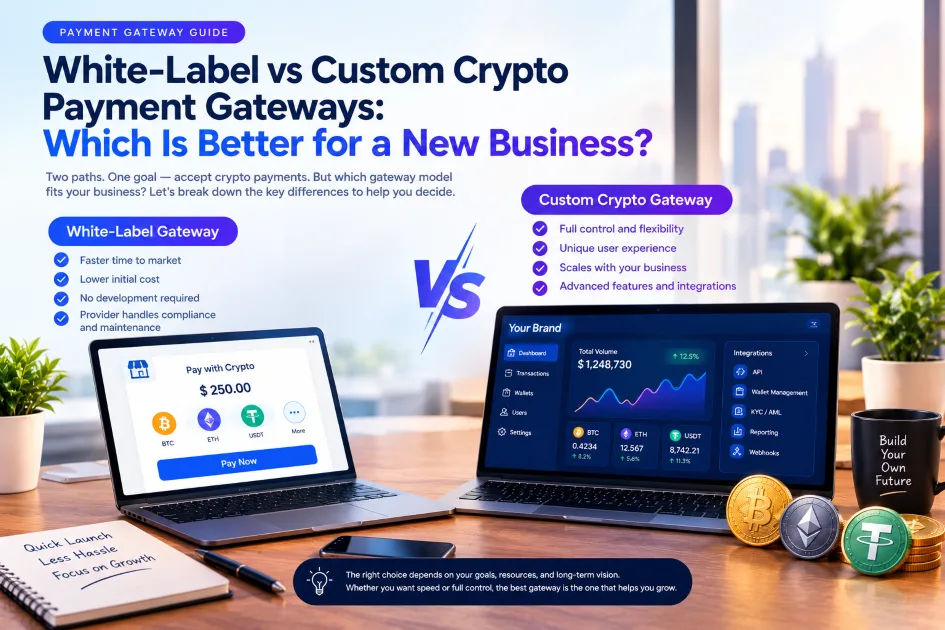
Accepting cryptocurrency can help new businesses reach customers who prefer digital assets for online payments. However, choosing the right payment gateway is an important decision. A business must consider setup costs, technical resources, transaction processing, security, and future growth before selecting a solution.
Two common options are white-label crypto payment gateways and custom-built gateways. A white-label solution allows a business to use existing payment technology under its own branding, while a custom gateway is developed to meet specific business requirements.
Businesses exploring the crypto payment market can review providers such as Oppi Payment to understand the available payment infrastructure and integration options. The best choice ultimately depends on the company's budget, technical capabilities, and long-term plans.
What Is a White-Label Crypto Payment Gateway?
A white-label crypto payment gateway is a ready-made payment solution that businesses can launch under their own brand. Instead of developing the entire system from scratch, a company uses an existing provider's technology and configures the available features to match its needs.
Depending on the provider, a white-label gateway may include payment processing, transaction monitoring, merchant dashboards, API integration, and support for multiple cryptocurrencies.
Benefits of a White-Label Gateway
- Faster launch: Businesses can avoid the lengthy process of building core payment technology.
- Lower initial development costs: Much of the underlying infrastructure is already available.
- Branding flexibility: Some providers allow businesses to customize the interface and customer-facing experience.
- Simpler maintenance: The provider may handle software updates, infrastructure maintenance, and technical support.
- Room for business growth: Companies can focus on acquiring merchants and improving their services instead of managing every technical component.
White-label solutions can be particularly useful for startups that want to enter the crypto payment market without hiring a large development team. However, customization options and access to the underlying technology vary by provider.
Businesses evaluating this approach can explore white-label crypto gateway solutions to understand how existing payment infrastructure can be adapted for a branded service.
What Is a Custom Crypto Payment Gateway?
A custom crypto payment gateway is a payment system developed specifically for a business. The company may build the entire platform internally or hire an external development team to create a solution based on its requirements.
This approach gives the business greater control over the payment flow, system architecture, integrations, and feature development. It can also make it easier to address specialized requirements that existing platforms do not support.
Benefits of a Custom Gateway
- Greater control: The business can determine how the platform is designed and operated.
- Specific integrations: Developers can build connections with internal accounting systems, merchant platforms, or other business software.
- Flexible features: The gateway can support specialized transaction rules, reporting needs, and payment workflows.
- Long-term product ownership: Depending on the development agreement, the business may own the source code and intellectual property.
- Tailored user experience: Checkout processes, dashboards, and merchant tools can be designed for a specific audience.
However, custom development usually requires more time, technical expertise, and investment. The company must also plan for security testing, ongoing maintenance, infrastructure costs, and future upgrades.
For a new business without a clear technical advantage to gain from custom development, these responsibilities can make the project difficult to manage.
White-Label vs Custom Crypto Payment Gateways: Key Differences
The main difference is how much technology a business needs to build and maintain itself.
FactorWhite-Label GatewayCustom GatewayInitial investmentGenerally lowerGenerally higherTime to launchUsually fasterUsually longerCustomizationDepends on providerGreater flexibilityTechnical expertiseLower internal development burdenRequires substantial technical resourcesMaintenanceOften shared with or handled by the providerManaged by the business or its development partnerSystem ownershipUsually limited to the business's branding and configuration rightsDepends on code ownership and development contractsScalabilityDepends on provider capabilities and service limitsCan be designed around specific scaling requirementsBest suited forStartups and businesses prioritizing speedBusinesses with specialized requirements and strong technical resourcesThese differences are general rather than universal. A white-label provider may offer extensive customization, while a custom-built system may still rely on third-party infrastructure. Contracts and technical architecture determine the actual level of control.
Which Option Is More Affordable for a New Business?
Cost is often one of the biggest concerns for startups. However, comparing only the initial development price can lead to an incomplete decision.
A white-label gateway may require setup fees, monthly charges, transaction fees, or additional payments for advanced features. These costs should be compared with the expense of building and maintaining a custom platform.
A custom gateway may involve developer salaries, software development, testing, hosting, security audits, monitoring, and ongoing technical support. Even after launch, the business may need to invest in updates and new integrations.
Costs to Compare Before Making a Decision
Businesses should evaluate the following expenses:
- Setup and development: Initial configuration fees versus design and development costs.
- Transaction charges: Processing fees, network fees, and any additional service charges.
- Maintenance: Software updates, infrastructure monitoring, and technical support.
- Security: Audits, vulnerability testing, access controls, and incident response.
- Integration: Connecting the gateway with websites, merchant systems, or internal software.
- Compliance: Legal advice, licensing where applicable, and obligations that depend on the business model and operating jurisdictions.
A white-label solution is often more practical when capital is limited and speed matters. Custom development may make financial sense when a business has specialized needs, sufficient resources, and a clear reason to control the technology itself.
Security and Control: What Should Startups Consider?
Security is essential for both types of crypto payment gateways. The choice between white-label and custom development does not automatically determine how secure a payment system will be.
A business should examine how transactions are verified, how access permissions are managed, what monitoring tools are available, and how the provider or development team responds to security incidents.
One important consideration is custody. In a custodial model, a provider may control the wallets or private keys used to hold customer funds. In a non-custodial model, funds may move directly to wallets controlled by the business or another intended recipient, depending on the implementation.
The distinction affects operational responsibilities, settlement arrangements, and the risks associated with relying on a third party. Businesses can learn more about these differences in this guide to custodial and non-custodial crypto payment gateways.
Regardless of the model, a startup should verify the provider's security practices, review its terms, understand who controls the funds, and establish clear procedures for handling failed or delayed transactions.
Customization and Integration: How Much Flexibility Is Needed?
Not every startup needs a fully customized payment platform. Many new businesses initially require only a reliable checkout experience, support for selected cryptocurrencies, transaction notifications, and basic reporting.
A white-label gateway may provide these features through existing tools and APIs. This can help a business launch without building and testing every component independently.
A custom gateway becomes more attractive when standard solutions cannot support important business requirements. For example, a company may need a specialized merchant dashboard, unusual settlement rules, proprietary reporting, or complex integrations with its existing software.
Before choosing custom development, the business should identify which features are essential at launch and which can be added later. Building unnecessary functionality can increase costs and delay market entry without creating meaningful customer value.
How Payment Requirements Differ Across Industries
The right gateway also depends on the industry and its payment workflows. An online retailer, SaaS provider, forex broker, and digital marketplace may have different requirements for payment confirmation, settlement, reporting, and customer support.
For example, businesses serving international clients may need to consider payment accessibility, transaction visibility, reconciliation, and the relationship between cryptocurrency payments and traditional financial systems.
A related discussion of how forex brokers can manage international client payments more efficiently illustrates why payment requirements should be evaluated in the context of a business's customer base and operating model.
These requirements should be documented before selecting a gateway. A solution that works well for one industry may not offer the controls or integrations required by another.
When Should a Business Choose a White-Label Gateway?
A white-label gateway is often the stronger option when a startup wants to enter the market quickly and avoid the complexity of building payment infrastructure from scratch.
It may be suitable when:
- The budget for initial development is limited.
- The business needs to test market demand before making a major investment.
- Standard payment features meet most requirements.
- The team has limited blockchain development experience.
- The priority is building a merchant base and improving the business model.
Before signing a contract, the company should confirm supported cryptocurrencies and networks, integration options, transaction limits, pricing, service availability, support arrangements, and customization rights.
It should also understand whether the provider allows data exports, system migration, and a transition to another platform if the business outgrows the service.
When Is a Custom Crypto Payment Gateway the Better Choice?
Custom development can be appropriate when payment processing is a core part of the business's competitive advantage. It may also be necessary when existing providers cannot meet specific technical, operational, or regulatory requirements.
A custom gateway may be worth considering when:
- The company has an experienced development and security team.
- Specialized payment workflows are essential.
- Existing platforms cannot provide the necessary integrations.
- The business needs greater control over its system architecture.
- The expected scale and revenue can justify ongoing development and maintenance costs.
However, custom development should begin with a realistic scope, a clear budget, and a long-term maintenance plan. Ownership of source code does not remove the need for security audits, infrastructure management, or operational oversight.
Can a Business Start With White-Label and Move to Custom Later?
Yes. A staged approach can reduce the risk of investing heavily before a business understands its market.
A startup can begin with a white-label gateway, validate customer demand, and learn which features merchants actually use. As transaction volumes grow and requirements become clearer, it can evaluate whether deeper customization or a custom-built platform is justified.
This approach works best when the initial provider offers documented APIs, reasonable data-export options, transparent contract terms, and a practical migration path.
The business should also avoid becoming dependent on features or data that cannot be transferred. Reviewing these issues early can make a future transition less expensive and disruptive.
Conclusion
White-label and custom crypto payment gateways serve different business needs. A white-label solution is generally a practical starting point for new businesses seeking faster deployment, lower initial development costs, and access to existing technology. A custom gateway offers greater flexibility and control but requires more investment, technical expertise, and ongoing maintenance.
For most startups, the sensible approach is to begin with clearly defined payment requirements, compare the total cost of ownership, and assess security, custody, integration, and scalability before making a decision. Custom development should be chosen when its additional control and specialized capabilities justify the extra expense—not simply because building a system from scratch appears more flexible.