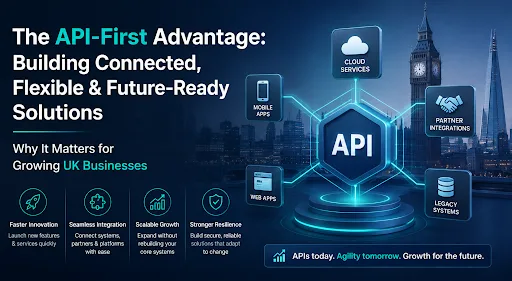
Right now, 83% of organisations use some form of API-first approach. Only 25% actually commit to it fully. That gap between “doing API-first” and “claiming API-first” is exactly where growing UK businesses either pull ahead of competitors with the right software development company in the UK or quietly fall behind them.
If your product roadmap includes a second platform, a partner integration, or an AI feature sometime in the next year, the architecture decision you make today decides how painful that becomes.
What “API-First” Actually Means
Most teams build an API the way you’d bolt a spoiler onto a car after it’s already built — as an afterthought, wired up once the web app already exists, because a partner or mobile team suddenly needs data out of it.
API-first flips that order. You design the API contract first — what data it exposes, how it authenticates, what it returns — before a single screen gets built. The web app, the mobile app, any partner integration, and any internal tool then all consume that same contract instead of getting built on top of whatever the original developer happened to wire up.
It sounds like a technical preference. It isn’t. It’s a business decision about how expensive your next integration is going to be.
The Business Case, Not Just the Technical One
Companies that adopt API-first architecture grow revenue 38% faster than those without a clear API strategy, according to enterprise research covering more than 100 projects. Organisations that standardise on APIs also see roughly a 45% uplift in deployment speed, because teams stop waiting on each other to ship.
The composable architecture movement built on top of API-first principles — often called MACH (Microservices, API-first, Cloud-native, Headless) — is backing this up at scale. Feature delivery runs 27% to 80% faster on composable, API-first stacks than on monolithic ones, and 87% of organisations increased their use of this approach over the past year alone.
In practical terms, an API-first foundation means:
• Faster integrations — a new partner, payment provider, or marketplace connects to an existing contract instead of triggering a custom build
• Parallel team output — frontend, mobile, and backend teams work off the same API spec at the same time instead of queuing behind each other
• AI-readiness — chatbots, agents, and automation tools can call your systems directly instead of needing a new integration layer built from scratch
• Vendor flexibility — you can swap a CMS, payment gateway, or search provider without rebuilding the whole platform around it
A UK Example Already Running at National Scale
You don’t need to look at a hypothetical case study — the UK already has one of the most mature API-first ecosystems in the world, and most people use it weekly without realising it.
Open Banking now serves more than 15 million UK users and processes over 2 billion API calls a month. Adoption is projected to reach 33.1 million UK users in 2026 — over 60% of the UK’s adult population — and the system maintains a 99.46% API success rate with average response times around 328 milliseconds.
That scale was only possible because challenger banks like Monzo and Starling were built API-first from the beginning. Every feature — account data, payments, spending categorisation — was designed as an API endpoint from day one, which is exactly why they could plug into the Open Banking framework almost immediately once it launched.
Why Legacy Systems Struggled to Catch Up
Older banks, built on decades-old core systems with no API layer, had a much harder route to the same finish line:
• Data lived inside monolithic cores never designed to be queried externally
• Every new integration meant custom middleware, not a standard connection
• Compliance and security had to be retrofitted around each new use case individually
• Rollouts took years instead of the months a fintech competitor needed
The lesson isn’t really about banking. It’s about what happens to any business that treats APIs as something you add later instead of something you build around.
Is Your Business Ready for an API-First Rebuild?
Signs You Need One
• You’re maintaining separate logic for your website, app, and admin panel because none of them talk to a shared contract
• Every new partner or integration request turns into a multi-week custom build
• Your team has said “we can’t do that without touching half the codebase” more than once this quarter
• You’re planning to add AI features and don’t have a clean way for a model actually to call your data
What to Expect From a Software Development Company in the UK
A software development company in the UK that actually understands API-first delivery should walk in with more than enthusiasm for the buzzword. Look for a team that:
• Documents the API contract before writing implementation code, not after
• Builds versioning into the API from day one, so old integrations don’t break when you ship new features
• Treats authentication and rate-limiting as core requirements, not a phase-two addition
• Designs with your next 18 months of integrations in mind, not just the current release
Conclusion
API-first isn’t a trend to bolt onto next quarter’s roadmap; it’s the difference between a platform that gets easier to extend over time and one that gets harder with every feature you add. The UK’s own Open Banking system proves the model works at national scale; the businesses winning inside it were simply the ones who built API-first before they had to.
If your current architecture makes every new integration feel like a small emergency, that’s the signal it’s time to rebuild with the API as the foundation, not the afterthought.