Business technology has changed dramatically over the past decade. Offices now depend on cloud applications, video meetings, wireless devices, IP phones, digital security systems, collaboration platforms, and large volumes of shared information. Yet one important part of this technological environment remains physical: the cabling that connects everything.
When that infrastructure is properly planned, employees may never think about it. When it is poorly designed, however, the effects can become obvious through slow connections, unreliable devices, difficult troubleshooting, and expensive upgrades.
For this reason, selecting an experienced data cabling contractor should be an important consideration when building or upgrading a commercial network.
A professional cabling project is not simply about placing cables inside walls. It involves understanding how information moves throughout a facility and designing an infrastructure capable of supporting today's devices while allowing the business to expand.
The Hidden Infrastructure Behind Modern Offices
Walk into a modern office and you may see laptops, phones, monitors, printers, wireless access points, cameras, and meeting-room technology. What is less visible is the infrastructure connecting those devices.
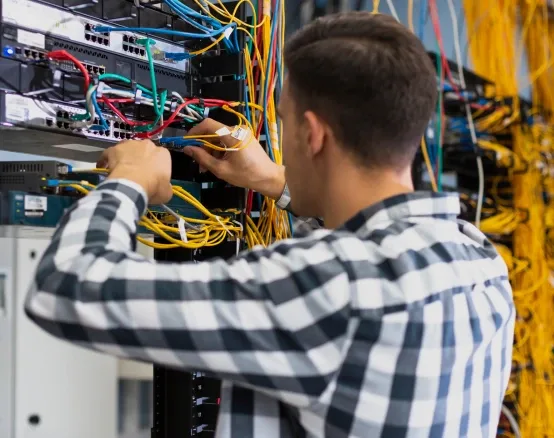
Behind the scenes are cables, patch panels, switches, racks, fiber connections, pathways, and telecommunications spaces.
A properly designed infrastructure helps create consistency across the facility.
When a company adds a new employee, for example, a structured network should make it relatively straightforward to provide another connection. When a conference room receives new equipment, the necessary connectivity should already be considered in the design.
This is one reason a professional data cabling contractor is valuable during both new construction and renovation projects.
What Is Structured Data Cabling?
Structured cabling is a standardized method of organizing telecommunications and network connections.
Rather than installing individual cables without a larger plan, structured cabling creates a coordinated system that can support different devices and applications.
A commercial system may include:
- Horizontal Ethernet cabling
- Fiber optic backbone connections
- Patch panels
- Network racks
- Telecommunications outlets
- Equipment cabinets
- Cable-management systems
- Pathways and conduits
The goal is to create an infrastructure that is easier to operate, troubleshoot, document, and expand.
Why Network Organization Affects Business Performance
Network performance is not determined solely by the internet service provider.
Internal cabling also plays an important role. A cable that is damaged, incorrectly terminated, excessively bent, or poorly routed can create connectivity problems.
Disorganized cabling can also make maintenance more difficult.
Imagine a business with hundreds of network connections but no clear labels. If one connection stops working, technicians may have to spend significant time identifying the correct cable.
Proper labeling and documentation can dramatically simplify this process.
An experienced cabling contractor treats organization as part of the installation rather than as an optional finishing step.
How a Professional Contractor Approaches a Project
A successful cabling project normally begins before the first cable is installed.
The contractor should understand the building layout, network requirements, equipment locations, and future growth plans.
Important questions include:
- How many users will the facility support?
- How many network devices are expected?
- Where will network equipment be located?
- Which applications require high bandwidth?
- Will the company add employees?
- Are wireless access points required?
- Will security cameras or other IoT devices be installed?
- Are there multiple floors or buildings?
- Is there existing cabling that can be reused?
- How much additional capacity should be reserved?
Answering these questions helps create a practical network design.
The Connection Between Cabling and Business Wi-Fi
Many organizations assume that wireless networking eliminates the need for structured cabling. In reality, modern wireless systems depend heavily on wired infrastructure.
High-performance business wifi solutions often use multiple access points throughout an office or commercial facility. These access points need network connectivity, and many are powered through Power over Ethernet.
This means access-point placement should be considered during the cabling design.
Installing access points without planning their network connections can result in unnecessary cable runs or poor equipment placement.
A coordinated approach allows the wireless system and wired infrastructure to complement one another.
Planning Wireless Coverage and Capacity
A wireless network should provide more than basic signal coverage.
Businesses also need capacity for multiple simultaneous users.
A conference room, for example, may support dozens of people who simultaneously use video conferencing, cloud applications, and wireless devices. A small number of poorly positioned access points may not be enough.
Professional business wifi solutions should therefore consider:
- Building dimensions
- Walls and physical obstructions
- Number of users
- Device density
- Application requirements
- Access-point locations
- Wired uplinks
- Security requirements
- Guest access
The cabling infrastructure should support this design from the beginning.
When Fiber Infrastructure Makes Sense
Copper Ethernet remains highly useful for many business connections, but fiber plays an increasingly important role in high-capacity environments.
A fiber optic contractor can help businesses plan and install fiber links for applications such as:
- Building backbones
- Data centers
- Server rooms
- Campus networks
- Long-distance connections
- High-bandwidth infrastructure
Fiber's ability to carry large amounts of information over substantial distances makes it an important option for businesses with demanding connectivity requirements.
Why Fiber Installation Requires Precision
Fiber optic installation requires careful handling.
Unlike ordinary electrical wiring, fiber depends on extremely precise optical connections. Installation professionals must consider cable routing, bend radius, termination, splicing, protection, and testing.
Contamination or physical damage can affect performance.
This is why businesses should evaluate the experience of a fiber optic contractor before beginning a major fiber project.
Professional installation and testing can help ensure that the infrastructure performs as intended.
Searching for Fiber Expertise Locally
When businesses need installation, repair, expansion, or troubleshooting, they may search online for fiber optic contractors near me.
Local availability can be beneficial when a project requires site visits or responsive service. However, proximity should be only one consideration.
Businesses should also evaluate:
- Commercial project experience
- Technical expertise
- Installation methodology
- Testing capabilities
- Documentation
- Communication
- Project scheduling
- Post-installation support
The best contractor is not necessarily the closest contractor. It is the company that can properly understand and execute the project.
Cabling During Office Construction
New construction offers a valuable opportunity to create a strong network foundation.
If cabling is considered early, pathways and telecommunications spaces can be planned alongside electrical, HVAC, security, and architectural requirements.
This can reduce installation challenges later.
During renovations, the situation may be more complicated because existing walls, ceilings, and equipment can restrict cable pathways.
A professional contractor can evaluate the environment and determine how new infrastructure can be integrated with existing systems.
Upgrading an Older Network
Not every business needs to replace every cable.
An evaluation can determine whether existing infrastructure remains suitable for current requirements.
Businesses should consider an upgrade when they experience issues such as:
- Frequent connectivity problems
- Difficulty supporting new devices
- Inadequate network speeds
- Outdated cabling
- Limited expansion capacity
- Poorly documented infrastructure
- Severely disorganized network rooms
A structured assessment helps identify which components require replacement and which can remain in service.
The Importance of Testing
Testing is an essential part of professional cabling work.
A completed cable connection may appear correct while still having performance problems.
Testing can help identify faults before employees begin using the network.
Documentation should also record relevant connection information. A well-documented installation becomes much easier to maintain.
For fiber systems, specialized testing can provide additional information about optical performance and potential faults.
Cable Management Is a Business Asset
Cable management is sometimes treated as a cosmetic concern. It is much more than that.
Organized cabling improves accessibility, reduces confusion, and can make future maintenance more efficient.
Proper management can also reduce the chance of accidental disconnections during equipment changes.
A professional cabling contractor should consider cable pathways, separation, labeling, rack organization, and future accessibility.
Preparing for Future Technology
Nobody can predict every technology a business will use five or ten years from now. However, infrastructure can be designed with flexibility in mind.
Future-ready planning may include additional pathways, spare capacity, scalable backbone connections, larger equipment racks, and appropriately selected cable categories.
The goal is not necessarily to install the most expensive technology available. Instead, businesses should build an infrastructure that provides a sensible balance between present requirements and future expansion.
Connecting Physical Infrastructure With IT Strategy
IT departments often focus on servers, software, cybersecurity, cloud platforms, and user devices. Physical network infrastructure needs to support those strategies.
For example, cloud-based operations may increase bandwidth demand. Increased wireless device usage may require additional access points. Video surveillance may add more network-connected equipment.
A coordinated infrastructure strategy prevents individual technology projects from creating a collection of disconnected solutions.
A data cabling contractor can work from the organization's broader requirements to develop a structured foundation.
Choosing a Qualified Cabling Partner
Businesses should avoid choosing an installer solely because of the lowest initial quote.
A low-cost installation can become expensive if it creates problems that require future correction.
When evaluating a contractor, ask about:
- Previous commercial projects
- Project planning
- Cable testing
- Documentation
- Installation standards
- Technician experience
- Warranty or workmanship policies
- Maintenance support
These factors provide a better indication of long-term value.
Why Integrated Expertise Matters
Modern networks combine multiple technologies.
A business may need copper connections to desks, fiber between network rooms, wireless access points throughout the building, and specialized connections for security or communications equipment.
This makes integrated expertise particularly valuable.
A cabling contractor with knowledge of different network technologies can help ensure that the components work together rather than being treated as isolated installations.
Final Thoughts
Reliable business connectivity starts with infrastructure that is carefully planned and professionally installed.
A qualified data cabling contractor can help businesses organize network connections, prepare for expansion, and reduce the complications associated with poorly planned installations.
For high-capacity applications, a skilled fiber optic contractor can provide the expertise needed for fiber backbone installations and related infrastructure. Businesses searching for fiber optic contractors near me should look beyond location and evaluate experience, testing, documentation, and commercial capabilities.
The wired network also provides the foundation for effective business wifi solutions. Wireless performance depends heavily on appropriate access-point placement and reliable wired connectivity.
Ultimately, investing in professional network infrastructure is an investment in business continuity. A well-designed cabling system can support today's employees, tomorrow's technologies, and the continued growth of the organization.
Frequently Asked Questions
1. What is the purpose of structured cabling?
Structured cabling organizes network infrastructure into a consistent system that can support computers, phones, access points, cameras, servers, and other devices.
2. Why is a data cabling contractor important?
A specialized contractor can plan, install, terminate, test, label, and document network cabling according to the requirements of the facility.
3. Is fiber better than Ethernet for every application?
Not necessarily. Copper Ethernet can be highly suitable for many device connections, while fiber is often useful for high-capacity or longer-distance backbone applications.
4. What should I ask fiber optic contractors near me?
Ask about commercial experience, fiber types supported, testing procedures, installation practices, documentation, scheduling, and ongoing support.
5. How does cabling affect business Wi-Fi?
Wireless access points require reliable network connections. Poor cabling can therefore limit the performance and reliability of an otherwise well-designed wireless network.