
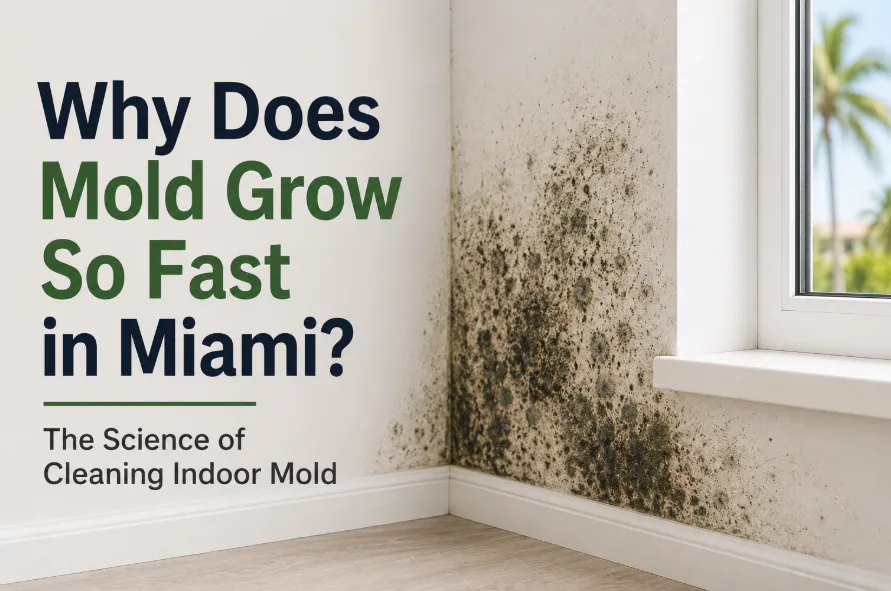
If you live in South Florida, you already know the drill. You step outside, your glasses immediately fog up, and the air feels heavy enough to chew. We are completely at the mercy of our subtropical climate. But while we can easily duck into a cooled building to escape the heat, our homes are constantly fighting a quieter, much more relentless battle against a silent squatter: mold.
In my years dealing with property health down here, I’ve seen it all. It usually starts the same way. You open a closet door and catch a faint, earthy whiff that shouldn’t be there. Or maybe you notice a tiny, fuzzy shadow creeping across the ceiling drywall right next to an AC vent. Because of our specific environment, a speck can escalate into a massive, stressful headache over the course of a single weekend.
Let's talk about why mold testing in Miami is essentially a five-star paradise for fungal growth, what is actually happening behind your walls, and how to handle it properly without accidentally making the problem twice as bad.
The Subtropical Perfect Storm: Why Miami is Mold Heaven
Whenever I walk a property with a frustrated homeowner, they often ask, "I keep a clean house, so how did this happen?"
I always tell them the same thing: mold doesn't care about your cleaning schedule. It just cares about biology. To thrive, a microscopic fungal spore needs exactly three things: a food source, a warm temperature, and moisture.
[High Humidity or a Hidden Leak] + [Drywall / Wood / Household Dust] + [Warmth (70°F–90°F)] = Active Mold Colonization within 24–48 Hours
In northern states, winter brings a dry, freezing freeze that acts as a natural reset button for biological growth. Down here? We don’t get that break. Our climate provides all three necessities on a silver platter, 365 days a year.
1. The Relentless Relative Humidity
Mold spores are generally lazy. They lie completely dormant as long as indoor relative humidity stays below 50%. The moment that number climbs past 60%, they wake up and start reproducing. Outdoor humidity in Miami hovers around 70% to 80% on an average day. If your indoor climate control isn't running perfectly, that heavy outdoor moisture constantly migrates inside through microscopic gaps in your windows, doors, and building foundation.
2. The Temperature Sweet Spot
Most indoor molds do their best work between 70°F and 90°F. Coincidentally, that is the exact temperature range of a South Florida home when an AC capacitor blows on a July afternoon, or when a seasonal resident turns their thermostat up to 82°F to save a few bucks on electricity while they're away for the summer.
3. An Unlimited Buffet
Mold isn't a picky eater. It feeds on organic matter. Traditional building materials—like the paper backing on standard drywall, wood wall studs, carpet fibers, and even the everyday household dust settling on surfaces—are prime food sources.
When you combine high humidity, warm stagnant air, and a drywall surface, you have created a literal incubator.
The Critical First Step: Mold Testing in Miami
When people realize they have a moisture issue, their immediate human instinct is to run to the hardware store, grab a jug of heavy chemical cleaner, and start scrubbing.
As someone who investigates these issues for a living, I beg you: please stop doing this. It is the exact equivalent of turning up the radio to drown out a weird knocking sound in your car engine. If you don't find out exactly why it's growing and where the water is coming from, you are just delaying the inevitable.
This is why objective, professional mold testing in miami is such a fundamental piece of owning property here.
Good testing isn’t just about confirming that mold exists. If you can see it with your own eyes, you already know you have an issue. The real value of a professional investigation comes down to things you can’t see:
- Tracking Invisible Moisture: Mold loves to grow inside wall cavities or deep within HVAC ductwork long before it ever breaks through the paint. A real pro will use infrared thermal imaging cameras to track hidden temperature drops where water is pooling completely out of sight.
- Reading the Air: Air sampling takes a snapshot of the invisible spore counts inside your living space and compares them to a control sample taken outdoors. If the indoor air shows an elevated concentration of specific water-damage indicators, it tells us exactly what kind of hidden moisture problem we're dealing with.
- Removing the Guesswork: If you are dealing with a landlord-tenant dispute, or trying to close on a real estate transaction, having certified laboratory data completely removes the emotion and finger-pointing from the conversation.
An Insider Tip on Florida Law: Our state has a fantastic consumer protection rule that everyone should know. By law (§468.8419), the exact same company cannot perform both the initial assessment/testing and the actual physical cleanup on the same property within a 12-month window. It is a massive conflict of interest. Always ensure your testing professional is entirely independent from the crew doing the physical treatment.
The Science of Cleaning and Remediation
Once testing confirms an elevated issue, the focus shifts to containment and removal. Cleaning up mold in a subtropical climate is entirely different from wiping down a dirty kitchen counter. It is a precise process rooted in physics and microbiology.
The Drywall Dilemma: Here is a mistake I see at least once a week. Someone sprays household bleach on porous materials like drywall or raw wood. Bleach is primarily water-based. While the chlorine chemical kills the surface fuzz momentarily, the porous drywall quickly filters out the chlorine and absorbs the water component. You are essentially watering the deep root structures of the colony, setting it up for an even bigger comeback a few weeks later.
True, professional-grade remediation relies on strict containment protocols to remove the damage without spreading it to the rest of your house:
Negative Air Containment
Before anyone cuts into a single sheet of contaminated drywall, the work zone must be completely isolated using heavy plastic sheeting. We use commercial air scrubbing machines equipped with HEPA filters to pull air out of the space and vent it outdoors. This creates negative pressure, ensuring that when the wall is opened up, the microscopic spores are sucked into a filter rather than drifting into your bedroom or kitchen.
Source Correction
I always tell clients: if you don't fix the water, you haven't fixed the mold. Whether it's a pinhole pipe leak, a failed window seal, or an AC condensate pan overflowing, the moisture source must be completely repaired before any real cleaning begins.
Controlled Disposal
Porous materials that are deeply saturated or heavily colonized—like insulation, old carpeting, or rotted drywall—simply cannot be saved. They must be carefully bagged, sealed, and removed from the property while the containment area is still locked down.
Beyond the Surface: Home Sanitization Services
Once the physical bulk of the mold and ruined materials are safely out of the house, the remaining solid elements—like concrete blocks, wood framing studs, and subfloors—must undergo a meticulous cleaning process. This is where comprehensive home sanitization services come in to completely reset the indoor environment to a healthy baseline.
This stage is all about neutralizing the invisible micro-particles that settled during the chaos. A true professional protocol involves:
- HEPA Vacuuming: Passing specialized, high-efficiency vacuums over every single square inch of the exposed framing to lift away microscopic fragments that traditional vacuums would just blow back into the room.
- Antimicrobial Washdowns: Applying professional-grade, EPA-registered solutions that penetrate wood fibers to eliminate remaining root structures safely, without leaving behind harsh, toxic fumes.
- HVAC Cleansing: Because our air conditioners constantly recirculate indoor air, spores naturally find their way into the ventilation system. Thorough sanitization ensures your AC machinery isn't acting as a distribution system once you move back into the space.
Practical Advice: Keeping Your Home Protected
While structural failures like roof leaks require professional repairs, managing everyday indoor moisture is completely in your hands. Here are a few real-world, practical habits I practice in my own home to keep it inhospitable to mold:
- Buy a Cheap Hygrometer: Spend fifteen or twenty bucks on a digital humidity monitor. Keep an eye on your indoor relative humidity. If it consistently climbs above 55%, your AC system might be oversized, short-cycling, or failing to remove moisture properly.
- Leave Bathroom Fans On: Don't turn the exhaust fan off the second you step out of the shower. Leave it running for at least twenty minutes afterward to completely clear out the humid air trap.
- Flush Your A/C Drain Line: Miami AC units pull gallons of water out of the air daily. If the drain line gets clogged with algae, that water backs up into your air handler closet, soaking the floorboards entirely unnoticed. Pouring a cup of plain vinegar down your drain line every month can save you thousands of dollars in unexpected damage.
Frequently Asked Questions
Can I just wipe away small patches of mold myself?
If it's a small area—think less than a 3x3 foot patch on a non-porous surface like bathroom tile, metal, or a plastic window sill—you can absolutely handle it yourself. Grab some dish soap and water or a dedicated mold cleaner, wear an N95 mask and gloves, and wipe it down. But if it’s on drywall or covers a large area, DIY scrubbing usually just flings spores everywhere.
Why is mold testing in Miami so frequently recommended before buying a house?
Because a fresh coat of cosmetic paint can hide a massive problem for a few months. A house might look absolutely gorgeous during an open house, but air testing will tell you the truth about whether a past storm or hidden plumbing issue left behind active colonies inside the walls. It's the cheapest insurance policy you can buy before signing a mortgage.
What is the difference between standard cleaning and professional home sanitization services?
Standard cleaning removes the dust and dirt you can see using consumer sprays. Professional sanitization is a methodical decontamination process. It involves sealing off rooms, using specialized HEPA vacuums to capture microscopic airborne particles, and using advanced antimicrobial solutions to reset the property's indoor air quality to a safe, baseline standard.
Will keeping my air conditioner running constantly prevent mold?
Only if the system is properly sized for your square footage. An oversized AC unit will cool down your house incredibly fast but shut off before it has a chance to actually pull moisture out of the air. This leaves you with a cold, clammy house—which is still highly vulnerable to mold growth.
The Final Word
At the end of the day, dealing with moisture is just a natural part of living in a beautiful, tropical place like Miami. Finding mold doesn't mean your house is dirty; it just means nature found an environment where it felt comfortable.
The secret to keeping your indoor air safe isn't magic—it's just staying vigilant. Keep your humidity low, pay attention to new smells, and don't hesitate to get independent, scientific mold testing in miami done the moment you suspect water has found a secret way into your home. Stay dry, protect your property, and let the right professionals handle the heavy lifting when you need peace of mind.