
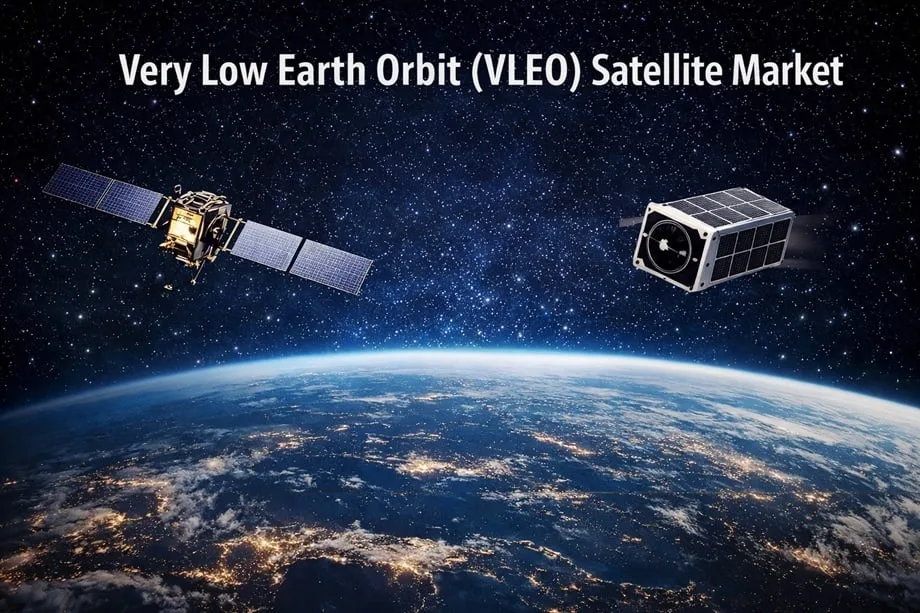
The Very Low Earth Orbit (VLEO) Satellite Market is gaining momentum as the space industry seeks more efficient, low-latency, and high-resolution satellite operations. VLEO satellites operate at altitudes below traditional low Earth orbit systems, enabling improved Earth observation, communication, and defense applications.
According to BISResearch, the Very Low Earth Orbit (VLEO) Satellite Market is projected to reach $1,502.5 Million by 2034 from $10.4 Million in 2024, growing at a CAGR of 73.86% during the forecast period 2025-2034.
Why Are Governments and Companies Investing in VLEO Satellites?
One of the primary drivers of the VLEO satellite market is the rising demand for high-resolution Earth observation and real-time data transmission. Operating closer to Earth allows VLEO satellites to capture more detailed imagery while reducing communication latency. These capabilities are becoming increasingly valuable for applications such as environmental monitoring, disaster management, military intelligence, and urban planning.
Another major growth factor is the expansion of satellite-based communication networks. VLEO satellites can deliver faster connectivity and improved bandwidth efficiency, making them attractive for future 5G and 6G communication ecosystems. Governments and private aerospace companies are also increasing investments in low-cost launch systems and miniaturized satellite technologies to strengthen space-based infrastructure.
The growing emphasis on national security and space defense programs is further accelerating market demand. Several countries are actively deploying advanced VLEO satellite systems for surveillance, reconnaissance, and secure communication operations.
Which Key Trends Are Shaping the VLEO Satellite Market?
- Increasing deployment of CubeSats, SmallSats, and minisatellites to enable flexible and customizable mission configurations.
- Expanding use across commercial and defense sectors, particularly in Earth observation, telecommunications, and navigation services.
- Rising strategic collaborations and investments among technology companies, aerospace firms, and space agencies.
- Ongoing advancements in materials and propulsion technologies that enhance satellite durability and performance in very low Earth orbits.
Request A Sample for VLEO Satellite Market - Focus on Type, Application, End User, and Region - Analysis and Forecast, 2025-2034
What Challenges and Opportunities Exist in the VLEO Satellite Market?
Despite its strong growth potential, the VLEO satellite market faces several technical and operational challenges. One of the biggest concerns is atmospheric drag, which can shorten satellite lifespan and increase orbital maintenance requirements. Maintaining stable operations at very low altitudes requires advanced propulsion systems and continuous trajectory adjustments.
Thermal management and radiation protection also remain important engineering challenges. Satellites operating in VLEO environments must withstand harsh space conditions while maintaining high-performance communication and imaging capabilities.
However, the market also presents substantial opportunities. The increasing demand for real-time geospatial intelligence, global connectivity, and climate monitoring is expected to create strong commercial demand for VLEO satellite solutions. Advancements in lightweight materials, autonomous navigation systems, and AI-powered satellite operations may further improve mission efficiency and reduce operational costs.
The rapid expansion of the commercial space economy is likely to create new opportunities for satellite manufacturers, launch service providers, and data analytics companies operating within the VLEO ecosystem.
Key Players in VLEO Satellite Market
- Sierra Space Corporation
- Redwire Corporation
- Earth Observant Inc.
- Thales Alenia Space
- EUTELSAT COMMUNICATIONS SA
- CASIC
- Albedo Space Corp.
- LeoLabs
Future Outlook
The future of the Very Low Earth Orbit (VLEO) satellite market looks highly promising as advancements in propulsion systems, lightweight materials, and autonomous satellite operations continue to overcome traditional orbital limitations. Increasing adoption across Earth observation, defense, climate monitoring, and low-latency communications is expected to expand commercial viability. As regulatory frameworks mature and private-public collaborations strengthen, VLEO satellites are likely to play a critical role in next-generation space infrastructure and global connectivity solutions.
Trending FAQ for VLEO Satellite Market
What is a Very Low Earth Orbit (VLEO) satellite?
A VLEO satellite operates at altitudes typically between 160 km and 450 km above Earth, enabling lower latency communication and higher-resolution Earth observation compared to satellites in higher orbits.
What are the key advantages of VLEO satellites?
VLEO satellites provide ultra-low latency, improved imaging resolution, reduced launch costs, and enhanced data transmission efficiency, making them suitable for advanced space applications.
Which industries are adopting VLEO satellites?
Industries such as telecommunications, defense, environmental monitoring, disaster management, and scientific research are increasingly adopting VLEO satellite technology.
Which industries are investing most in VLEO satellite technology?
The defense sector, telecommunications providers, Earth observation companies, climate research organizations, and government space agencies are among the leading investors in VLEO satellite systems.
Conclusion
The VLEO Satellite Market is emerging as a transformative segment within the global aerospace and satellite industry. Driven by demand for high-resolution imaging, low-latency communication, and advanced defense capabilities, VLEO satellite technologies are attracting significant investments from governments and private companies worldwide. Although technical challenges such as atmospheric drag and orbital sustainability remain, continuous innovation in propulsion systems, AI integration, and reusable launch technologies is expected to support long-term market growth.