Water is an important resource for almost every industrial sector. Manufacturing plants, power facilities, chemical industries, food processing units, textile factories, pharmaceutical companies, and wastewater treatment plants all depend on water for different operations. As industries grow, managing this resource efficiently becomes more difficult.
Traditional water monitoring often depends on manual meter readings, periodic inspections, paper records, and separate monitoring systems. These methods may work for small facilities, but they can become inefficient when an industrial site has multiple production areas, tanks, pumps, pipelines, and treatment units.
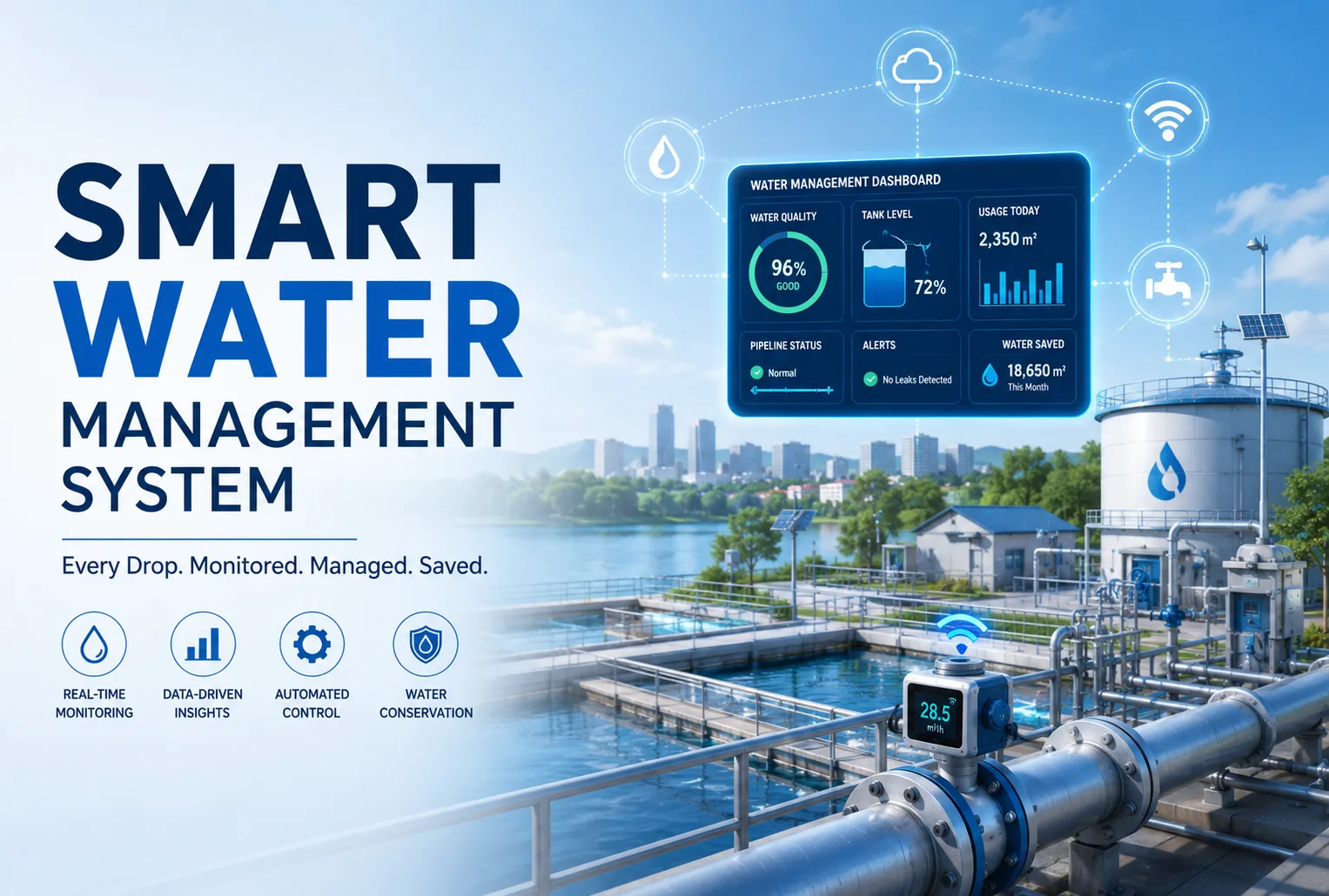
A smart water management system brings water infrastructure into a connected digital environment. Sensors, meters, gateways, software, dashboards, and analytics can work together to provide better visibility into water consumption and system performance. This makes connected water management more than a monitoring tool. It becomes an important part of industrial efficiency, cost control, resource conservation, and long-term sustainability.
What Is Smart Water Management?
Smart water management is the use of connected technologies to monitor, analyze, and manage water resources more efficiently.
A modern system can connect different field devices such as:
- Water meters
- Flow sensors
- Level sensors
- Pressure sensors
- Water-quality sensors
- Pumps
- Valves
- Controllers
- Energy meters
The information collected by these devices can be transferred through communication networks to a centralized platform. Users can then access the information through dashboards and receive alerts when unusual conditions occur.
The basic process is:
Sensors and meters → Communication → Gateway → Cloud platform → Dashboard → Analysis → Action
This approach gives Industrial IoT teams a more complete view of their water infrastructure.
Why Industries Need Better Water Management
Industrial facilities can consume large amounts of water every day. Water may be used for production, cooling, cleaning, processing, boilers, equipment operation, landscaping, and wastewater treatment.
Even a small amount of daily wastage can become significant over a long period.
Common problems include:
- Pipeline leakage
- Tank overflow
- Excessive water consumption
- Pump inefficiency
- Unusual flow
- Poor water-quality monitoring
- Delayed maintenance
- Manual data collection
- Lack of centralized information
When these issues are identified late, the cost can increase.
Digital monitoring helps organizations understand their water infrastructure continuously rather than relying only on occasional inspections.
How Smart Water Monitoring Works
A connected water monitoring system normally consists of several important components.
ComponentPurposeWater MeterMeasures water consumptionFlow SensorTracks the movement of waterLevel SensorMonitors tanks and reservoirsPressure SensorTracks pipeline pressureQuality SensorMeasures selected water-quality parametersIoT GatewayTransfers data from field devicesCloud PlatformStores and processes collected dataDashboardDisplays real-time informationAlert SystemNotifies teams about unusual conditionsAnalyticsHelps identify trends and patterns
The sensors collect information from the physical water infrastructure. An IoT gateway can gather data from multiple devices and transfer it to the central platform.
The platform then organizes the information and displays it through dashboards.
This allows industrial teams to monitor water systems without physically visiting every location.
1. Reduce Water Wastage
One of the biggest reasons industries adopt connected water monitoring is to reduce wastage.
Without continuous monitoring, it can be difficult to understand where water is being consumed.
A digital system can show consumption across different areas, production units, or processes. This allows managers to compare usage and identify areas where water consumption appears unusually high.
For example, if one production line consistently uses more water than similar lines, the team can investigate the reason.
Better visibility makes it easier to take corrective action.
2. Detect Leaks Faster
Water leaks can remain unnoticed for a long time, especially when pipelines are located underground or in difficult-to-access areas.
Continuous flow monitoring can help identify unusual patterns.
For example, if water continues to flow during a period when the facility normally has very little activity, the system can generate an alert.
Maintenance teams can then inspect the relevant section.
Early detection can reduce water loss and help prevent additional damage to infrastructure.
3. Reduce Operational Costs
Water management is connected to several other operational expenses.
Industries may spend money on:
- Water supply
- Pumping
- Electricity
- Treatment
- Maintenance
- Wastewater processing
- Labour
When water is wasted, some of these resources are also wasted.
By monitoring consumption and identifying inefficiencies, organizations can work toward reducing unnecessary expenses.
The goal is not simply to use less water. The goal is to use the required amount of water in the most efficient way possible.
4. Monitor Water Consumption in Real Time
Traditional meters usually provide a reading at a particular point in time.
Connected meters can provide much more information.
Industrial teams can view consumption trends over hours, days, weeks, or months. This makes it easier to understand how water usage changes during different production periods.
Real-time visibility can help answer questions such as:
- When is water consumption highest?
- Which area uses the most water?
- Is consumption increasing?
- Is there unusual nighttime flow?
- Has consumption changed after maintenance?
- Is a particular process using more water than expected?
These answers can support better operational planning.
5. Improve Pump and Equipment Monitoring
Water infrastructure often depends on pumps and other equipment.
A pump problem can affect production, water supply, and energy consumption.
Connected monitoring can help teams track pump status, operating conditions, and selected performance indicators.
If a pump starts behaving differently from its normal pattern, the system can notify the responsible team.
This supports proactive maintenance and reduces dependence on emergency repairs.
6. Support Better Water Quality Monitoring
Water quantity is only one part of water management.
Water quality can also be important for industrial operations.
Depending on the application, sensors can monitor parameters such as:
- pH
- TDS
- Chlorine
- Temperature
- Turbidity
- Conductivity
The required parameters depend on the industry's process and regulatory requirements.
Connecting these measurements to a centralized platform can make it easier for teams to monitor water conditions and identify changes.
7. Reduce Manual Monitoring
Manual readings require employees to visit different locations, record information, prepare reports, and share the results.
This can take considerable time in a large industrial facility.
An automated water monitoring platform can collect information continuously and make it available through a centralized dashboard.
This does not eliminate the need for skilled employees. Instead, it allows them to spend less time collecting basic readings and more time analyzing problems and improving operations.
8. Improve Decision-Making With Data
Water data becomes more valuable when it is available over time.
Historical data can help organizations identify patterns and compare performance.
For example, a factory may compare water consumption between different months or production periods. If consumption rises without a similar increase in production, the organization can investigate the difference.
This makes decisions more evidence-based.
Instead of relying only on assumptions, managers can use actual operational data.
9. Connect Water Management With IIoT
Industrial water management does not have to operate as a separate system.
It can become part of a wider IIoT environment.
Machines, energy meters, pumps, production equipment, water meters, and environmental sensors can all contribute information to a connected industrial platform.
This creates a broader view of the facility.
For example, a company may compare:
Production + Water Consumption + Energy Consumption + Equipment Performance
Together, these data points can reveal relationships that may not be visible when each system is monitored separately.
10. The Importance of IoT Device Management
As the number of connected sensors increases, managing the devices becomes important.
Industrial facilities may have hundreds of connected devices operating across different areas.
Good iot device management helps teams monitor whether devices are online, transmitting information correctly, and operating as expected.
It can help with:
- Device status monitoring
- Connectivity checks
- Device configuration
- Fault identification
- Data communication monitoring
- Remote device management
- System maintenance
Reliable device management helps maintain the quality of the data used by the water management platform.
11. Why an IoT Gateway Matters
An iot gateway acts as an important communication layer between field devices and the central software platform.
Industrial sites may contain different types of sensors and communication technologies. A gateway can collect information from these devices and transfer the required information to the cloud or monitoring platform.
This is especially useful for large facilities where devices are spread across different locations.
A suitable gateway architecture can help organizations build scalable connected systems without requiring every field device to communicate directly with the cloud.
12. Smart Water Management for Different Industries
Connected water monitoring can support many industrial sectors.
Manufacturing
Manufacturing facilities can monitor water used in production, cooling, cleaning, and equipment operation.
Textile Industry
Textile operations can track water consumption during processing, washing, dyeing, and other activities.
Food and Beverage
Water monitoring can support production, cleaning, processing, and utility operations.
Pharmaceutical Industry
Water quality and consumption can be important parts of pharmaceutical manufacturing and facility management.
Chemical Industry
Connected monitoring can support process water, cooling systems, storage, and wastewater operations.
Power Plants
Water is commonly required for cooling and other utility processes. Monitoring can provide greater visibility into consumption and system conditions.
Wastewater Treatment
Treatment plants can monitor flow, tank levels, water quality, pumps, blowers, and other equipment.
Smart Water Metering in Industrial Facilities
A smart water meter can provide continuous or scheduled water consumption information instead of relying only on manual readings.
For industrial facilities, metering can be installed at multiple points.
For example:
- Main water inlet
- Production areas
- Cooling systems
- Utility areas
- Treatment plants
- Individual buildings
- Process units
This allows organizations to understand water consumption at a more detailed level.
When multiple meters are connected to one platform, managers can compare different areas and identify unusual consumption.
Key Benefits at a Glance
BenefitIndustrial ValueReal-Time MonitoringProvides continuous visibility into water usageLeak DetectionHelps identify unusual flow earlierCost ReductionSupports lower water and operational expensesRemote AccessAllows teams to monitor systems from a central locationAutomated ReportsReduces manual reporting workBetter MaintenanceHelps identify equipment-related issuesWater QualitySupports monitoring of selected parametersHistorical DataHelps identify trends and consumption patternsSustainabilitySupports responsible resource managementScalabilityAllows additional devices to be added as needs grow
Important Statistics and Practical Indicators
The value of digital water monitoring can be understood through measurable operational indicators.
AreaWhat Can Be MeasuredWater UsageDaily, weekly, and monthly consumptionFlowFlow rate and unusual flow patternsTanksLevel and overflow conditionsPumpsOperating status and performanceQualitypH, TDS, chlorine, and other selected parametersEnergyEnergy used for pumping and related operationsMaintenanceEquipment alerts and abnormal conditionsReportingAutomated operational reports
The exact results of a water-management project depend on the facility, equipment, water usage, existing infrastructure, and implementation approach. The important point is that connected monitoring gives organizations measurable information that can be used to improve performance.
Challenges in Implementing Smart Water Management
Although digital water management provides many advantages, industries should plan implementation carefully.
Initial Investment
Sensors, meters, gateways, software, installation, and integration require an initial investment.
Connectivity
The communication method must be suitable for the facility's location, environment, and coverage requirements.
Integration
The new system should work with relevant existing equipment and infrastructure.
Data Security
Industrial data should be protected with appropriate access controls and security practices.
Employee Training
Employees should understand how to use dashboards, interpret alerts, and respond to system information.
Maintenance
Sensors and other connected equipment need periodic inspection and maintenance to ensure reliable data.
A successful project should consider both technology and operational requirements.
How KarIoT Supports Smart Water Management
KarIoT provides IoT-based monitoring solutions designed to help organizations manage water more effectively. Its services bring together sensors, meters, gateways, cloud platforms, dashboards, analytics, alerts, and remote monitoring.
The company provides solutions for industrial facilities, commercial buildings, apartments, government applications, and water and wastewater treatment operations.
Its platform can monitor areas such as water consumption, flow, tank levels, pressure, water quality, energy consumption, and equipment operation.
For industrial applications, KarIoT highlights monitoring for STP, WTP, and ETP facilities, along with real-time dashboards, automated reporting, alerts, and remote monitoring.
This type of connected approach can help organizations move from periodic manual readings to continuous digital visibility.
The Future of Industrial Water Management
Water management is becoming increasingly connected.
As industries focus more on sustainability, efficiency, automation, and cost control, digital monitoring will become an increasingly important part of water infrastructure.
Future systems will likely combine sensors, IoT platforms, analytics, automation, and artificial intelligence to provide deeper insights.
Instead of simply showing how much water was used, advanced systems can help organizations understand why consumption changed and what action may be required.
This can support a more proactive approach to water management.
The future is not only about monitoring water. It is about understanding the entire water system and making it more efficient.
Final Thoughts
Water is too valuable to manage only through occasional readings and manual inspections.
For modern industries, connected water monitoring provides better visibility, faster alerts, improved resource management, and stronger operational control. It can help organizations identify leaks, understand consumption patterns, monitor equipment, reduce unnecessary costs, and support sustainability goals.
A well-designed smart water management system connects water meters, sensors, gateways, software, analytics, and people into one coordinated environment.
If your industry wants to reduce water wastage, improve monitoring, control operational costs, and make better decisions using real-time information, KarIoT can help you move toward a smarter approach.