
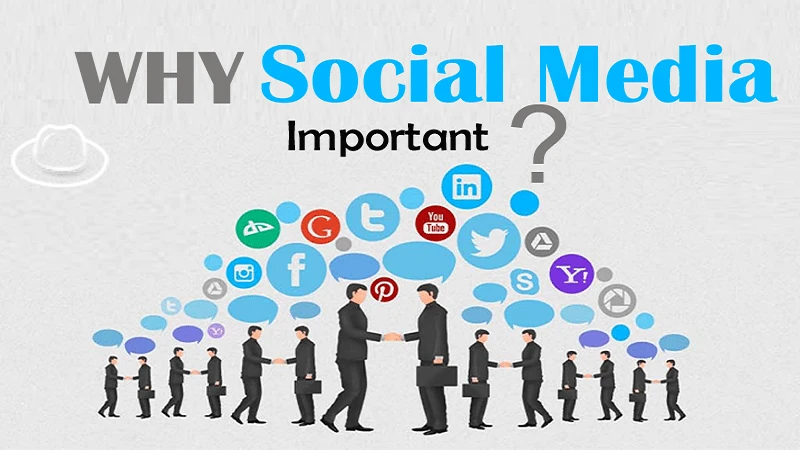
For businesses of all scales and niches, social media platforms, like Facebook, Instagram, and LinkedIn, have proved to be highly valuable for attracting audiences and improving business sales. This is because of the huge audience base, from which businesses can identify their targeted audience and attract them with marketing efforts. This sheer scale of audience has transformed social media into a growth engine. In this blog post, we will discuss the key reasons why social media is important for business growth.
How Social Media Helps Businesses?
As there are over 5.24 billion active global users on social media, which is well over 60% of the entire global population, social media can help businesses, despite the competitiveness in their niche, in a multitude of ways. Below, we have listed the key reasons how social media helps businesses.
1. Brand Visibility and Discovery
In today’s digital competitive market, a business cannot grow if the right audience is unable to discover it. One of the best impact of social media on businesses is that its practices, both organic and paid, can contribute significantly to improving brand visibility and making it more likely for the audience to discover a business. Below, we have listed the key ways by which social media can help with this aspect.
Creating engaging content: The audience on social media is likely to engage with content that they can relate to. Therefore, by sharing valuable and engaging content, a business will be able to attract its targeted audience and guide them through the marketing funnel.
Using hashtags: Smart usage of hashtags can assist a business in connecting with trending topics as well as broader conversations. This increases the likelihood of the business being easy to discover.
Targeted Advertising: By running paid advertisements, a business can reach a highly specific audience, thus making the business visible in the competitive market.
2. Lead Generation & Conversion
Social media is not just for doom-scrolling reels and sharing memes. Instead, it is a channel that can directly help a business improve its conversion. Generating leads and converting them on social media can be done via the following practices.
Social commerce: Thanks to social commerce features, such as shoppable posts and in-app purchases, a business can directly engage with the audience and transform them into leads.
Running social ads: Paid advertisement still proves to be one of the best methods to reach the targeted audience and transform them into leads. Later, these leads can be fostered into conversion with proper marketing efforts.
Answering pain points: By figuring out the concerns of the audience and answering them through posts, reels, or even ads, a business can attract a large group of users who can be turned into leads. However, a robust knowledge of what is social media will be required in order to identify the pain points.
3. Reputation Management
Aside from being more visible and generating leads, social media is also a powerful tool for managing business reputation. As even a single negative comment can easily raise chaos and may cause a business to fall apart, using social platforms for reputation management is one of the key reasons why social media is important for business growth. Reputation management can not only assist a business in handling crises, but can even build a loyal community of followers around the business. Below, we have listed the key ways by which social media can help with reputation management.
Crisis management: A business can use social media to quickly respond to a crisis and inform the audience about the misinformation. This can not only help mitigate the damage but can also ensure that the crisis does not transform into a much bigger problem.
Content amplifications: By sharing positive stories, values, and even stories, a business can maintain a positive presence across social platforms. Due to the practice being free of cost and highly effective, it is expected to be among the key social media strategies for 2026.
Fast resolutions: As the majority of users expect a response within 24 hours, being able to quickly resolve their query will result in significantly improving reputation, loyalty, and retention.
4. Competitive Advantage
Getting a competitive edge today is a task much easier said than done. However, the best social media marketing company in Gurgaon makes use of social platforms to understand trending topics and audience queries, and responds to them. Through this, the company attains an edge over the rest of the competition. While this edge might be slight, it can, nevertheless, help fuel business growth. Below, we have listed the key ways in which social media helps businesses gain a competitive edge.
- Analyzing competitors’ data can help a business understand the strengths and weaknesses of the opposition.
- By highlighting and promoting the unique values, a business can gain opportunities to further differentiate its products and services from its competitors.
- Consistently sharing valuable content can help attract the competitor’s audiences.
5. Cost-Effective
One of the major reasons why social media is important for business is that the marketing method is highly cost-effective. Even small businesses can use the practice to attain a position in the competitive market. Moreover, thanks to the huge audience base, even the free methods of social media marketing can contribute significantly to achieving the desired business success. However, the only requirement from the business would be to stay consistent and share valuable content.
Social Media For Business Growth
From brand visibility to sales, social media touches almost every corner of the business. Due to this, the question is no longer why social media is important for business. Instead, the question is how quickly a business can adapt to this method for measurable growth. Businesses that can include social media in their marketing efforts are sure to be able to open the door to a plethora of benefits, including the ones we have listed in this blog post.