
You pour time into your website. The content is solid. The design works. Yet somehow, traffic feels stuck. Meanwhile, AI answers are showing up everywhere, pulling information from sources you never expected. Who gets picked for those answers? And more importantly, why is your site not among them?
These questions come up often in conversations with Avira Digital Studios, an SEO Expert in India helping businesses navigate this shift. The rules of visibility have changed, and understanding them now makes all the difference.
How AI Search Engines Generate Answers
Let us look at how these systems actually work. Traditional search engines, the kind we used for years, matched your query to pages that had those words. If you searched for "best laptops," Google showed you pages with that phrase.
AI search is different. These models read across thousands of sources and then write something new based on what they learned. They do not just list links. They try to give you an answer directly.
This changes everything for website owners. If your page is not structured in a way these models can understand, or if your authority is not clear, the AI simply moves on to another source. LLM-powered search engines are selective. They look for signals that tell them a source is trustworthy, and if those signals are missing, you stay invisible.
Why AI Systems Choose Some Websites Over Others
Here is where it gets interesting. AI models do not have personal opinions. They do not prefer one site because the design looks nice. They choose sources based on patterns.
If your website is consistently mentioned by other reputable places, that pattern gets noticed. If your content gets referenced in discussions, forums, or news articles, the AI starts to view you as someone worth listening to. On the other hand, if your site exists in a vacuum with no external validation, the model has no reason to trust you.
We have seen this happen with clients who had great content but zero presence elsewhere. No backlinks, no brand mentions, nothing. The AI simply did not know they existed. This is where LLM SEO becomes relevant. It is about building a reputation that machines can detect.
The Role of Content Quality in AI Search Visibility
Let us be honest. Content quality has always been important. But the definition keeps changing.
Years ago, you could write something average, stuff some keywords in, and rank. That does not work anymore. AI models are trained in human language. They can tell when something was written just to check a box. They also notice when content actually answers the question.
Think about the last time you searched for something specific. You wanted a clear explanation, not fluff. AI looks for the same thing. Pages that go deep, that cover angles others miss, and that actually help the reader get smarter on a topic tend to get picked.
This shift is shaping the future of SEO with AI. It is moving away from tricks and toward substance. That is good news for people who genuinely know their field.
How Structured and Contextual Content Improves AI Citations
Now, substance alone is not enough. You also need clarity.
Imagine giving someone directions. If you mumble or jump around, they get confused. AI feels the same way about messy content. If your headings do not match the text underneath, or if you bury the main point somewhere in the middle, the model struggles to pull what it needs.
Simple formatting helps. Use headings that actually describe what comes next. Break up long paragraphs. If you have a list, make it a list. These small choices make a difference. When the AI scans your page, it should immediately see where the answer lives.
Common Reasons Websites Remain Invisible in AI Search
We talk to a lot of people who are frustrated by this. They tell us their content is solid, but nothing changes. When we look closer, a few patterns show up.
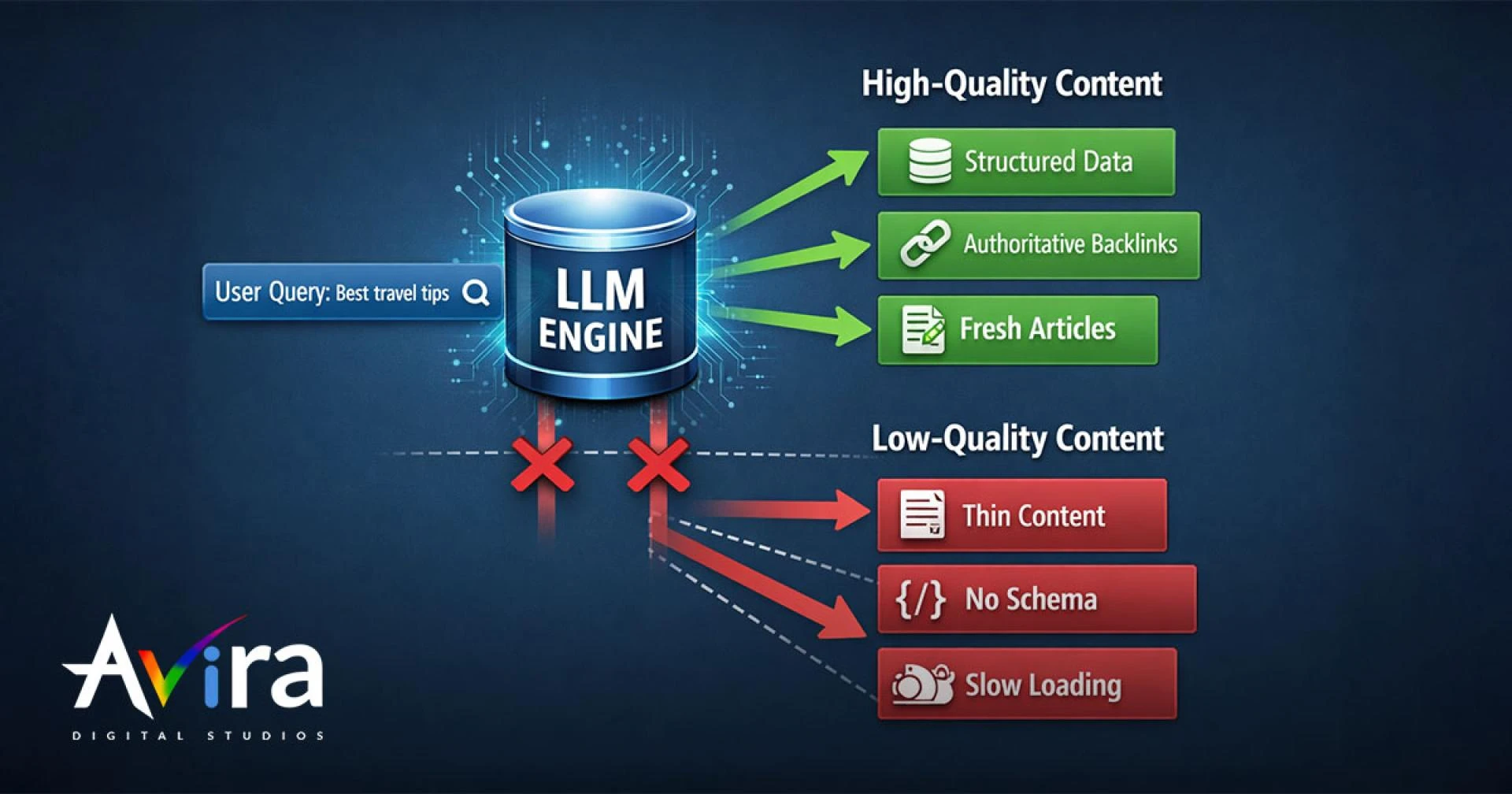
- Shallow content. The page touches on a topic but never really digs in. AI looks for depth.
- Technical problems. Slow loading or broken links stop AI crawlers before they even start.
- The authority gap. No one links to you. No one mentions your brand. AI has no context for who you are.
It is not personal. It is just how the math works.
Strategies That Help Websites Appear in AI Search Answers
So what actually helps?
First, pick a topic and own it. Do not write one article and move on. Write ten. Cover the basics, the advanced stuff, the common mistakes, the case studies. Build a library around that subject until you become the obvious resource.
Second, get your name out there. Guest posts, interviews, collaborations. When other sites talk about you, the AI takes notice. It builds a web of trust around your brand.
Third, clean up your technical foundation. Schema markup, fast hosting, clean code. These things matter more now than they used to.
Working with someone who understands this landscape helps. A good SEO Expert in India can spot gaps you might miss and guide you toward the changes that actually move the needle.
The Growing Importance of AI Search Optimization for Websites
Here is the reality. AI search is not waiting for anyone. It is already here, and it is only going to become more common. If your website is not optimized for how these systems think, you are leaving visibility on the table.
AI search optimization is about making sure your content speaks the language these models understand. It is about being clear, being referenced, and being useful. The websites that figure this out now will be the ones cited later. The ones that wait will keep wondering why no one finds them.
If you’re wondering how content strategies are evolving with AI search, Want to understand this in depth? Check out our LLM SEO guide for 2026.
FAQs About AI Search Visibility
1. How do AI search engines select sources?
AI search engines look at patterns. Which sites get mentioned by others? Which ones have clear, structured content? Which ones stay consistent over time? The answers to those questions guide their choices.
2. Can SEO help websites appear in AI search results?
Yes, but the approach shifts. Traditional SEO still matters for crawling and indexing. But now you also need to think about how your brand is perceived across the web. It is a broader game.
3. What type of content works best for AI search?
Content that answers real questions works best. Tutorials, comparisons, deep dives, and well-researched guides tend to perform well. Fluff pieces and thin posts do not.
Conclusion
Nobody likes being invisible. When your content does not show up in AI answers, it feels like you are doing something wrong. But most of the time, it is just a mismatch between what you built and what the AI needs.
By focusing on depth, clarity, and reputation, you close that gap. Avira Digital Studios, an SEO Expert in India, helps businesses understand these shifts and adjust their approach accordingly.
It takes time. It takes consistency. But the websites that put in that work will be the ones showing up when people ask questions.
Ready to get your site seen in AI search? Contact Avira Digital Studios today for a consultation.