
Walk into almost any growing business and you will see the same pattern.
A business owner finishes a client meeting only to discover several missed calls waiting to be returned. A receptionist is switching between emails, calendars and spreadsheets while trying to answer customer enquiries. A sales team is manually following up prospects because no automated process exists. None of these tasks are particularly difficult, yet together they consume hours that could have been spent winning new business or strengthening customer relationships.
This is not a question of poor management.
It is often the result of success.
As organisations grow, so does the complexity of running them. New customers bring more enquiries. More enquiries create additional administration. Additional administration demands more software, more processes and more time. Before long, many businesses find themselves working harder simply to maintain the same level of service.
Technology was meant to simplify work.
Ironically, it has sometimes done the opposite.
Many organisations now rely on separate systems for customer records, appointment scheduling, marketing campaigns, communication and reporting. While each platform performs its own function, employees often spend valuable time moving information between systems that were never designed to work together.
The result is not only inefficiency.
It is inconsistency.
A customer submits an enquiry but does not receive an immediate response. A follow-up email is forgotten because someone became busy. An appointment reminder is missed. None of these situations happens intentionally, yet each one affects the customer experience and, ultimately, business performance.
These are everyday challenges that rarely make headlines, but they influence how organisations grow.
Artificial intelligence is increasingly being discussed as the answer to these problems. Yet much of the public conversation focuses on what AI might achieve in the future rather than how it can solve practical business challenges today.
For many organisations, the real opportunity lies in removing repetitive work that prevents people from focusing on higher-value responsibilities.
Consider a small accounting practice during tax season.
The team spends most of the day advising clients, preparing documents and meeting important deadlines. Meanwhile, incoming enquiries continue to arrive through email, telephone calls and online forms. Existing clients ask routine questions about appointments and documentation, while prospective clients want to know whether the firm is accepting new business.
None of these enquiries should be ignored.
Yet responding immediately is not always possible when advisers are already occupied.
An intelligent system that acknowledges enquiries, gathers relevant information, schedules appointments and keeps communication moving allows professionals to concentrate on the work that requires experience, judgement and personal relationships.
The same principle applies well beyond accountancy.
A healthcare clinic managing appointment requests, a property agency arranging viewings, a retailer responding to customer questions, or a manufacturer coordinating enquiries from distributors all face similar operational pressures. Every industry has routine processes that consume time without creating additional value.
This is where practical artificial intelligence has begun to demonstrate its greatest strengths.
Not by replacing people.
By allowing people to focus on what they do best.
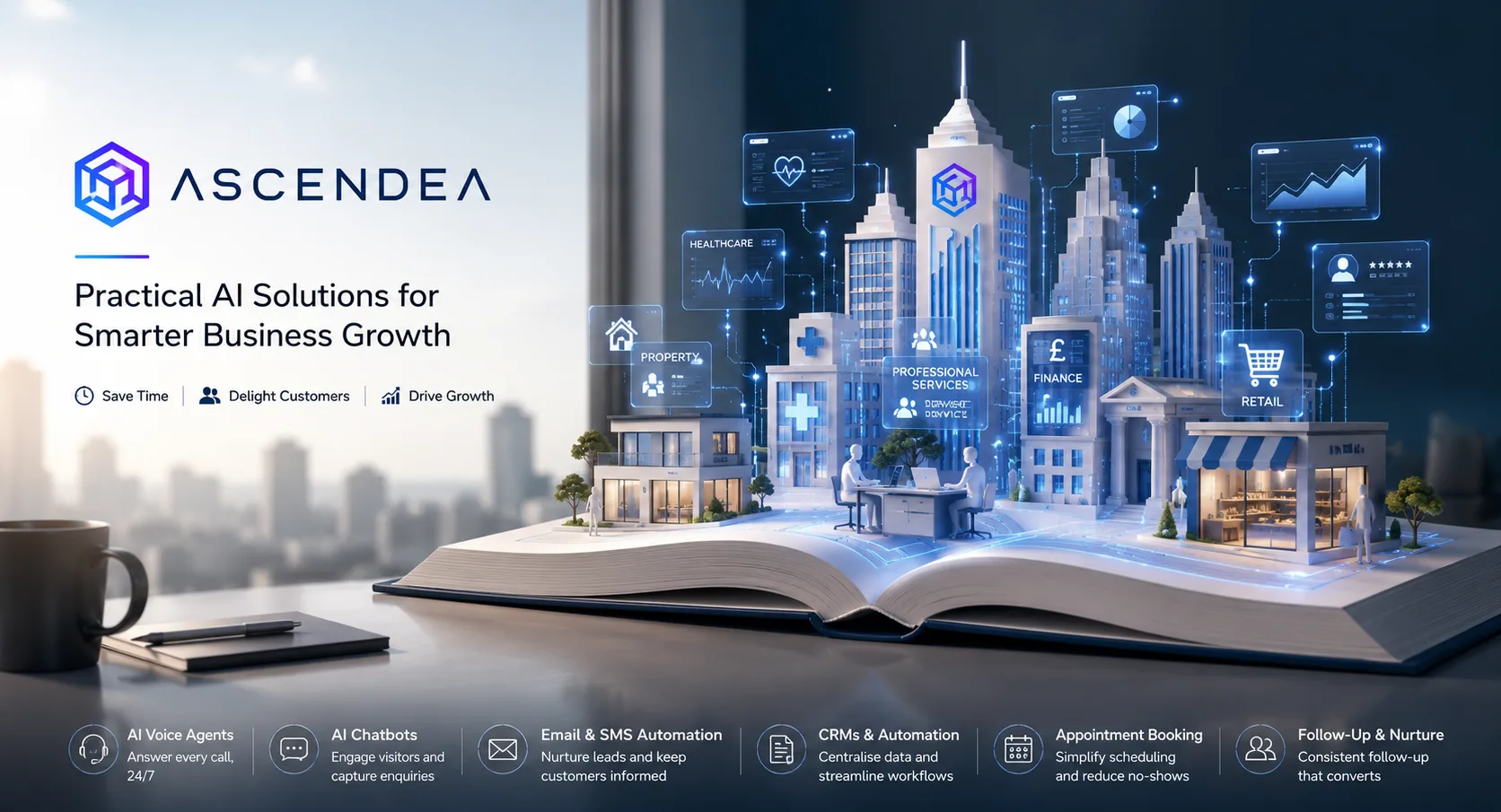
Ascendea, a UK-based AI consultancy, works with small and medium-sized enterprises to identify where automation can genuinely improve day-to-day operations. Rather than encouraging businesses to adopt technology for its own sake, the company focuses on practical improvements that simplify customer communication, reduce repetitive administration and create more connected workflows.
Its proprietary platform brings together customer communication, AI-powered automation, CRM management, workflow automation, appointment scheduling, lead management and marketing into a single connected environment. Instead of asking employees to navigate multiple disconnected applications, businesses gain a clearer view of customer interactions while reducing the manual effort required to keep operations moving.
The objective is not to automate every decision.
It is to automate the routine processes that slow businesses down.
A customer who submits an enquiry late in the evening receives an immediate acknowledgement instead of waiting until the next working day. A prospective client requesting information is guided through the next step without relying on manual intervention. Existing customers receive timely reminders and follow-up communication that might otherwise be delayed during busy periods.
These improvements may appear modest when viewed individually.
Collectively, they create a more reliable customer experience and allow organisations to operate with greater consistency.
Perhaps one of the biggest misconceptions surrounding artificial intelligence is that it requires businesses to completely redesign how they work.
In reality, the most successful implementations often involve refining existing processes rather than replacing them. Technology becomes an extension of the team rather than an obstacle to overcome.
As Rob Arnold, Founder of Ascendea.ai, explains:
"Businesses grow because people build trust with customers. Technology should strengthen those relationships by removing unnecessary administration, giving teams more time to focus on the conversations and decisions that genuinely make a difference."
That philosophy reflects a broader shift taking place across industries.
Artificial intelligence is no longer viewed solely as an emerging technology.
It is becoming another business tool, much like accounting software, cloud storage or video conferencing once did. Its value depends not on how advanced it appears, but on how effectively it solves real operational challenges.
Business owners are not looking for technology that impresses investors.
They are looking for systems that help customers receive faster responses, enable employees to work more efficiently and provide leaders with better visibility across their operations.
The organisations achieving the greatest benefits are often those that begin with a simple question.
Where are we losing time that could be better spent serving our customers?
Answering that question frequently reveals opportunities to improve productivity without increasing headcount or adding unnecessary complexity.
Artificial intelligence cannot replace experience, empathy or professional judgement.
It can, however, reduce the repetitive work that prevents those qualities from creating their greatest value.
Businesses have always succeeded by adapting to changing customer expectations.
Today, customers expect timely communication, consistent service and organisations that are easy to do business with. Meeting those expectations increasingly depends on having systems that support people rather than slow them down.
Choosing practical AI is not about following a trend.
It is about building a business that has more time to focus on its customers, its people and its future.
To learn more about how Ascendea helps organisations implement practical AI solutions that improve business efficiency, customer engagement and operational performance, visit:
To discuss how practical AI could support your business, contact Rob Arnold via WhatsApp: +44 7887 846680