If you've ever walked down to your basement after a heavy spring storm and felt that telltale dampness in the air, you already know something Rochester homeowners learn sooner or later: water doesn't ask permission. It finds the smallest crack, the weakest seam, the lowest point in your foundation, and it settles in. By the time you notice a stain on the wall or a musty smell near the stairs, the damage is often already spreading below the surface.
That's why waterproofing isn't a luxury upgrade — it's a maintenance essential, especially in a region defined by freeze-thaw cycles, heavy snowmelt, and clay-rich soil that expands and contracts with the seasons. And when moisture problems go unaddressed long enough, they stop being a basement issue and become a structural one, which is when homeowners start searching for foundation repair in Rochester, NY.
The Connection Between Water and Foundation Damage
Most people think of waterproofing and foundation repair as two separate services. In reality, they're deeply connected — almost inseparable. Water is one of the primary forces behind foundation deterioration. When soil around a home becomes saturated, it exerts hydrostatic pressure against basement walls and footings. Over months and years, that pressure can cause bowing walls, shifting slabs, and cracks that widen with every freeze-thaw cycle.
According to industry inspection data widely cited by home inspection associations, a large majority of basements will experience some form of water intrusion during the life of the home. In climates like Western New York's, where snow accumulation in winter is followed by rapid spring thaw, that risk is even higher. The ground simply doesn't have time to dry out before the next wave of moisture arrives.
Why Rochester's Climate Makes This Worse
Rochester sits in a lake-effect snow belt, which means homes here deal with more freeze-thaw cycles per year than much of the country. Each cycle causes soil to expand and contract, gradually working cracks open in concrete and mortar joints. Combine that with clay soil — common throughout Monroe County — which absorbs and holds water longer than sandy or loamy soil, and you have a near-perfect recipe for foundation stress.
This is why local expertise matters so much. A waterproofing company that only works in dry climates may not fully appreciate how aggressively Rochester's seasonal swings attack a foundation. Choosing a team with hands-on regional experience is one of the most important decisions a homeowner can make.
Signs Your Home Needs Professional Attention
Not every problem is obvious right away. Here are some of the early indicators worth watching for:
Interior Warning Signs
- Musty odors or rising humidity in the basement
- Efflorescence (white, chalky residue) on concrete walls
- Peeling paint or bubbling drywall near the floor line
- Doors and windows that stick or no longer close flush
Exterior Warning Signs
- Visible cracks in the foundation wall, especially horizontal ones
- Soil pulling away from the foundation perimeter
- Pooling water near the base of the house after rain
- Sloping or sinking sections of the yard close to the structure
Horizontal cracks deserve special attention. Vertical cracks are often the result of normal concrete curing and settling, but horizontal cracking usually signals that hydrostatic pressure is actively pushing against the wall — a sign that waterproofing and structural reinforcement may both be needed.
What Effective Waterproofing Actually Involves
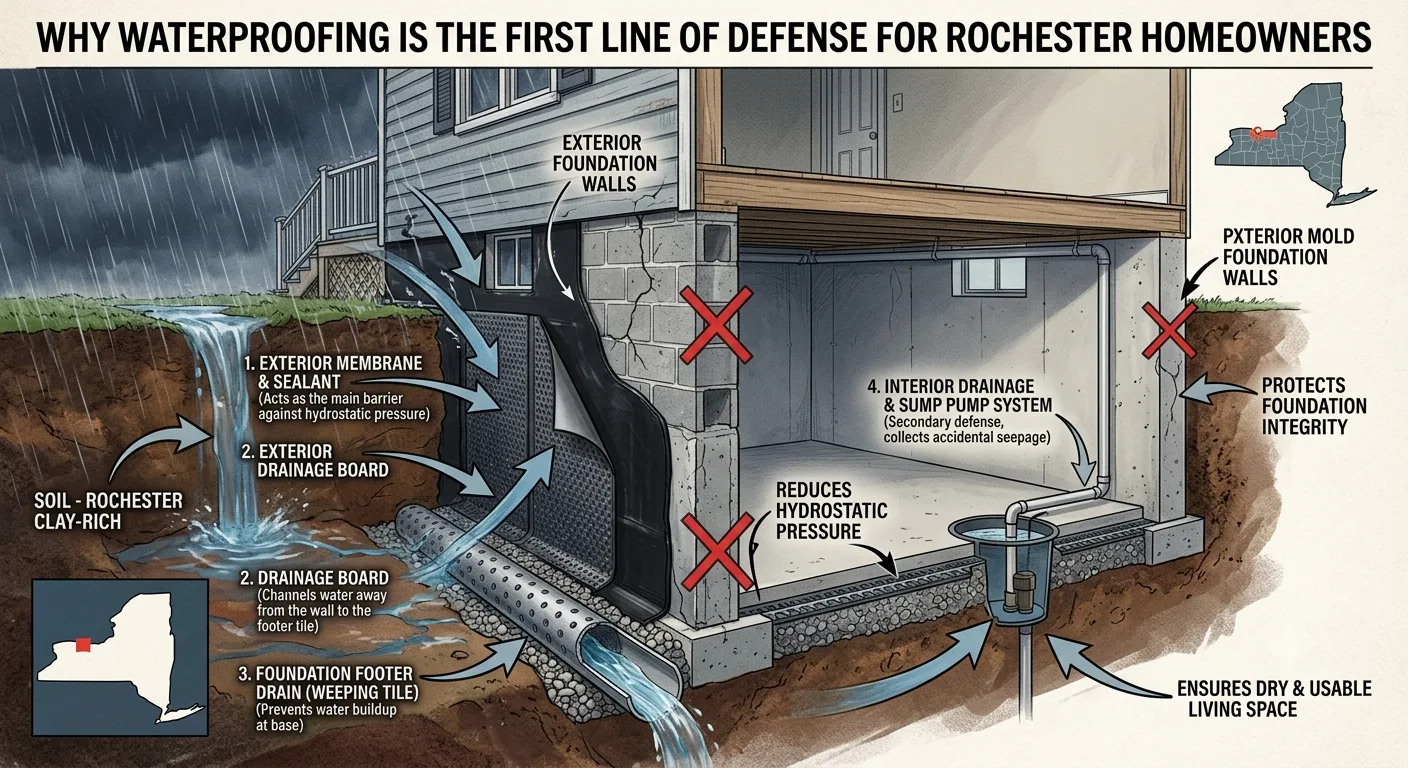
A quality waterproofing plan isn't a single product — it's a system designed around how water moves through and around your home. Reputable contractors typically evaluate and combine several strategies:
- Interior drainage systems that capture water at the point where the wall meets the floor and redirect it to a sump pump before it can pool.
- Sump pumps and battery backups to actively remove water during heavy storms or power outages, when the risk of flooding is highest.
- Exterior grading and downspout extensions to keep surface water moving away from the foundation instead of toward it.
- Crack injections, using epoxy or polyurethane, to seal existing cracks and prevent further water entry.
- Vapor barriers and dehumidification to control humidity levels and reduce the risk of mold growth in enclosed spaces.
The right combination depends on your home's age, soil type, grading, and the severity of existing damage — which is why a proper inspection should always come before any recommendation.
When Waterproofing Isn't Enough: Understanding Foundation Repair
Sometimes moisture control alone isn't sufficient, particularly if a foundation has already begun to shift or crack under pressure. This is where structural solutions come in, and it's a major reason homeowners specifically look for foundation repair in Rochester, NY rather than waterproofing alone.
Common structural interventions include:
- Carbon fiber wall reinforcement to stabilize bowing walls without full excavation
- Steel or helical piers to lift and support settling foundations
- Wall anchors that use soil tension outside the home to counteract inward pressure
- Push piers driven to load-bearing soil or bedrock to stop further settlement
These are not do-it-yourself projects. Structural work requires an accurate read on soil conditions, load distribution, and the specific type of movement affecting the home — the kind of assessment that comes from years of local field experience, not a one-size-fits-all national playbook.
Why Professional Experience Matters More Than a Quick Fix
It's tempting to patch a crack with a tube of hardware-store sealant and call it done. Sometimes that's genuinely enough. But when a homeowner is dealing with recurring moisture, visible wall movement, or a foundation showing multiple warning signs at once, a surface-level fix can mask a deeper problem rather than solve it.
A trustworthy contractor will walk you through what they're seeing, explain why they're recommending a specific solution, and be upfront about what does — and doesn't — need immediate attention. That transparency is worth as much as the repair itself, because it helps homeowners make informed decisions instead of paying for more than they need or, worse, less than the situation requires.
Protecting Your Home for the Long Haul
Waterproofing and foundation repair aren't one-and-done tasks; they're part of an ongoing relationship between your home and the ground it sits on. Regular inspections, especially after major storms or unusually harsh winters, can catch small issues before they become expensive ones. Keeping gutters clear, maintaining proper grading, and monitoring for new cracks are simple habits that go a long way toward preserving your foundation's integrity.
For homeowners in and around Rochester, the combination of heavy seasonal moisture and clay-heavy soil means foundation health deserves ongoing attention rather than a reactive approach. Whether you're dealing with a damp basement, visible cracking, or you simply want peace of mind before the next freeze-thaw season arrives, working with an experienced local team — one that understands both waterproofing systems and structural foundation repair in Rochester, NY — is the surest way to keep your home standing strong for decades to come.