
Utility infrastructure is changing rapidly, but some technologies continue to remain relevant because they combine practical performance with straightforward installation and long service potential. Wooden utility poles are a good example.
They have been used for decades across electricity distribution and telecommunications networks, and treated timber poles continue to support overhead infrastructure in both established and developing utility systems.
The main reason is not simply tradition. Properly selected and treated wooden poles can offer a useful combination of structural performance, ease of handling, adaptable sizing and preservative protection for outdoor service.
Jauda Koks specialises in impregnated wooden poles for overhead power and telecommunication lines. Its current production range uses Scots Pine (Pinus sylvestris) and includes Tanalith E-treated and creosoted poles in lengths from 7 to 16 metres.
Why Wooden Poles Continue to Be Used in Utility Networks
Overhead distribution systems need support structures that can withstand conductor loading, environmental exposure and the mechanical demands of installation and maintenance.
Utilities can choose among several pole materials, including wood, steel and concrete. Each has advantages depending on the project.
Wooden poles remain relevant because they are relatively straightforward to transport, handle and install. This can be particularly useful in rural or remote areas where access for heavy lifting equipment may be limited.
Their natural material properties also make them suitable for several utility applications, including:
· electricity distribution
· telecommunication networks
· rural electrification
· street lighting
· railway-related infrastructure
· other overhead utility installations
Jauda Koks identifies impregnated wooden poles for electricity and communication lines as its main product category.
Why Treatment Is Essential for Wooden Utility Poles
Untreated timber is naturally vulnerable to biological deterioration.
Moisture, fungi, insects and microorganisms can gradually weaken timber exposed to outdoor conditions, particularly where the pole is installed in the ground.
For this reason, utility-grade poles are typically preservative-treated before installation.
Jauda Koks uses pressure impregnation to protect timber against decay and biological attack. The manufacturer describes a full-cell, or Bethell, process in which the wood is placed inside a pressure vessel, air and moisture are removed under vacuum, and preservative is then forced into the wood under pressure.
This treatment is one of the main reasons treated wooden poles can remain in service for extended periods in outdoor environments.
How the Impregnation Process Works
The quality of the final pole depends heavily on timber preparation before preservative treatment.
Jauda Koks outlines several stages in its production process.
The timber is first selected and peeled. After rough peeling removes the bark, smooth peeling produces the finished surface. The poles are then sorted according to diameter and length.
Before impregnation, moisture content needs to be reduced so the preservative can penetrate the wood more effectively. Jauda Koks states that poles are dried to approximately 25–28% moisture content before treatment. Natural drying can take several months, while a dedicated kiln can accelerate drying for urgent orders.
Only after the drying stage are the poles placed in pressure-treatment autoclaves.
This demonstrates why treated timber poles should be evaluated not only by timber species but also by the quality of the treatment process.
Why Scots Pine Is Commonly Used
Jauda Koks uses Scots Pine, or Pinus sylvestris, as the raw material for its utility poles.
The manufacturer notes that the sapwood structure of Scots Pine allows preservative to penetrate effectively, making it suitable for pressure-treated pole production. Latvian pine also grows relatively slowly under northern European conditions, producing closely spaced growth rings and dense timber.
For utility applications, material consistency is important because the pole needs to support mechanical loads while remaining suitable for preservative treatment.
Raw timber quality therefore forms the first stage of reliable pole production.
Tanalith E and Creosote Treatment Options
Different utility projects can specify different wood preservatives.
Jauda Koks currently produces both Tanalith E-treated poles and creosoted poles.
Tanalith E is used in a large proportion of the company's current production, while creosoted poles are also manufactured for markets where that treatment is specified.
Preservative selection should depend on project standards, local regulations, environmental conditions and utility requirements.
The treatment method should therefore be part of the technical pole specification rather than treated as a secondary purchasing detail.
Pole Length and Size Need to Match the Application
Wooden poles are not supplied as a single universal size.
Jauda Koks manufactures poles from approximately 7 to 16 metres in length, with 9 to 12 metre poles representing a common demand range.
The actual pole selected for a project depends on factors such as:
· overhead-line height
· conductor arrangement
· span length
· ground clearance
· mechanical loading
· pole function
· structure geometry
· local design standards
An intermediate support pole, for example, may have a different loading requirement from a terminal or angle pole.
This makes correct structural specification essential when selecting power line poles.
Wooden Poles Can Simplify Transport and Installation
One practical advantage of timber poles is relatively straightforward handling compared with heavier structural alternatives.
Lower structural weight can reduce transport and lifting requirements in some projects, particularly where access roads are limited or distribution networks extend through rural terrain.
This does not mean wooden poles can be installed without suitable equipment or engineering controls.
Pole length, weight, soil conditions and lifting requirements still need to be considered during planning.
However, the practical handling characteristics of timber remain one of the reasons utilities continue to use wooden electrical poles in widespread distribution and telecommunication networks.
Maintenance and Inspection Still Matter
Preservative treatment significantly improves resistance to decay, but treated poles still need periodic inspection.
Utility operators should monitor:
· ground-line condition
· signs of physical damage
· cracking or splitting
· insect attack
· surface deterioration
· mechanical loading changes
· condition of attached line hardware
The ground-line area deserves particular attention because this section experiences both soil contact and changing moisture conditions.
Inspection programmes help utilities identify deterioration before structural performance is significantly affected.
This principle applies to all utility-pole materials: material selection does not eliminate the need for asset management.
Wooden Poles Can Support Both Power and Telecommunications
Utility poles frequently support more than one type of infrastructure.
Jauda Koks manufactures its poles for both electricity lines and communication lines, reflecting their use across traditional utility and telecommunications networks.
This versatility can be useful in infrastructure projects where overhead communications and electrical distribution share similar support requirements.
Telecommunication networks may also use wooden poles for:
· fibre-optic routes
· copper communication cables
· rural telecom infrastructure
· network extensions
· roadside communication systems
The pole still needs to be engineered for the actual loading and attachment configuration.
Durability Depends on More Than the Timber Species
It is easy to assume that one species of wood will automatically produce a durable utility pole.
In practice, pole durability depends on several connected factors:
· raw timber quality
· drying
· peeling and surface preparation
· preservative penetration
· preservative type
· treatment quality
· installation method
· soil conditions
· environmental exposure
· inspection and maintenance
This is why production process and quality control matter.
Jauda Koks states that it has around five decades of experience in wood impregnation and currently operates manufacturing capacity of approximately 50,000–100,000 poles per year.
International Standards Support Consistent Specification
Utility poles are often procured against recognised technical standards.
Jauda Koks states that its wooden poles are manufactured according to international requirements including BS 1990, NF C 67-100, ANSI O5.1 and EN 351, depending on the project and market.
Dutco Tennant's current wooden-pole listing also identifies BS 1990 Part 1 as an applicable wooden-pole standard and specifies Pinus sylvestris as the timber species for its listed range.
Standards help create consistency around dimensions, strength, treatment and other technical criteria.
Even so, utilities should always review the exact project specification rather than relying only on a general standards reference.
Where Wooden Poles Can Be Particularly Practical
Wooden poles can be suitable across a range of applications, but they are often especially practical where infrastructure needs to be expanded efficiently.
Typical examples include:
· rural distribution networks
· remote electrification programmes
· telecommunication extensions
· street lighting
· lower-voltage overhead networks
· temporary or staged utility development
· locations where transport access is constrained
They may also be useful where utilities value relatively straightforward field handling and replacement.
Material selection should still be based on lifecycle requirements, structural loading and environmental conditions.
Environmental Considerations Are Evolving
Wooden poles are based on a renewable natural material, but environmental performance should be assessed across the complete lifecycle rather than assumed from the material alone.
Timber source, preservative chemistry, pole service life, maintenance requirements and end-of-life treatment all influence the environmental profile.
Jauda Koks is currently participating in a multi-year project focused on the sustainable reuse of removed utility poles, running from 2025 to 2028.
This reflects a wider industry trend toward considering what happens to infrastructure materials after they leave service, rather than focusing only on initial installation.
Wooden Poles in Modern Utility Infrastructure
Modern grid development is often associated with advanced conductors, digital monitoring, automation and smart substations.
Structural support remains just as important.
Distribution lines still require poles capable of maintaining clearances and supporting conductors through wind, temperature change and mechanical loading. Telecommunication networks still need dependable routes for fibre and other cables.
For these applications, wooden transmission poles and distribution poles continue to offer a practical structural option when correctly engineered, treated and maintained.
The continued use of timber poles therefore reflects practical utility requirements rather than resistance to newer infrastructure technologies.
Wooden Utility Infrastructure at Middle East Energy 2026
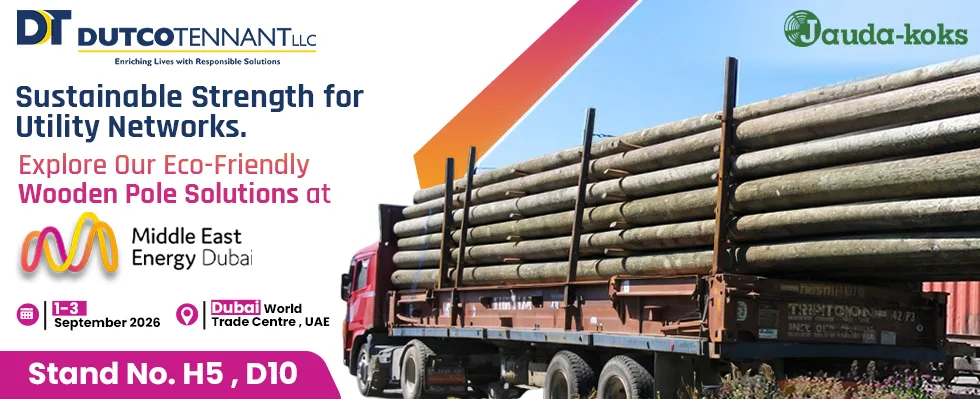
Utility infrastructure and distribution technologies will form part of the wider industry discussions at Middle East Energy 2026, scheduled for 1–3 September 2026 at Dubai World Trade Centre, UAE.
Dutco Tennant LLC is scheduled to exhibit at Hall H5, Stand D10, with Jauda Koks wooden poles forming part of its utility infrastructure portfolio. Dutco Tennant's current event information identifies Jauda Koks as a manufacturer of impregnated wooden utility poles for electrical distribution and telecommunication networks.
Jauda Koks's current product range includes impregnated wooden poles produced from Scots Pine, with Tanalith E and creosote treatment options and lengths ranging from approximately 7 to 16 metres.
For utilities, consultants and infrastructure planners attending MEE 2026, wooden poles provide a useful reminder that effective grid development does not depend only on advanced electronics and automation.
Reliable utility infrastructure also requires practical structural components that can be transported, installed, maintained and matched to real network conditions.
When high-quality timber, effective preservative treatment, appropriate structural design and regular inspection are combined, treated wooden poles can continue to provide a practical support solution for electrical distribution and telecommunication networks.