Quick Answer: To put God first in a busy life, start each day with prayer and a short Scripture reading before you check your phone. Then name your worries and hand them to God. Jesus taught this in Matthew 6:33, when He told His listeners to seek God’s kingdom first and trust Him with daily needs. Small, steady habits work better than big gestures.
Worry rarely arrives alone. It shows up with a full calendar, a long to-do list, and a phone that never stops buzzing. If that sounds familiar, you are in good company. Jesus spoke to the same problem, and He gave a clear answer: putting God first. This guide explains what He meant, what putting God first does not mean, and six small habits you can start this week.
In this guide:
- Why worry grows in a busy life
- What Jesus said about worry in Matthew 6
- What putting God first actually means
- Six habits for a busy life
- Peace is a fruit, not a performance
- When worry feels too heavy
- Common mistakes
- Frequently asked questions
Why Worry Grows in a Busy Life
A full schedule leaves little room to think. You move from one task to the next, and your mind fills the gaps with “what if.” What if the bill comes early? What if the meeting goes badly? What if my child struggles at school? Each question feels small, but together they pile up.
Busyness also hides worry. When you stay in motion, you do not notice how tense you feel. Then the house goes quiet at night, and every unfinished task speaks at once. Many people lie awake at that hour, running through lists they cannot finish.
Scripture treats worry as a real burden, not a character flaw. Psalm 94:19 says, “In the multitude of my thoughts within me thy comforts delight my soul.” The writer admits that his thoughts multiplied. He also says that God’s comfort reached him in the middle of them.
So the goal is not to feel nothing. The goal is to know where to take what you feel. That is where putting God first begins.
What Jesus Said About Worry in Matthew 6
Jesus gave His longest teaching on worry in the Sermon on the Mount (Matthew 6:25 to 34). He spoke to ordinary people who wondered where their next meal would come from. Their worries were practical, and He treated them that way.
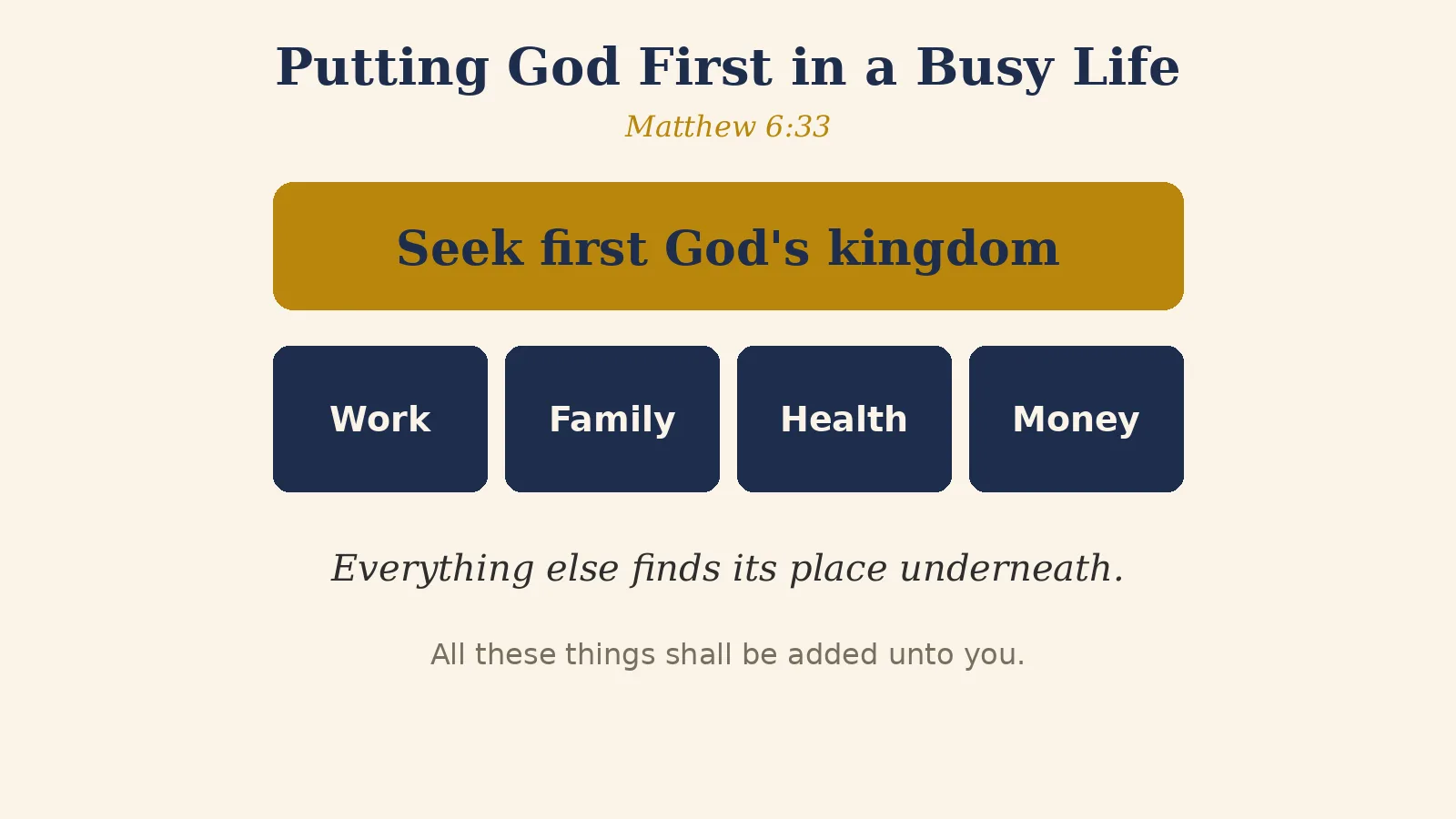
He made four points. First, He asked listeners to look at the birds. They do not farm or store grain, yet the Father feeds them (verse 26). Second, He pointed to wildflowers, which God clothes with more beauty than Solomon’s royal robes (verses 28 and 29). Third, He said the Father already knows what His children need (verse 32). Finally, He gave the center of the teaching in verse 33: “But seek ye first the kingdom of God, and his righteousness; and all these things shall be added unto you.”
Many readers want to know what it means to seek first the kingdom of god in real life. The verse does not tell you to ignore your job or your bills. It tells you what to put in first place. When God holds that place, other needs stop competing for it.
Jesus ended with a practical line: “Take therefore no thought for the morrow... Sufficient unto the day is the evil thereof” (verse 34). In the KJV, “take no thought” means do not be anxious. Handle today’s work today, and trust God with tomorrow.
Image 2: matthew-6-worry-teaching-in-order.png
Alt text: Matthew 6:25 to 34 in order for putting God first: do not worry, look at the birds, look at the flowers, seek first the kingdom, take tomorrow one day at a time
What Putting God First Actually Means
Putting God first does not mean quitting your job to pray all day. It does not mean ignoring bills, skipping family time, or feeling guilty about every minute you spend on something else. Most people who feel that guilt end up more anxious, not less.
Instead, putting God first means that He gets the first and best of your attention, and that every other task finds its place under that. Think of a dinner table. If you set the main dish first, the sides fit around it. If you start with the sides, the main dish never fits.
Luke 10:38 to 42 shows the difference. Martha welcomed Jesus into her home and then spent the visit in the kitchen. She felt pulled in many directions. Jesus told her, “Martha, Martha, thou art careful and troubled about many things: But one thing is needful.” He did not scold her work. He pointed her back to the one thing that steadied everything else.
That “one thing” looks different for each person. For one, it might be a quiet morning. For another, it might be a prayer while commuting. Either way, putting God first starts with a choice, not a feeling.
Six Habits for Putting God First in a Busy Life
Putting God first does not need a perfect routine. It needs a few small habits that you can keep when life gets loud. Try these six.
1. Start with a ten-minute morning resetBefore you open your phone, take ten minutes. Pray briefly, read one short passage, and write down one thing you want to remember. Mark 1:35 says that Jesus rose “a great while before day” to pray in a quiet place. If the Son of God made room for prayer in a busy ministry, so can you.
Image 3: ten-minute-morning-reset-putting-god-first.png
Alt text: Ten-minute morning reset for putting God first: pray, read, name one worry, pick one task
Vague worry grows. Named worry shrinks. Say it plainly in prayer: “I am afraid about the rent,” or “I worry about my son’s grades.” Then give it to God. First Peter 5:7 tells believers to cast “all your care upon him; for he careth for you.”
3. Pray with thanksgivingPaul wrote from prison, and he knew worry well. In Philippians 4:6 and 7, he gave a short plan. Bring every request to God “with thanksgiving,” and “the peace of God, which passeth all understanding, shall keep your hearts and minds through Christ Jesus.” Thanksgiving matters because it moves your eyes from what is missing to what God has already done.
4. Read one passage, not a stackMany busy people quit Bible reading because the goal feels huge. Shrink it. Paul told Timothy to study to show yourself approved, and that charge calls for steady effort, not long hours. Five to ten verses a day, read slowly, will do more for you than a full chapter you rush through.
5. Do the next right taskWorry lives in the future. Obedience lives in the present. When your mind races, ask what the next right task is, and do only that. Jesus said tomorrow has its own troubles. You cannot solve them today, and you were not meant to.
6. Protect one slower stretch each weekJesus said in Mark 2:27, “The sabbath was made for man, and not man for the sabbath.” Rest is a gift, not a reward for finishing everything. Choose one evening or one afternoon each week to slow down. Turn off notifications, share a meal, and pray without a deadline.
Peace Is a Fruit, Not a Performance
Many believers treat peace like a skill they must earn. They try harder, fail, and feel worse. Scripture describes peace differently. Galatians 5:22 lists it as part of the fruit of the Spirit: “love, joy, peace, longsuffering...” Fruit grows from a healthy root. It does not come from straining.
That is good news for a busy person. You do not manufacture calm by willpower. Instead, you stay close to God through prayer, Scripture, and honest conversation, and peace grows over time. Readers who want a closer look can read this guide to the fruit of the spirit verse and see how each quality grows.
Growth takes time. Some days you will feel calm, and other days you will feel anxious. Neither one cancels your faith. Keep returning to the habits of putting God first, and trust that God works in small steps.
Image 4: worry-loop-versus-prayer.png
Alt text: Instead of a worry loop, putting God first means praying with thanksgiving and letting God’s peace guard your heart
When Worry Feels Too Heavy
Ordinary worry and a deeper struggle are not the same. If your anxiety keeps you from sleeping, working, or caring for your family, talk with a doctor or a licensed professional. Seeking medical help is wise, and it does not show a lack of faith. Many believers pray and get treatment at the same time.
Biblical counseling can walk beside you in the spiritual side of what you carry. It listens, prays, and applies Scripture to the situation in front of you. It is a ministry of care, not clinical treatment, so it works alongside medical care and does not replace it.
If you ever feel hopeless or think about harming yourself, call or text 988 in the United States right away. In another country, call your local emergency number. You do not have to carry this alone.
Common Mistakes When Trying to Put God First
A few patterns trip up many sincere people:
- Treating it as a checklist. A prayer you rush through to check a box does not calm anything. Slow down and speak honestly.
- Waiting for a perfect schedule. Life never clears out. Start with ten minutes in the mess you have.
- Feeling guilty about missed days. One missed morning changes nothing. Pick up the next day.
- Hiding the worry. Silence makes it grow. Tell God, and tell one trusted friend.
Frequently Asked Questions
What does it mean to put God first in your life?It means giving God the first and best of your attention, time, and trust, and letting every other task fit under that. You still work, care for family, and pay bills. The difference is that you start each day with God instead of fitting Him in last.
Does the Bible say not to worry?Yes. Jesus said in Matthew 6:25 not to be anxious about life, food, or clothing. He did not scold people for having needs. He pointed them to the Father who knows those needs and promised to provide for those who seek His kingdom first.
How do I put God first when I am too busy?Putting God first starts small. Spend ten minutes each morning on prayer and one short Bible passage before you check your phone. Name your worries to God, do the next right task, and keep one slower stretch each week. Small habits last longer than big plans.
What does “seek first the kingdom of God” mean?It means making God’s rule and His ways your top priority, ahead of money, comfort, or reputation. Jesus said that when you do, God supplies what you need. The phrase invites trust. It does not demand perfect performance.
Is worry a sin?Scripture calls believers not to be controlled by worry, but it also shows God’s patience with anxious people. Jesus gently said, “O ye of little faith,” and then kept teaching. Treat worry as a signal to pray, not as a reason for shame.
Take the Next Step
If worry keeps crowding out your peace, or putting God first feels hard, you do not have to sort it out by yourself. Glory Deliverance offers Virtual Biblical Counseling rooted in Scripture for individuals, couples, and families. Sessions run by secure video, and each one starts with prayer. Biblical counseling is a ministry of care, not clinical treatment.
You do not need to have everything figured out to begin. You only need to be willing to talk. Visit the Glory Deliverance site to schedule a session, or send a prayer request if you would like someone to pray with you first.