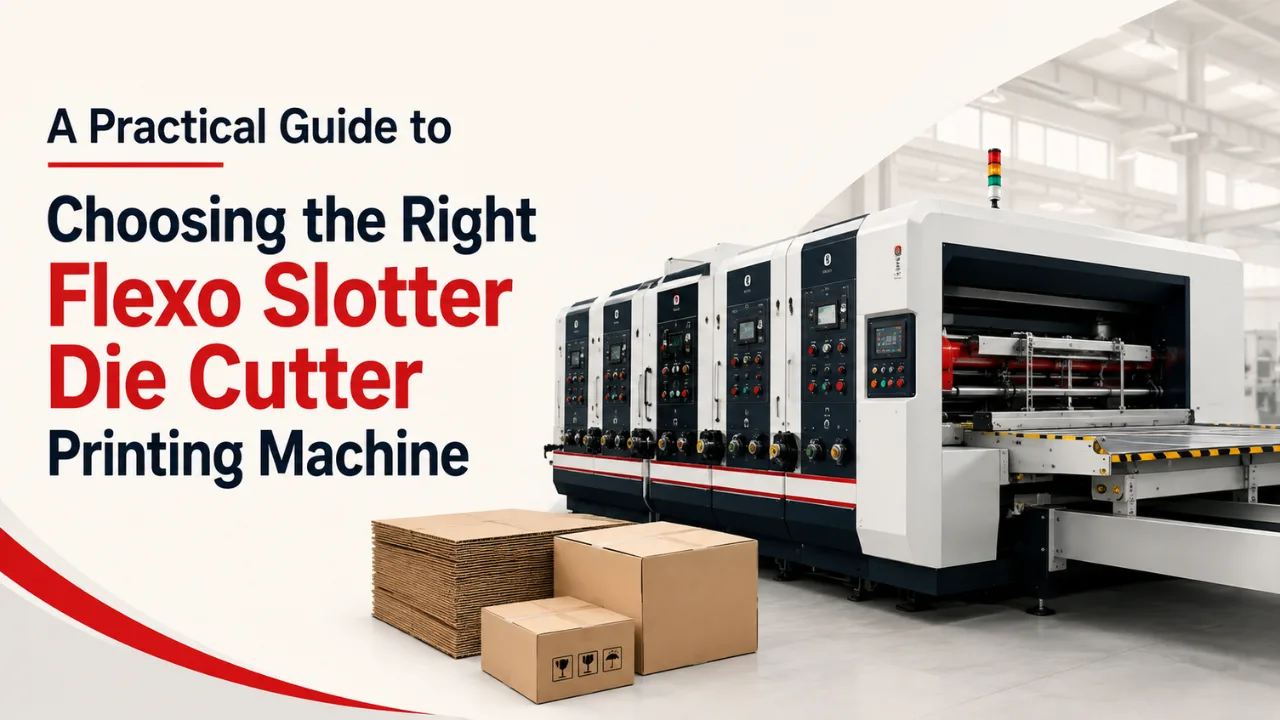
Buying a flexo slotter die cutter printing machine is not a decision you make once and move on from.
It shapes your plant's output quality for years. It determines what client types you can serve. It sets the print standard your brand delivers. And it directly affects how efficiently your production line runs every single shift.
Get it right and the machine becomes the backbone of your box converting operation. Get it wrong and you deal with inconsistent print quality, slotting errors, slow changeovers, and clients who notice the difference.
This guide covers every practical factor you need to consider before choosing a flexo slotter die cutter printing machine for your corrugated box plant. No filler. No vague advice. Just a clear, step by step framework that helps you make the right decision for your plant.
Step 1: Understand What the Machine Actually Does
Three Operations in One Pass
Before evaluating any machine, understand what a flexo slotter die cutter printing machine actually combines.
Flexo Printing uses flexible rubber or photopolymer plates mounted on rotating cylinders to transfer ink onto the corrugated board surface. Each print station applies one colour. Multi-colour machines have multiple stations that apply colours in sequence with precise registration.
Slotting uses rotating slotting heads to cut vertical grooves into the board at precise intervals. These grooves become the fold lines for the box flaps and panels. Slotting accuracy directly affects how the box folds and whether flaps meet cleanly.
Die Cutting uses a steel cutting die mounted on a rotating cylinder to cut the board into the required box shape. This can be a standard rectangular RSC shape or a custom shape with hand holes, ventilation cut-outs, display windows, or other features.
One machine. One pass. One operator overseeing the full operation. The efficiency and quality gains over running three separate machines are significant.
Where It Sits in Your Production Line
Understanding where the machine sits in your corrugated box plant line helps you set the right speed and compatibility requirements.
Full Production Flow:
Paper Rolls → Board Plant → Slitter Scorer → Sheeting Machine → Flexo Slotter Die Cutter Printing Machine → Folder Gluer or Stitching Machine → Finished Boxes
The machine receives corrugated board sheets from the sheeting machine and outputs finished, printed, slotted, and die-cut box blanks to the folder gluer or stitching machine. Its speed must match both upstream and downstream machines.
Step 2: Define Your Production Requirements
Start with Your Daily Output Target
This is the step most buyers skip. They go straight to machine comparisons without a clear picture of what their plant actually needs. The result is a machine that either exceeds requirements and costs more than necessary or falls short and creates bottlenecks.
Your daily output target is the starting point. How many boxes does your plant need to produce per shift? This single number drives almost every other machine specification. A plant producing 10,000 boxes per day needs a very different machine than one targeting 50,000 boxes per day.
Be honest about this number. Do not plan for your theoretical maximum. Plan for your realistic current order volume with room for growth over the next two to three years.
Know Your Board Width and Sheet Size Range
Before speaking to any corrugated box making machine manufacturers, know the smallest and largest board widths and sheet sizes your plant needs to process.
Every machine has a minimum and maximum board width capacity. If your largest box requires a wider sheet than the machine can handle, you cannot produce that box. If your smallest box requires a sheet smaller than the machine's minimum, feeding problems and quality issues follow.
List every box size you currently produce. Add every box size you plan to produce within the next two years. Use this list as a non-negotiable specification when evaluating machines.
Be Clear on Your Print Colour Requirement
How many print colours do your clients need? Do you print plain boxes with a single colour barcode? Two colour regional branding? Full four or six colour retail graphics?
Your answer to this question determines how many print stations your machine needs. And print stations are one of the biggest cost drivers in a flexo slotter die cutter printing machine. Buying more stations than you need wastes capital. Buying fewer than you need limits your client market.
Understand Your Box Type Mix
Do you produce only standard RSC boxes? Or do you also produce custom shapes with hand holes, display windows, or ventilation openings?
Custom shapes require die cutting capability. Standard RSC boxes use simpler slotting and straight cuts. If your box mix includes custom shapes, confirm the machine's die cutting section is suited to the complexity of shapes you need to produce.
Clarify Your Automation Level and Budget
Semi-automatic machines cost less and need more manual involvement. Fully automatic machines cost more and deliver higher speed and consistency with fewer operators.
Your budget sets the boundary. Your daily volume and labour cost determine which automation level makes financial sense. Get clarity on both before you start evaluating machines.
Write all of this down. Share it with every manufacturer you speak to. A manufacturer who does not ask you these questions is selling you a machine. A manufacturer who does is helping you solve a production problem.
Step 3: Choose the Right Number of Print Stations
Single Colour: The Entry Point for Industrial Box Plants
A single colour flexo slotter die cutter printing machine suits plants whose clients need plain boxes with basic text, barcodes, or simple one-colour identification marks. Industrial manufacturers, auto parts companies, and warehousing operations typically fall into this category.
The upfront cost is the lowest of all configurations. But the client market is limited. If your growth plan involves serving FMCG brands, retail chains, or e-commerce businesses, a single colour machine will become a constraint within one to two years.
Two Colour: Basic Branding Without the Premium Price
A two colour machine lets you print simple logos, brand names, and basic product information in two colours. This covers most regional FMCG clients and smaller retail brands who want their boxes to look professional without investing in full colour printing.
This is often the right starting configuration for plants that are building a branded packaging client base. It costs less than a multi-colour machine and serves a wide enough client market to generate strong revenue while you grow.
Three to Four Colour: The Branded Packaging Sweet Spot
Three and four colour configurations are where the margin story for flexo slotter die cutter printing machines gets compelling. These machines can print full brand colour schemes, product imagery, nutritional information, and marketing graphics that meet national FMCG and retail packaging standards.
Clients at this level pay significantly more per box than industrial or plain box clients. The investment in additional print stations pays back through better margins per box rather than volume alone. For most growing corrugated box plants targeting the FMCG and retail market, a four colour machine is the right configuration.
Five to Six Colour: Premium and Export Packaging
Five and six colour machines deliver print quality that competes with offset printing for richness and detail. Premium retail brands, international exporters, and e-commerce companies with strong brand identity requirements operate at this level.
The investment is the highest in the range. The client market that justifies this investment is real but takes time to develop. Most plants that invest in five or six colour machines have already built a strong branded packaging client base at the three or four colour level and are moving upmarket to serve premium accounts.
The Practical Rule on Print Stations
Match your current client base. Add one level above for the clients you are actively pitching. Do not invest in six colour capability if your pipeline does not include premium packaging accounts. Do not hold yourself back with a single colour machine if FMCG clients are already approaching you.
Step 4: Decide Between Semi-Automatic and Fully Automatic
The Automation Decision Is About Your Business Stage
The terms semi-automatic and fully automatic are often used loosely. Here is what they actually mean for your daily operations and your long-term cost per box.
FactorSemi-AutomaticFully AutomaticSize Change MethodManual tool adjustmentElectronic servo adjustmentSetup Time Per Job30 to 60 minutes10 to 20 minutesPrint RegistrationOperator dependentMachine maintained precisionOutput SpeedLowerHigherLabour RequiredMore operatorsFewer operatorsQuality ConsistencyVariable by operatorHigh and consistentUpfront CostLowerHigherLong Term Labour CostHigherLowerBest Daily VolumeUp to 20,000 boxes20,000 boxes and aboveClient SuitabilityLocal, regional, varied runsLarge FMCG, national, exportSemi-Automatic Is the Right Starting Point When
Your daily volume is below 20,000 boxes. Your order mix changes frequently with many different box sizes. Your budget is limited and the lower upfront cost of a semi-automatic machine is the priority. You are a new or growing corrugated box plant still building your client base and your order volume does not yet justify the higher investment of full automation.
Starting semi-automatic is not a compromise. It is a practical business decision. Many successful corrugated box plants started with semi-automatic machinery and upgraded to fully automatic when their volumes and revenue made the investment straightforward.
Fully Automatic Makes Sense When
Your daily volume is above 20,000 boxes consistently. You run long production runs for large FMCG, export, or national brand clients where quality consistency is non-negotiable. Labour costs in your area are rising and reducing your margins. You are pitching for accounts where buyers will visit your plant and assess your production capability before placing orders.
In 2026, with labour costs increasing steadily across India, the financial case for full automation is stronger than it has been at any point in the past decade. The upfront cost difference between semi and fully automatic machines is recovering faster than it used to through labour savings alone.
Step 5: Evaluate Board Width and Sheet Size Capacity
The Specification Most Buyers Overlook
Board width capacity is one of the most important specifications on a flexo slotter die cutter printing machine. And it is the one most buyers overlook until they discover the machine cannot handle a box size they need.
Board width refers to the maximum width of corrugated board sheet the machine can process. If your largest box requires a sheet wider than the machine's maximum board width, you cannot produce that box.
Sheet length refers to the maximum length of sheet the machine can process. This must cover your longest box blank.
Minimum sheet size matters for plants producing small boxes. Some machines cannot handle very small sheets efficiently without adjustment.
Before finalising your machine choice, list every box size you currently produce and every box size you plan to produce within the next two years. Confirm the machine's board width and sheet size range covers every one of them.
Buying a machine that cannot handle your full size range forces you to either turn away orders or invest in a second machine much sooner than planned.
Step 6: Check Changeover Speed Between Box Sizes
Why Changeover Time Matters More Than Most Buyers Realise
In a corrugated box plant producing a variety of box sizes for different clients, changeover time between production runs adds up quickly.
Every time you change box size, you need to:
- Adjust slotting head positions for the new slot pattern
- Set up the die cutting section for the new box shape
- Adjust print registration if the print design changes
- Set feed margins and guides for the new sheet size
On a manual machine this process takes 30 to 60 minutes per changeover. On a fully automatic machine with servo-driven size adjustment it takes 10 to 20 minutes.
If your plant changes box size eight times per shift, the difference between a 45-minute and a 15-minute changeover is four hours of production time per shift. That is four hours of lost boxes every day.
How to Evaluate Changeover Speed
Ask the manufacturer specifically:
- What is the typical changeover time between box sizes on this machine
- Is size change electronic or manual
- How many operators are needed during changeover
- Can print plates be changed without stopping the machine
Get these answers in writing. Vague claims about fast changeover are not enough. You need specific time figures you can verify with existing users of the machine.
Step 7: Evaluate the Ink System Quality
What the Ink System Determines
The ink system is what determines print consistency across a production run. A poor ink system produces prints that vary in density, colour, and coverage from the first sheet to the last.
Key ink system components to evaluate:
Anilox Roll The anilox roll controls how much ink is transferred from the ink fountain to the printing plate. The anilox is engraved with microscopic cells that hold and transfer a precise volume of ink. The quality of the anilox engraving directly affects ink consistency and print density.
Ask about the anilox specification in lines per centimetre and cell volume. Higher line counts give finer print quality. Confirm the anilox is easy to clean and maintain.
Ink Doctoring System The doctor blade removes excess ink from the anilox surface, leaving only the ink held in the engraved cells. A well-designed doctoring system maintains consistent ink application across the full width of the anilox.
Ink Viscosity Control Flexographic ink viscosity must be maintained within a specific range for consistent print quality. Ask whether the machine has an ink viscosity monitoring system or whether this is managed manually by operators.
Ink Containment Ink containment systems reduce ink waste and keep the press environment clean. Better ink containment means lower ink cost per thousand boxes printed and a cleaner working environment.
Step 8: Assess After-Sales Support Before You Buy
The Support Question Most Buyers Ask Too Late
Most buyers spend 90 percent of their evaluation time comparing machine specifications and purchase prices. They spend almost no time evaluating after-sales support until they need it and cannot get it.
A flexo slotter die cutter printing machine is a complex piece of equipment. It has mechanical, pneumatic, and electronic systems that require regular maintenance and occasional expert attention. When something goes wrong mid-production run, the speed of your manufacturer's response determines how much output you lose and how much revenue disappears while the machine is idle.
Engineer Availability and Response Time
The first question to ask every corrugated box making machine manufacturers candidate is simple. If my machine breaks down tomorrow, how quickly can one of your engineers reach my plant?
The answer tells you a great deal about the manufacturer's after-sales infrastructure. A manufacturer with service engineers based across India can reach most locations within 24 to 48 hours. A manufacturer with a single service base may take several days.
Get a specific answer. Not a vague commitment. Ask which service locations they operate from and which one would cover your plant. And ask existing clients whether the manufacturer's engineers actually show up within the stated timeframe.
Spare Parts Availability and Lead Time
Critical wear parts on a flexo slotter die cutter printing machine include printing plates, anilox rolls, doctor blades, slotting heads, and cutting dies. These parts wear over time and need replacing as part of normal operation.
Ask your manufacturer specifically which parts wear most frequently and how quickly they can supply replacements. Parts stocked domestically can be dispatched within a day or two. Parts sourced from overseas can take weeks.
A machine that sits idle for two weeks waiting for an imported spare part is not just a maintenance problem. It is a revenue problem and a client relationship problem.
Operator Training and Knowledge Transfer
A flexo slotter die cutter printing machine produces its best results when operators understand it well. Operators who are properly trained set up jobs faster, maintain print quality more consistently, catch problems before they affect production, and keep the machine in better condition through correct daily maintenance.
Ask whether operator training is included with machine supply or charged separately. Confirm how many days of training are provided and whether it is conducted on-site at your plant or at the manufacturer's facility. And ask whether follow-up training or refresher support is available after the initial commissioning period.
Step 9: Compare Total Cost of Ownership Not Just Purchase Price
Why the Purchase Price Is Only the Beginning
Two machines with similar purchase prices can have very different total costs over five years of operation. Buyers who evaluate only the purchase price often find that the machine they thought was the cheaper option turns out to be the more expensive one when all costs are accounted for.
Total cost of ownership covers everything from the day you place the order to the end of the machine's working life. Understanding each component helps you compare machines on a real financial basis rather than just on the price tag.
The Upfront Cost Components
The purchase price is the most visible cost. But upfront costs also include installation and commissioning, which reputable corrugated box making machine manufacturers include in the supply package, and operator training, which should also be included. If a manufacturer charges separately for installation or training, factor these into the purchase price for a fair comparison.
Power connection costs, if your plant needs an upgraded electrical supply to handle the machine's connected load, are another upfront cost that buyers frequently overlook until the installation team arrives.
The Ongoing Operating Costs That Add Up
Monthly electricity consumption is a significant ongoing cost. Ask every manufacturer for the power consumption specification in kilowatts and calculate your monthly electricity cost at your local rate. Across five years this difference between two machines can be substantial.
Consumables including printing plates, inks, and doctor blades are a regular operating expense. The cost and replacement frequency of these items varies between machine designs. Printing plates that last longer and inks that deliver more boxes per litre reduce your per-box production cost.
Wear parts including anilox rolls, slotting heads, and cutting dies need replacement over the machine's life. Ask for the typical replacement schedule and cost of each critical wear part before you buy.
The Hidden Cost of Downtime
Unplanned machine downtime has a cost that most buyers never calculate before purchasing. Every hour your flexo slotter die cutter printing machine is idle is lost production. Lost production means delayed orders, potential client penalties, and the fixed cost of your plant continuing to run with no output to show for it.
A machine that is slightly more expensive upfront but breaks down rarely and gets serviced quickly when it does will almost always cost less over five years than a cheaper machine with frequent downtime and slow service response.
Ask manufacturers what their average machine uptime is across their installed base. Ask existing clients whether downtime has been a problem. This information is more valuable than any specification sheet.
Step 10: Visit the Manufacturer Before You Buy
Why a Factory Visit Matters
If you are investing Rs. 15 lakh or more in a flexo slotter die cutter printing machine, visiting the manufacturer's facility before placing an order is worth the time and travel cost.
A factory visit lets you:
- See the machine running in production rather than on a showroom floor
- Check the quality of manufacturing and assembly
- Meet the engineering and service team who will support you after purchase
- See the spare parts stocking level and dispatch capability
- Ask technical questions directly to the engineers who build the machines
A manufacturer who discourages factory visits is a manufacturer with something to hide. A manufacturer who welcomes visits and can show you machines running at customer sites is one worth serious consideration.
Why Natraj Machines for Your Flexo Slotter Die Cutter Printing Machine
Natraj Machines, headquartered in Palwal, Haryana, is one of India's most established corrugated box making machine manufacturers. ISO 9001:2008 certified, the company has decades of experience manufacturing corrugated box making machinery including a comprehensive range of flexo slotter die cutter printing machines.
Their range covers:
- Single colour to six colour configurations
- Semi-automatic and fully automatic operation
- Board widths from small to wide format
- Servo-driven precision size change systems
- Complete after-sales support including installation, commissioning, operator training, and spare parts
Every machine is engineered in-house, tested thoroughly before delivery, and backed by a service network that covers corrugated box plants across India and international markets.
Whether you are equipping your first corrugated box plant or upgrading an existing converting line to higher print quality and greater output capacity, Natraj Machines has the experience and product range to match the right machine to your specific requirements.
Visit natrajmachines.com/machines/category/printing to explore their full flexo slotter die cutter printing machine range. Visit natrajmachines.com to learn more about their complete corrugated box making machinery and plant solutions.
Final Thoughts
Choosing the right flexo slotter die cutter printing machine is not complicated when you follow a clear process.
Define your production requirements first. Choose the right number of print stations for your client base. Decide between semi-automatic and fully automatic based on your volume and labour cost. Confirm board width and sheet size capacity covers your full product range. Evaluate changeover speed, ink system quality, and after-sales support before you commit.
And always compare total cost of ownership not just purchase price.
The right machine from the right corrugated box making machine manufacturers will serve your corrugated box plant well for a decade or more. It will define the print quality your clients see. It will determine the accuracy of every blank your folder gluer receives. And it will be the machine your plant grows around.
Take the time to choose it right.