
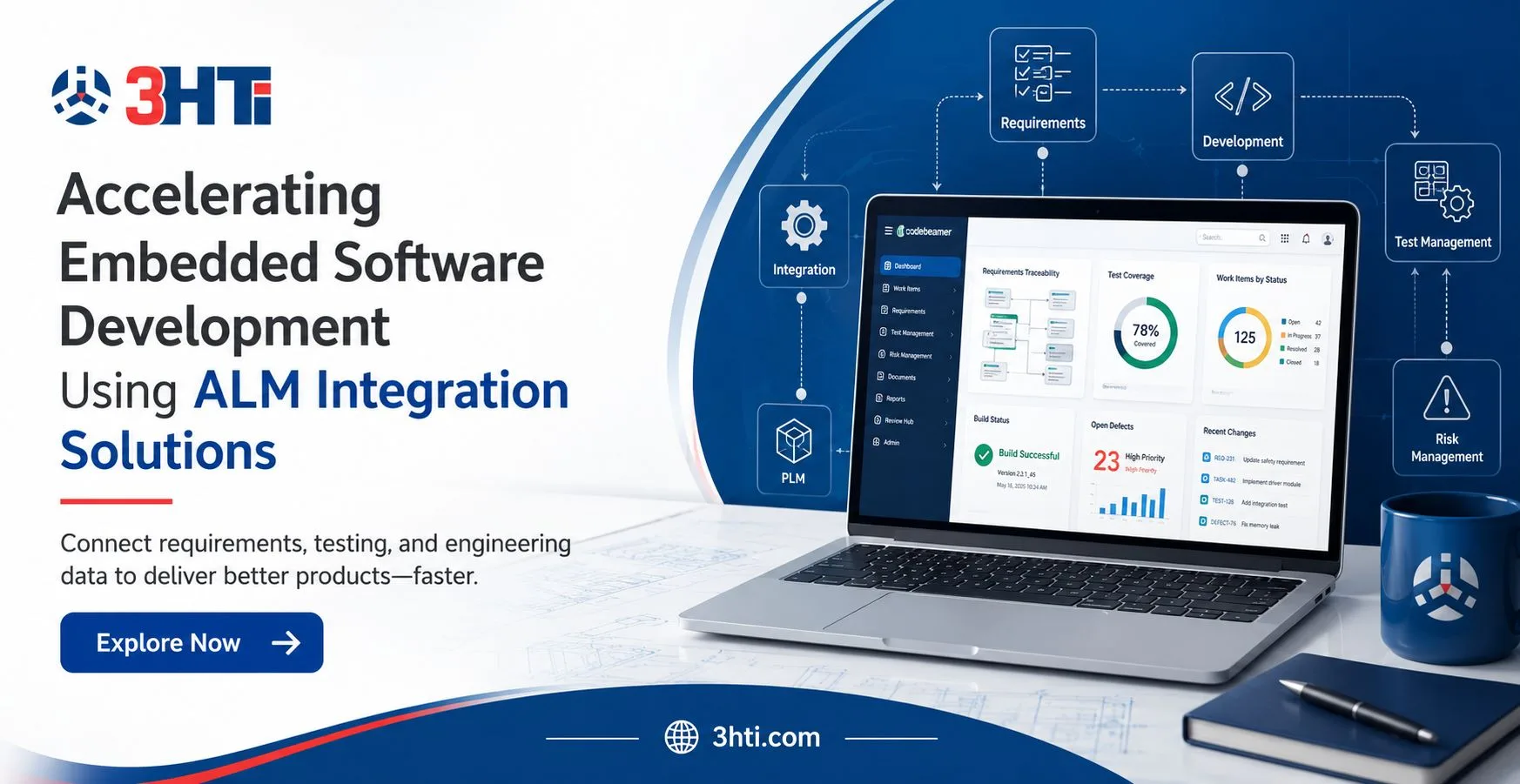
Embedded software has become the defining element of modern products, from advanced driver-assistance systems and connected medical devices to industrial automation equipment and aerospace control systems. As software complexity grows, engineering organizations must coordinate requirements, design, testing, hardware development, regulatory compliance, and product releases across multiple teams. ALM integration solutions address this challenge by connecting Application Lifecycle Management (ALM) with engineering, quality, and Product Lifecycle Management (PLM) systems, creating a unified development environment that accelerates delivery without sacrificing traceability or quality.
Direct Answer
ALM integration solutions connect Application Lifecycle Management platforms with engineering, PLM, testing, quality, and enterprise systems to provide end-to-end visibility throughout software development. Their primary function is to synchronize requirements, development activities, validation, and product data, enabling engineering teams to improve collaboration, maintain traceability, reduce manual processes, and accelerate embedded software delivery.
Why Embedded Software Development Requires Integrated Lifecycle Management
Developing embedded software differs significantly from building traditional enterprise applications.
Software functionality must remain synchronized with hardware revisions, electrical designs, firmware, safety requirements, and manufacturing milestones. A software modification may affect mechanical components, electronic control units, system requirements, regulatory documentation, and customer validation procedures.
When lifecycle information is managed in isolated systems, engineering teams commonly experience:
- Inconsistent requirements
- Manual synchronization between software and hardware teams
- Delayed impact analysis
- Duplicate documentation
- Incomplete traceability
- Longer validation cycles
An integrated lifecycle approach reduces these bottlenecks by ensuring every engineering discipline works from connected information rather than isolated data repositories.
What Are ALM Integration Solutions?
ALM integration solutions establish controlled data exchange between lifecycle management platforms and enterprise engineering applications.
Rather than replacing existing tools, they connect them into a coordinated engineering ecosystem.
Typical integrations include:
- Requirements management
- Source code repositories
- Test management platforms
- Product Lifecycle Management (PLM)
- Configuration management
- Continuous Integration/Continuous Deployment (CI/CD)
- Quality Management Systems (QMS)
- Enterprise Resource Planning (ERP)
This connected environment allows engineering decisions to propagate automatically across related systems, reducing manual intervention while improving consistency.
How ALM Integration Accelerates Embedded Software Development
End-to-End Requirements Traceability
One of the most significant advantages of integrated ALM is complete traceability.
Every requirement can be linked to:
- Functional specifications
- Development tasks
- Source code changes
- Test cases
- Validation results
- Defect reports
- Product releases
If a requirement changes, engineering teams can immediately determine which software components, validation activities, and hardware systems require updates.
This dramatically reduces the effort involved in change impact analysis.
Improved Cross-Disciplinary Collaboration
Embedded products require mechanical, electrical, electronics, firmware, and software engineers to work simultaneously.
Without integrated lifecycle management, each discipline often maintains separate documentation and approval workflows.
ALM integration solutions create a shared engineering environment where stakeholders access synchronized lifecycle information without duplicating data.
The result is faster engineering decisions, fewer communication gaps, and improved product consistency.
Faster Verification and Validation
Testing frequently becomes a bottleneck when development artifacts are disconnected.
Integrated ALM platforms automatically associate test cases with approved requirements and software builds, allowing teams to:
- Measure requirement coverage
- Identify failed validations
- Prioritize unresolved defects
- Generate traceability reports
Instead of manually compiling validation evidence, engineering teams obtain real-time visibility into project quality.
The Role of Codebeamer ALM in Integrated Engineering
Codebeamer ALM is widely used by organizations developing safety-critical and highly regulated products because it combines requirements management, risk management, testing, quality assurance, and workflow automation within a single platform.
When integrated with enterprise engineering systems, Codebeamer enables organizations to:
- Maintain bidirectional traceability
- Automate approval workflows
- Link requirements to verification activities
- Improve audit readiness
- Simplify change management
- Support Agile, Hybrid, and V-Model development methodologies
These capabilities are particularly valuable for organizations managing large engineering programs with multiple product variants.
Why ALM Services Matter Beyond Software Deployment
Technology alone does not improve engineering performance.
Professional ALM services ensure lifecycle platforms are configured to support actual business processes rather than forcing organizations to adapt to default software configurations.
Comprehensive ALM services typically include:
- Process assessment
- Lifecycle architecture design
- Workflow configuration
- Requirements modeling
- User training
- Migration planning
- Governance framework development
- Continuous platform optimization
Organizations that invest in process alignment alongside technology generally experience higher adoption rates and more sustainable operational improvements.
Integrating ALM with PLM for Complete Product Traceability
Software increasingly defines product functionality, but product success also depends on mechanical designs, manufacturing information, and engineering documentation.
PLM implementation services extend lifecycle visibility beyond software by integrating ALM platforms with Product Lifecycle Management systems.
This integration enables organizations to connect:
- Product structures
- Bills of Materials (BOMs)
- CAD revisions
- Software requirements
- Configuration baselines
- Engineering change requests
- Manufacturing documentation
The result is a digital thread that connects every stage of product development, from concept through production and service.
Supporting Enterprise Digital Transformation
Many manufacturers view ALM modernization as part of a broader engineering transformation initiative.
Digital transformation consulting services help organizations evaluate existing engineering processes, identify operational bottlenecks, and implement connected lifecycle management strategies.
Rather than focusing solely on software deployment, successful transformation programs address:
- Process standardization
- Data governance
- Organizational change management
- Platform interoperability
- Engineering performance measurement
- Continuous improvement
This broader perspective ensures lifecycle integration supports long-term business objectives rather than isolated technology upgrades.
Practical Example
Consider an automotive manufacturer developing advanced driver-assistance software.
Mechanical engineering manages CAD models within a PLM platform, while software teams use independent development tools and quality teams maintain separate testing documentation.
A software requirement changes following safety testing. Without lifecycle integration, engineering managers spend days determining affected software modules, hardware revisions, and validation activities.
After implementing ALM integration solutions using Codebeamer ALM integrated with the organization's PLM environment, every requirement becomes linked to software development tasks, engineering changes, validation evidence, and product configurations.
As a result:
- Impact analysis becomes significantly faster.
- Traceability improves across engineering disciplines.
- Validation activities become more efficient.
- Audit preparation requires substantially less manual effort.
- Product releases become more predictable.
A frequent implementation mistake is integrating software platforms without first defining standardized engineering workflows, resulting in automated inconsistencies rather than operational improvements.
Common Challenges During ALM Integration
Organizations often underestimate the organizational aspects of lifecycle integration.
Typical challenges include:
- Poorly defined requirements management processes
- Legacy engineering data with inconsistent structures
- Limited stakeholder alignment
- Fragmented governance policies
- Duplicate engineering records
- Inadequate user training
- Custom integrations without long-term maintenance strategies
Successful implementations prioritize business process maturity alongside technical integration.
Best Practices for Implementing ALM Integration Solutions
Organizations achieve the strongest outcomes when lifecycle integration is treated as an engineering transformation initiative rather than an IT project.
Recommended practices include:
- Define standardized lifecycle processes before implementation.
- Establish enterprise-wide requirements management policies.
- Integrate ALM with PLM, quality, and engineering systems.
- Maintain complete bidirectional traceability.
- Automate change management and approval workflows where appropriate.
- Validate data quality before migration.
- Provide structured user training across engineering disciplines.
- Measure performance using lifecycle metrics such as requirement coverage, defect resolution time, and release predictability.
Organizations evaluating enterprise lifecycle modernization can explore ALM integration solutions, and implementation expertise.
ALM Integration vs Standalone Lifecycle Management
Standalone lifecycle tools provide value within individual engineering functions but often create disconnected development environments.
Integrated ALM environments establish relationships between requirements, development, testing, PLM, manufacturing, and quality management systems.
For organizations developing complex embedded products, integration offers superior traceability, improved collaboration, stronger governance, and more efficient engineering workflows.
Future Trends in Embedded Software Lifecycle Management
Embedded software development continues to evolve toward increasingly connected engineering ecosystems.
Key developments include:
- Artificial intelligence-assisted requirements analysis
- Model-Based Systems Engineering (MBSE)
- Cloud-native engineering collaboration
- Digital thread architectures
- Automated compliance reporting
- DevSecOps integration
- Digital twin connectivity
- Predictive engineering analytics
Organizations establishing integrated lifecycle management today will be better positioned to adopt these technologies while maintaining engineering consistency and regulatory readiness.
Conclusion
Embedded software development demands complete visibility across requirements, engineering changes, testing, quality, and product data. ALM integration solutions provide that visibility by connecting lifecycle platforms with enterprise engineering systems, enabling organizations to improve collaboration, reduce development risk, and accelerate product delivery.
When combined with experienced ALM services, Codebeamer ALM, PLM implementation services, and strategic digital transformation consulting services, integrated lifecycle management becomes a foundation for scalable engineering excellence and long-term product innovation.
Frequently Asked Questions
1. What are ALM integration solutions?
ALM integration solutions connect Application Lifecycle Management platforms with PLM, testing, engineering, quality, and enterprise systems to improve traceability, collaboration, and lifecycle visibility throughout software development.
2. Why are ALM integration solutions important for embedded software development?
Embedded software depends on synchronized hardware, firmware, and software development. Integration ensures requirements, engineering changes, testing, and product configurations remain aligned throughout the development lifecycle.
3. How does Codebeamer ALM support lifecycle integration?
Codebeamer ALM centralizes requirements, risk management, testing, workflows, and traceability while integrating with enterprise engineering platforms to improve collaboration and regulatory readiness.
4. What do ALM services include?
ALM services include lifecycle assessments, platform implementation, workflow configuration, requirements management, migration planning, governance development, user training, and ongoing lifecycle optimization.
5. How do PLM implementation services complement ALM integration?
PLM implementation services connect software lifecycle activities with product structures, CAD models, engineering documentation, and manufacturing information, creating end-to-end product traceability.
6. What industries benefit most from ALM integration solutions?
Aerospace & Defense, Automotive, Medical Devices, Life Sciences, and Industrial Manufacturing organizations benefit from improved engineering collaboration, compliance, traceability, and lifecycle governance.
7. What are the biggest implementation challenges?
The most common challenges include inconsistent engineering processes, poor data quality, fragmented governance, inadequate user training, and integrating technology before standardizing lifecycle workflows.