Advertising on Radio in India: Complete Guide to Radio Advertising, FM Channels, Costs & Campaign Strategies
Radio remains one of India's most recognizable and accessible advertising platforms. Even as digital marketing, social media, streaming platforms, and online video continue to grow, radio provides brands with something highly valuable: the ability to reach audiences repeatedly through a familiar and engaging audio environment.
From local retailers and restaurants to national consumer brands, real estate companies, educational institutions, automobile businesses, financial services, healthcare providers, and government campaigns, organizations across India can use radio to build awareness and communicate promotional messages.
For businesses planning a radio campaign, understanding what are radio advertisements, how radio advertising works, which FM stations are relevant, and how to choose a radio advertising agency in India is essential.
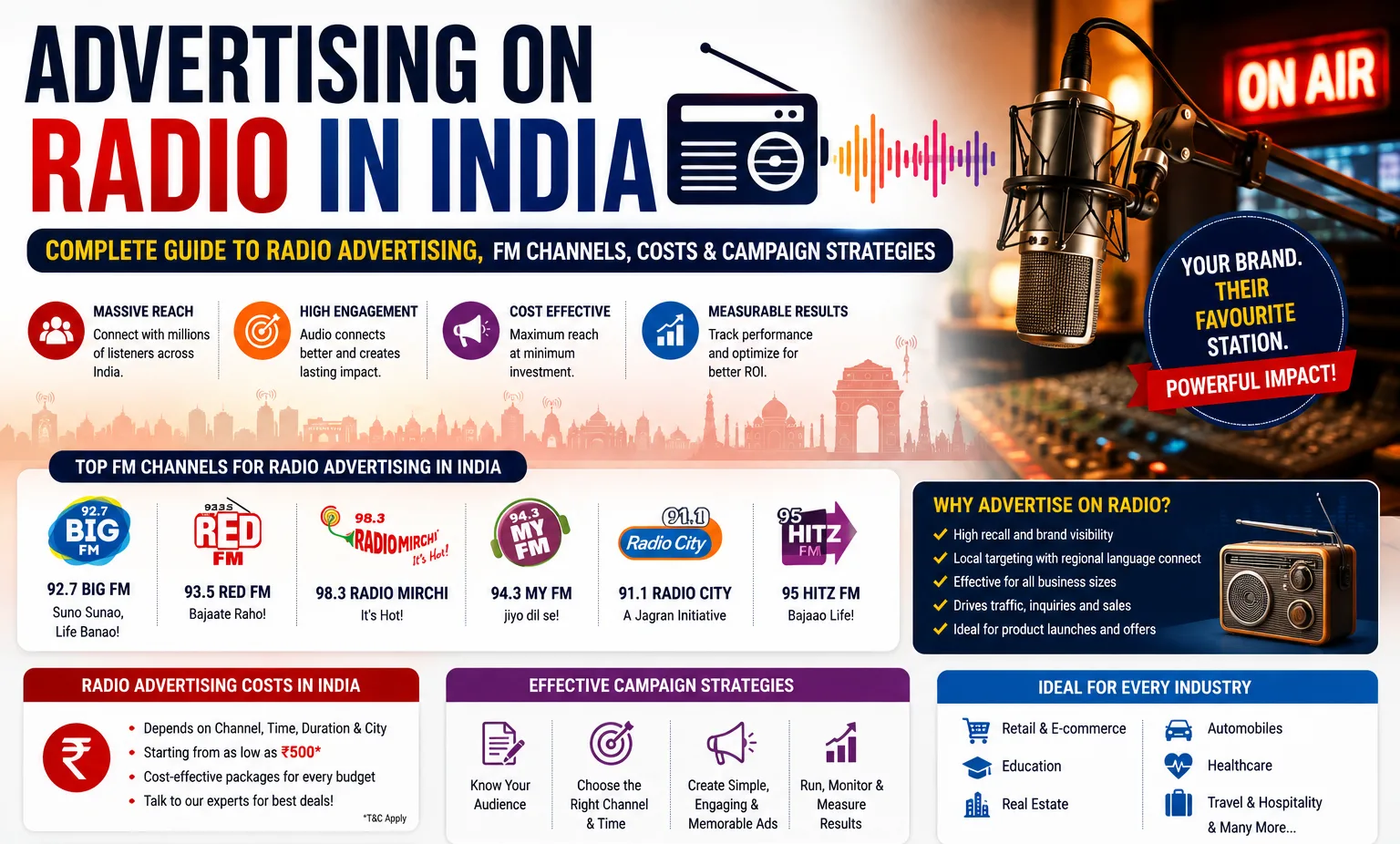
Popular FM brands such as 92.7 BIG FM advertising, 93.5 Red FM advertising, 98.3 Radio Mirchi advertising, 94.3 MY FM advertising, 91.1 Radio City FM advertising, and 95 Hit FM advertising may represent different audience environments and market opportunities. However, advertisers should always verify current station branding, frequency, programming, market availability, and advertising inventory before planning a campaign.
This comprehensive guide explores advertising on radio in India, explains different radio advertising formats, compares radio with television, discusses campaign planning, and provides practical strategies for creating effective radio campaigns.
What Are Radio Advertisements?
One of the most basic questions for businesses entering audio marketing is: what are radio advertisements?
Radio advertisements are paid promotional messages broadcast through radio stations to communicate information about a brand, product, service, event, offer, or organization.
Unlike print advertising, radio relies entirely on sound. This means advertisers need to use:
- Voice
- Music
- Sound effects
- Dialogue
- Storytelling
- Brand jingles
- Repetition
- Calls to action
A radio advertisement may be only a few seconds long or may be developed as a longer sponsored segment, depending on the station's available formats and advertising policies.
The effectiveness of a radio advertisement depends heavily on the quality of the script, voice delivery, audio production, station selection, audience targeting, frequency, and timing.
Why Advertising on Radio in India Still Matters
Advertising on radio in India offers several advantages for brands seeking mass and regional reach.
Radio can reach audiences while they are:
- Driving
- Commuting
- Working
- Shopping
- Travelling
- At home
- Running errands
- Listening through connected devices
The medium is particularly useful for local and regional campaigns because advertisers can select stations based on geographic markets.
For example, a restaurant opening in a particular city does not necessarily need a national advertising campaign. A targeted FM campaign can help the business communicate with listeners within its service area.
Similarly, a real estate company can use radio to promote a new project to audiences in the surrounding metropolitan region.
The Role of a Radio Advertising Agency in India
A professional radio advertising agency in India can help businesses manage the entire campaign process.
This may include:
- Audience research
- Station selection
- Market selection
- Campaign planning
- Script development
- Voice-over selection
- Audio production
- Media buying
- Spot scheduling
- Campaign monitoring
- Performance reporting
An agency can also help advertisers compare different FM stations and determine where their target audience is most likely to be listening.
This is important because the station with the largest audience is not automatically the best choice for every brand.
How Radio Advertising Works
A typical radio advertising campaign involves several stages.
Step 1: Define the Objective
The advertiser should establish whether the campaign is designed for:
- Brand awareness
- Product launch
- Lead generation
- Store visits
- Event promotion
- Sales
- Market expansion
- Corporate branding
- Seasonal promotions
Step 2: Identify the Audience
The target audience should be defined by:
- Location
- Age
- Profession
- Lifestyle
- Income profile
- Interests
- Purchasing behavior
Step 3: Select Stations
The agency evaluates stations based on audience profile, programming, market presence, reach, and campaign objectives.
Step 4: Create the Advertisement
A professional scriptwriter develops the message, followed by voice recording and audio production.
Step 5: Schedule Spots
The advertisement is scheduled according to the campaign's selected time bands and station inventory.
Step 6: Monitor Performance
The campaign can be evaluated through enquiries, website traffic, promotional codes, customer surveys, store visits, and other relevant indicators.
92.7 BIG FM Advertising
BIG FM advertising has historically been associated with the BIG FM radio brand and its presence in Indian radio markets.
Businesses considering advertising through this network should verify the current station name, frequency, city availability, programming structure, and commercial inventory before booking.
Radio campaigns associated with such stations can potentially be useful for brands seeking regional awareness and repeated communication.
Industries that may consider FM advertising include:
- Real estate
- Automobile
- Retail
- Education
- Healthcare
- Financial services
- Restaurants
- Consumer goods
- Entertainment
- Local services
The effectiveness of a campaign depends on selecting markets and programming relevant to the target audience.
93.5 Red FM Advertising
Red FM advertising is another commonly recognized search category among businesses looking for FM advertising opportunities in India.
Red FM has historically positioned itself around entertainment, music, presenters, and city-focused programming.
Advertisers considering a Red FM campaign should evaluate the current market presence, programming, audience profile, available advertising formats, and commercial terms.
A campaign can include traditional spot advertising or other available promotional integrations, subject to the station's current offerings.
98.3 Radio Mirchi Advertising
Radio Mirchi advertising is often associated with one of India's well-known FM radio brands.
Brands considering Radio Mirchi advertising can evaluate the station based on the specific city or market they want to target.
Radio campaigns may be useful for:
- Product launches
- Retail promotions
- Automobile campaigns
- Entertainment promotions
- Real estate
- Education
- Consumer products
- Corporate branding
Advertisers should evaluate audience relevance rather than simply choosing a station because of brand recognition.
94.3 MY FM Advertising
MY FM advertising can be relevant for brands targeting markets where the station has a presence.
Regional FM advertising can be particularly valuable for companies with city- or state-specific objectives.
For example, a business promoting a local retail outlet, educational institute, healthcare facility, property project, or restaurant can use regional radio to build awareness within a defined market.
Before booking a campaign, advertisers should confirm current frequency, city availability, audience profile, and advertising inventory.
91.1 Radio City FM Advertising
Radio City FM advertising represents another search area for advertisers interested in FM campaigns.
Radio City has historically operated across multiple Indian markets, but advertisers should verify current station details and availability for the desired city.
The campaign strategy should be based on:
- Target market
- Audience
- Programming
- Campaign objective
- Frequency
- Budget
- Advertising inventory
95 Hit FM Advertising
Hit FM advertising can be explored by brands interested in radio opportunities associated with the Hit FM brand or relevant local market.
Because station branding, frequencies, ownership, and market availability can change, advertisers should verify current commercial details before making a media purchase.
The broader lesson is important: radio media planning should always use current station information rather than relying on old directories or historical frequency listings.
Fever FM Advertising
Fever FM advertising can be an effective way for brands to reach urban audiences through FM radio. Fever FM is associated with contemporary music, entertainment, city-focused programming, and radio-jockey-led content, making it a potential platform for businesses looking to build awareness and frequency in relevant markets.
Brands can explore radio spots, sponsorships, RJ integrations, contests, branded segments, and other promotional opportunities depending on the current commercial inventory available in their target market.
Radio Advertising Formats
Radio advertising is not limited to a simple recorded commercial.
Depending on the station and market, advertisers may explore several formats.
Radio Spots
A pre-recorded advertisement is broadcast at scheduled intervals.
This is one of the most common forms of radio advertising.
Sponsorships
A brand may sponsor a particular program, segment, contest, or feature.
RJ Integrations
Radio jockeys may integrate a brand message into their programming, subject to station policies and available commercial products.
Contests
Brands can sponsor listener contests to increase interaction and engagement.
Branded Segments
A business can associate itself with a recurring content segment.
Promotional Partnerships
Radio stations may offer campaign packages combining spots, presenter mentions, events, digital promotion, or other media components.
Availability varies by station.
Radio Advertising vs Radio & TV Advertising
The phrase radio & TV advertising refers to using both audio and television media as part of an integrated campaign.
Radio and television have different strengths.
Radio vs Television
Primary Medium:
Radio — Audio
Television — Audio + visual
Creative Requirement:
Radio — Voice, music, sound
Television — Video + audio
Production Cost:
Radio — Generally lower
Television — Generally higher
Local Targeting:
Radio — Strong
Television — Strong
Storytelling:
Radio — Audio storytelling
Television — Visual storytelling
Frequency:
Radio — Can be high
Television — Depends on budget
Mobility:
Radio — Strong
Television — Primarily screen-based
Brand Demonstration:
Radio — Limited
Television — Strong
Repetition:
Radio — Strong
Television — Strong
Radio is particularly effective when a brand wants frequent reminders, local reach, or a lower-production-cost campaign.
Television can be powerful when visual demonstration and emotional storytelling are essential.
For some campaigns, combining both can create a stronger media strategy.
Benefits of Radio Advertising
1. Strong Local Reach
Radio can be highly effective for businesses targeting specific cities or regional markets.
2. High Frequency
Radio advertisements can be repeated throughout the day, helping build brand familiarity.
3. Audio Recall
Music, jingles, distinctive voices, and memorable phrases can help reinforce brand recognition.
4. Flexible Creative
A radio advertisement can be adapted quickly for different cities, offers, languages, and audiences.
5. Lower Production Complexity
Compared with television, radio generally requires less complex production.
6. Mobile Listening
Radio and audio consumption can reach people while they travel or perform other activities.
7. Local Language Communication
Regional campaigns can be developed in languages that resonate with local audiences.
Radio Advertising for Different Industries
Real Estate
Property developers can promote:
- New projects
- Launch offers
- Site visits
- Investment opportunities
- Residential properties
- Commercial projects
Radio can be particularly effective when the project targets a defined city or region.
Education
Schools, universities, coaching institutes, and professional training companies can use radio to promote admissions and programs.
Healthcare
Hospitals, diagnostic centres, clinics, and healthcare brands can use radio to increase local awareness.
Retail
Retail businesses can promote discounts, store openings, seasonal sales, and special events.
Automobiles
Dealerships can promote new models, test drives, service camps, and offers.
Restaurants
Restaurants can advertise new locations, menus, delivery services, and promotional offers.
Financial Services
Banks, insurance providers, and financial companies can use radio for awareness campaigns and product communication.
How to Write an Effective Radio Advertisement
Radio advertising is fundamentally a writing and audio-performance exercise.
Start With a Strong Hook
The first few seconds should capture attention.
A question, surprising statement, short story, or memorable sound can create interest.
Focus on One Main Message
Avoid trying to communicate too many benefits.
Use Simple Language
The listener cannot reread the advertisement.
The message should be understandable the first time.
Use Sound Strategically
Music and sound effects should support the message rather than distract from it.
Make the Brand Name Memorable
Repeat the brand name appropriately.
End With a Strong Call to Action
Tell listeners exactly what to do.
Examples include:
- Visit the store
- Call today
- Search online
- Download the app
- Book a consultation
- Visit the website
The Importance of Frequency
One of the most important concepts in radio FM advertising is frequency.
A single advertisement may create awareness, but repeated exposure can help build recall.
However, frequency should not simply mean repeating the same message endlessly.
Advertisers can rotate multiple creative versions while maintaining consistent branding.
For example:
Creative A: Introduces the brand.
Creative B: Highlights the product benefit.
Creative C: Promotes a limited-time offer.
Together, these advertisements can create a more complete communication strategy.
Selecting the Right Radio Station
The right station depends on the target audience.
Consider:
Geographic Coverage
Does the station reach your target city or region?
Audience Profile
Does the listener profile match your target customer?
Programming
Does the station's programming align with your audience?
Time Bands
When is your audience most likely to listen?
Campaign Frequency
Can the station provide sufficient repetition?
Commercial Inventory
Is the desired advertising format available?
A professional radio advertising agency in India can help evaluate these factors.
Radio Advertising During Different Time Bands
Radio stations often structure advertising around different programming periods.
For example:
Morning
Useful for reaching commuters and people beginning their day.
Midday
Potentially useful for businesses targeting shoppers, homemakers, professionals, and other listeners.
Evening
Can be valuable for commuters returning home.
Night
May suit particular audiences depending on station programming.
The appropriate schedule depends on the campaign's target audience and current station data.
How to Measure Radio Advertising
Radio campaigns can be supported by measurable response mechanisms.
Businesses can use:
- Dedicated phone numbers
- Promotional codes
- QR codes
- Dedicated landing pages
- Website traffic analysis
- Search-volume monitoring
- Store-visit surveys
- Customer questionnaires
- Lead-source tracking
For example, a retailer can create a radio-specific promotional code.
When customers use the code, the business gets an indication of campaign response.
Combining Radio With Digital Marketing
Radio does not have to operate independently.
A modern campaign can combine radio with:
- Search advertising
- Social media
- YouTube
- Display advertising
- Influencer marketing
- WhatsApp campaigns
- Website content
For example, a radio advertisement can encourage listeners to search for a branded keyword.
The digital campaign can then provide additional information and facilitate conversion.
This creates a connection between offline awareness and online action.
Radio Advertising vs Digital Advertising
Digital marketing provides detailed targeting and measurable online actions.
Radio provides mass audio reach, repetition, local familiarity, and a different type of audience engagement.
Instead of treating radio and digital as competitors, businesses can use them together.
A campaign could work like this:
Radio → Brand Awareness → Online Search → Website → Lead → Conversion
The radio advertisement creates initial recognition, while digital channels support the next stage of the customer journey.
How a Radio Advertising Agency Can Improve Campaign Results
An experienced agency can provide several advantages.
Better Media Planning
The agency can compare available stations and markets.
Professional Creative
Experienced writers and voice artists can improve the advertisement.
Media Buying
An agency can coordinate bookings and schedules.
Campaign Optimization
Performance information can be used to refine the strategy.
Integrated Marketing
Radio can be combined with television, digital, social media, outdoor advertising and other channels.
Common Radio Advertising Mistakes
Too Much Information
Listeners cannot process long lists of features.
Weak Opening
If the first few seconds fail to attract attention, the message may be ignored.
Poor Audio Quality
Background noise, unclear voices, or unsuitable music can reduce effectiveness.
No Repetition
A campaign without sufficient frequency may struggle to build recall.
Wrong Station
Even a well-produced advertisement can underperform when the audience does not match.
No Call to Action
Listeners need a clear next step.
No Tracking
Without measurement, it becomes difficult to assess campaign effectiveness.
How to Plan a Radio Advertising Campaign in India
A practical campaign planning framework is:
1. Set the Goal
Define the desired business outcome.
2. Identify the Market
Choose the cities or regions that matter most.
3. Define the Audience
Understand who you want to reach.
4. Select Stations
Compare audience, programming, reach, and commercial availability.
5. Develop the Creative
Write and produce an engaging advertisement.
6. Determine Frequency
Plan sufficient exposure without creating unnecessary repetition.
7. Add a Call to Action
Connect the campaign to a measurable response.
8. Launch and Monitor
Track enquiries, traffic, sales, and other relevant indicators.
9. Optimize
Adjust creative, scheduling, or station mix based on campaign results.
Future of Advertising on Radio in India
Radio advertising continues to evolve alongside changes in consumer media habits.
Traditional FM broadcasting is increasingly complemented by digital audio, streaming, podcasts, mobile listening, social media, and online content.
This creates opportunities for advertisers to develop integrated audio campaigns.
The future of audio advertising is likely to involve a combination of:
- Traditional radio
- Digital audio
- Streaming platforms
- Podcasts
- Branded content
- Social media
- Influencer partnerships
- Data-informed audience targeting
For brands, this means radio can become part of a broader audio strategy rather than operating as a standalone medium.
Frequently Asked Questions
What are radio advertisements?
Radio advertisements are paid audio messages broadcast through radio stations to promote brands, products, services, events, or organizations.
What is a radio advertising agency in India?
A radio advertising agency in India helps businesses plan, create, purchase, schedule, and manage radio advertising campaigns across relevant markets.
Is radio advertising effective for local businesses?
Yes. Radio can be useful for local businesses because campaigns can focus on specific cities and regional audiences.
What is 92.7 BIG FM advertising?
92.7 BIG FM advertising refers to advertising opportunities associated with the BIG FM radio brand. Advertisers should verify the current station details and commercial inventory before booking.
What is 93.5 Red FM advertising?
93.5 Red FM advertising refers to advertising opportunities associated with Red FM in relevant markets. Current station availability and commercial offerings should be confirmed.
What is 98.3 Radio Mirchi advertising?
98.3 Radio Mirchi advertising refers to advertising opportunities associated with the Radio Mirchi brand. Campaign availability varies by market and should be verified.
What is 94.3 MY FM advertising?
94.3 MY FM advertising refers to advertising opportunities associated with MY FM in relevant markets. Advertisers should confirm current frequency and market coverage.
What is 91.1 Radio City FM advertising?
91.1 Radio City FM advertising refers to advertising associated with the Radio City brand in relevant markets. Current station information should be checked before campaign planning.
What is 95 Hit FM advertising?
95 Hit FM advertising refers to advertising opportunities associated with the Hit FM brand or relevant market. Advertisers should verify current branding, frequency, and commercial availability.
Conclusion
Advertising on radio in India remains a valuable option for brands that want repeated audio exposure, local market reach, and memorable communication.
Understanding what are radio advertisements is only the beginning. Successful campaigns require careful audience research, station selection, creative development, scheduling, frequency planning, and performance measurement.
Brands can explore opportunities associated with stations and networks such as 92.7 BIG FM advertising, 93.5 Red FM advertising, 98.3 Radio Mirchi advertising, 94.3 MY FM advertising, 91.1 Radio City FM advertising, and 95 Hit FM advertising, while verifying current station availability and advertising inventory for their specific market.
Radio can also complement radio & TV advertising, digital marketing, social media, airport advertising, metro advertising, and other offline and online channels.
For businesses unfamiliar with radio media buying, an experienced radio advertising agency in India can help simplify station selection, creative production, scheduling, and campaign management.
The most successful radio campaigns generally have a few things in common: a clear target audience, a compelling opening, a simple message, strong audio production, sufficient frequency, memorable branding, and a measurable call to action.
As India's media ecosystem continues to evolve, radio can remain an effective awareness and engagement channel—particularly when it is integrated with digital and other advertising platforms.
Ultimately, the goal is not simply to buy radio airtime. It is to create an audio message that listeners remember and connect with the brand long after the advertisement has ended.