Picture a manufacturer reformulating a biscuit to cut the sugar. The trial batches taste good, the texture holds up, and the team is ready to scale. Then the first full order arrives and the powder behaves differently from the sample. It clumps, dissolves slowly, or leaves a gritty finish. Nothing is wrong with the recipe. The ingredient simply was not checked closely enough.
If you plan to buy erythritol food powder in bulk, price per kilo is only one part of the decision. This guide covers what to check before you place the order, so the product you test is the product you receive.
A quick look at erythritol
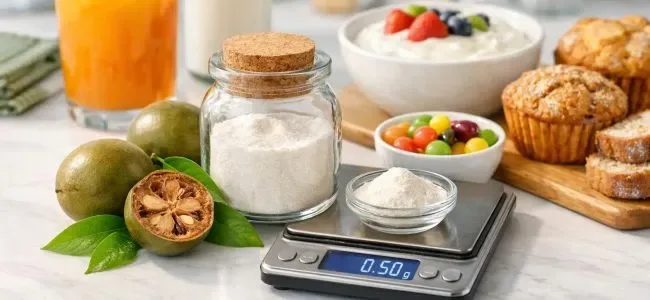
Erythritol is a polyol, or sugar alcohol. It is sold as a white crystalline powder and is widely used as a bulk sweetener in sugar-reduced and low-calorie products. It is less sweet than sugar, so most formulators use it for bulk and body and pair it with a stronger sweetener when they need to match sugar's sweetness.
It turns up in bakery, confectionery, chocolate, beverages, protein bars, ice cream, dairy alternatives and tabletop sweeteners. That range is exactly why specifications matter. A grade that works well in a drink mix may not suit a chocolate coating.
When you work with an erythritol wholesale distributor, the product on the data sheet should match what you formulated with, batch after batch. Everything below is about making sure it does.
Powdered or granulated: pick for the application
Particle size is the detail buyers overlook most often. Finer powder dissolves faster and gives a smoother mouthfeel, which helps in chocolate, icings, fillings and beverage mixes. Coarser granules flow well and can suit products where a little crunch or visual crystal is fine.
Before ordering, ask for the particle size range and run a small test in your own process. Check how it disperses, how quickly it dissolves, and whether it leaves any grittiness in the finished product.
What to check before you buy erythritol food powder
Use this as a working checklist when comparing suppliers.
Food-grade status and specification sheet
Confirm the product is sold as food grade and ask for the full specification sheet. It should state purity, appearance, moisture, particle size and any limits on residues. If a supplier cannot send one quickly, treat that as a warning sign.
Certificate of Analysis for each batch
A Certificate of Analysis (COA) shows the test results for the specific lot you are receiving. Ask whether one comes with every shipment, and compare it against the specification sheet.
Allergen, GMO and origin documents
Erythritol is made by fermentation, and the starting material varies by producer. If your customers care about allergen status, GMO status or origin, ask for written documentation. Do not assume, and do not repeat a claim on your own label unless you can back it up.
Certifications relevant to your market
Depending on who you sell to, you may need HACCP, ISO, Halal or Kosher documents. Ask which ones the supplier holds and request copies rather than relying on a logo on a website.
Compliance with Australian standards
Ingredients and finished products sold here need to meet Food Standards Australia New Zealand (FSANZ) requirements, including labelling rules for polyols. Your own regulatory adviser should confirm what applies to your product, but a good supplier will understand the local framework and answer basic questions.
Packaging, storage and shelf life
Ask about pack format, storage conditions and shelf life. Erythritol is generally stable, but any powder can pick up moisture if it is stored badly. Sealed bags kept in a cool, dry place are the usual advice, and your warehouse should be able to follow it.
Minimum order quantity and pack sizes
Minimum order quantities decide whether a trial is practical. A 25 kg bag with a 25 kg minimum, for example, suits sample runs and small production batches, while pallet quantities suit steady volume. Match the supplier's format to your production plan.
How to choose an erythritol wholesale distributor
The supplier matters as much as the spec sheet. A few questions separate a reliable erythritol wholesale distributor from a trader who only quotes a price.
- Is stock held locally? Local stock usually means shorter lead times and fewer surprises with freight and customs. Overseas ordering can work, but it needs more planning and a bigger safety buffer.
- How consistent is supply? Ask how often the product is in stock and what happens if a shipment is delayed.
- Can they trace the product? You should be able to link a delivered lot back to its COA and source.
- Is there technical support? Someone who can talk through dosage, blending and processing saves a lot of trial and error.
- How do they communicate? Quick, clear answers during the quoting stage tend to predict how they behave once you are a customer.
If you are looking for somewhere to start, BLB Erythritol from Food Ingredients Australia in Melbourne is worth asking for a sample of. It is supplied as a food-grade white crystalline powder in 25 kg bags, which makes small trials easy.
Common mistakes buyers make
- Comparing on price alone. The cheapest quote can cost more if the powder clumps, the lot varies or the shipment arrives late.
- Skipping the sample. A data sheet tells you what a product should do. Only a trial tells you what it does in your formula.
- Ignoring particle size. The wrong grade can change texture, dissolving time and appearance.
- Not checking lead times. A stock-out on a key ingredient can stop a production line.
- Ordering too much, too early. Finish your trials before you commit to a pallet.
- Forgetting about price drivers. Bulk pricing moves with volume, grade, packaging, freight, exchange rates and lead time, so ask for a quote that spells these out.
Run a proper trial before you commit
A short trial protects you from most of these problems.
- Request a sample and the specification sheet.
- Test it in your actual formulation and process, not just in water.
- Check dissolving speed, texture and visual appearance.
- Taste for the mild cooling sensation erythritol can give, and for any aftertaste at your target level.
- Try blending with other sweeteners such as stevia or monk fruit extract if you need to close the sweetness gap.
- Record the results against the COA so that you can compare future lots.
Final thoughts
Buying in bulk is easier when you know what to ask for. Before you buy erythritol food powder, get the specification sheet, check the COA, confirm the particle size, look at the paperwork behind any claims, and test a sample in your own product. Then judge the supplier on consistency, support, and price.
A few well-chosen questions at the start usually save weeks of trouble later. Request a sample and the spec sheet before you commit to a larger order, and let your own trial results make the decision.