
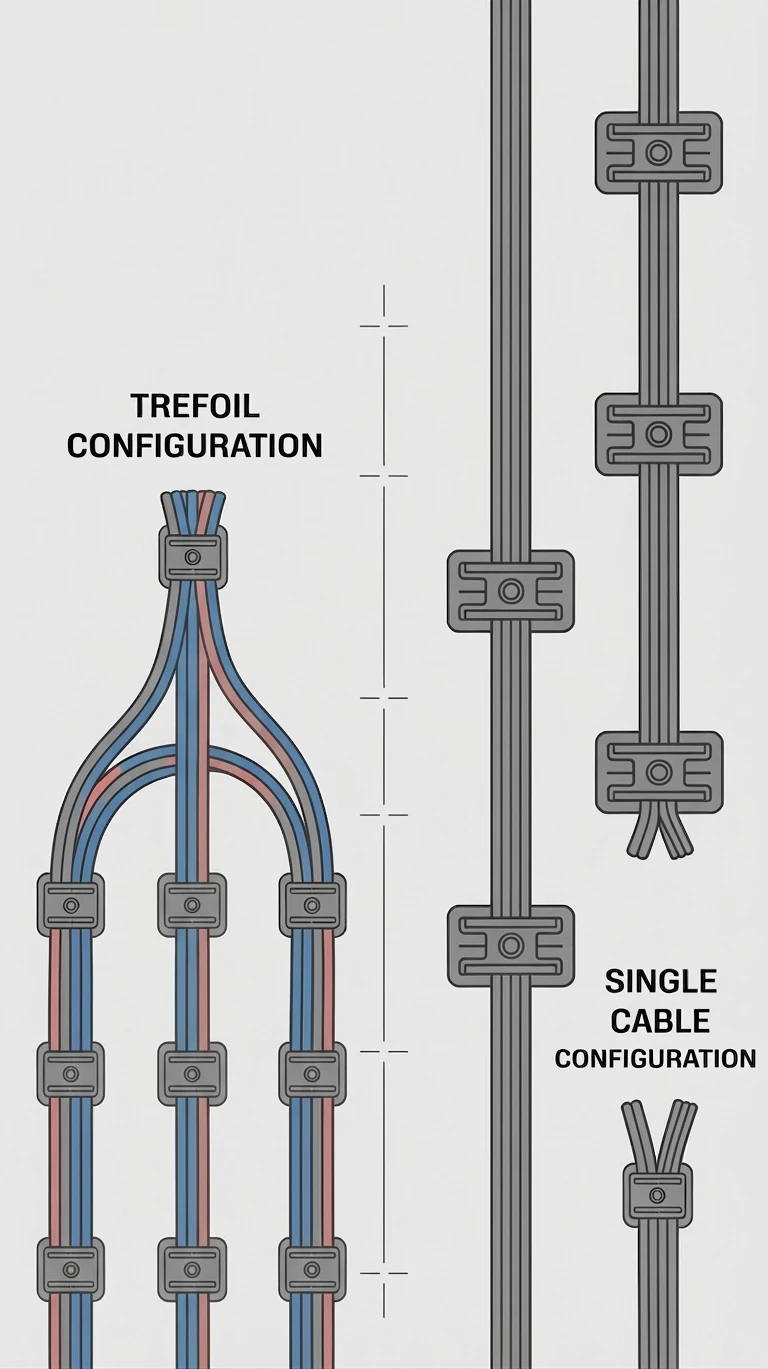
Trefoil cable cleats outperform single cable cleats in high-voltage three-phase systems by balancing electromagnetic forces and providing superior short-circuit protection per IEC 61914. Single cable cleats suit flat layouts where heat dissipation matters more than fault containment. Choose based on voltage, space, and load.
What Are Cable Cleats?
Cable cleats secure electrical cables on trays, ladders, or walls. They prevent movement from short circuits, vibration, or thermal expansion. Tested to IEC 61914, they ensure safety in LV, MV, and HV installations. Cable cleats for cable tray applications resist axial, lateral, and torsional forces up to 193 kA peak.
Trefoil Cable Configurations Explained
Trefoil formation arranges three single-core cables in a tight triangular shape. Trefoil cable cleats clamp all three together. This setup balances magnetic fields, cuts induced currents, and lowers net forces during faults.
Key benefits:
- Space-saving on cable trays
- Reduced eddy currents in armour/sheath
- Ideal for 11kV–132kV power distribution
Single Cable Configurations Explained
Single (flat) formation places cables side-by-side or spaced. Single cable cleats fix each cable individually. Better airflow improves current-carrying capacity but creates higher unbalanced forces in short circuits.
Key Differences: Trefoil vs Single Cable Cleats
Trefoil cable cleats provide lower net electromagnetic forces because cables touch in triangular formation. This reduces cable stress and tray damage during faults. Single cable cleats allow better heat dissipation with air gaps but face higher forces on outer cables in short-circuit events. Trefoil setups save space on cable trays while single configurations need wider layouts. Both must meet IEC 61914 standards.
Advantages of Trefoil Cable Cleats
- Strong fault protection that contains cable whipping in milliseconds before breakers trip.
- Electromagnetic balance that reduces stress on cables and supports.
- Excellent corrosion resistance with stainless steel 316L models for outdoor cable trays.
- Real example: A 33kV substation in India used Ellis trefoil cleats and avoided major rework after a fault.
When Single Cable Cleats Are the Better Choice
Use single cable cleats when heat buildup risks cable derating, cables run in long horizontal trays, or simpler installation is needed. They work well in data centres and industrial plants with spaced flat layouts where cooling is priority.
Cable Cleats for Cable Tray: Installation Best Practices
- Select cleat size according to cable outer diameter and formation.
- Maintain proper spacing as per IEC 61914 guidelines.
- Fix cleats securely to tray rungs with M8 or M10 bolts.
- For vertical runs, alternate cleat orientation every 180 degrees.
- Always verify impact, flame, and corrosion resistance ratings.
Proper use of cable cleats for cable tray reduces installation time by 30% and improves overall safety.
Expert Insights and Statistics
IEC 61914 testing shows trefoil setups can reduce short-circuit forces by up to 40% compared to flat formations. Industry data from Panduit and Prysmian confirms stainless trefoil cable cleats achieve Very Heavy impact classification. Non-compliant cleats contribute to 15% of cable tray failures in real projects.
Conclusion and Key Takeaways
Trefoil cable cleats win for high-fault, space-tight HV jobs. Single cable cleats suit heat-critical flat runs. Always match cleat type to configuration and follow IEC 61914.
Key takeaways:
- Prioritise trefoil cable cleats for 11kV+ power distribution.
- Use cable cleats for cable tray to prevent costly faults.
- Verify short-circuit rating before purchase.
Ready to upgrade your installation? Contact Nasco for premium trefoil and single cable cleats with fast delivery across India.