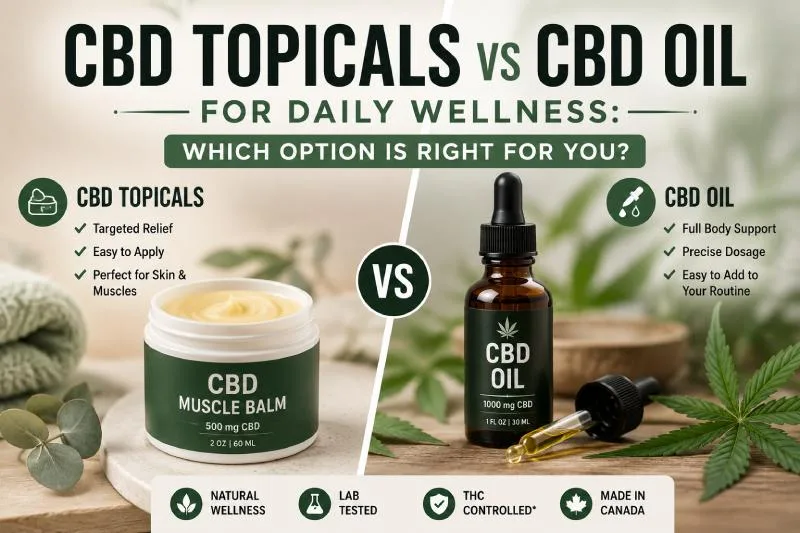
CBD is available in more forms than ever, but two options continue to attract the most attention: CBD topicals and CBD oil.
At first glance, the difference seems simple. Topicals go on the skin, while oils are generally taken by mouth. However, choosing between them involves more than deciding how you would prefer to use CBD. Each format offers a different experience, suits different routines, and requires consumers to examine different parts of the product label.
For someone exploring CBD topicals vs CBD oil for daily wellness, the right choice depends on where and how they want to use the product, how comfortable they are measuring CBD, which ingredients they prefer, and whether they are looking for a targeted or broader routine.
CBD is regulated under Canada’s Cannabis Act, even when it comes from industrial hemp. It is not intoxicating in the same way as THC, although it can still affect the brain and interact with certain medications. Canadian consumers should therefore approach CBD as a regulated product rather than an ordinary cosmetic or unrestricted wellness supplement.
This guide compares CBD oil and CBD topicals in practical terms. It explains how each format is used, what to check before purchasing, and how to select an option that fits naturally into a responsible daily wellness routine.
Important: This article is intended for general education only. It should not be considered medical advice or a recommendation to treat any condition. Consult a qualified healthcare professional before using CBD, particularly if you take medication, have an underlying health condition, are pregnant or breastfeeding, or experience persistent symptoms.
What Is CBD Oil?
CBD oil is a cannabis extract that combines cannabidiol with a carrier oil. Common carrier ingredients may include medium-chain triglyceride oil, coconut-derived oil, or another plant-based oil.
CBD oils are usually sold in bottles with droppers. The label generally shows the total amount of CBD in the bottle and its concentration per millilitre.
For example, a 30-millilitre bottle containing 900 milligrams of CBD provides approximately:
900 mg ÷ 30 mL = 30 mg of CBD per mL
This calculation is important because the total milligram number on the front of a bottle does not tell you how much CBD is present in each measured amount.
CBD oil is popular among consumers who value flexibility. Depending on the concentration and dropper markings, users may be able to measure different quantities rather than being limited to a fixed amount per capsule or edible unit.
However, CBD oil also requires more attention to measurement. A consumer needs to understand the concentration, use the dropper correctly, and follow the instructions provided with the legal product.
What Are CBD Topicals?
CBD topicals are products designed for external application. They may come in forms such as:
- Creams
- Balms
- Lotions
- Salves
- Roll-ons
- Gels
- Massage products
Unlike CBD oil, a topical is applied directly to a selected area of the skin. This makes it attractive to people who prefer a localized self-care routine rather than taking CBD orally.
Topical products may also contain other ingredients, including:
- Menthol
- Camphor
- Essential oils
- Botanical extracts
- Shea butter
- Coconut oil
- Fragrances
- Beeswax
- Aloe vera
These additional ingredients may affect the texture, scent, cooling sensation, or overall user experience. They can also be important for people with sensitive skin or ingredient allergies.
In Canada, cannabis topicals are regulated cannabis products. Their packaging and labels are subject to specific rules, and Canadian regulations prohibit unapproved health or cosmetic benefit claims on cannabis topical labels.
CBD Topicals vs CBD Oil: The Main Difference
The most important difference is the method of use.
CBD oil is generally used orally and becomes part of a broader internal routine.
CBD topicals are applied externally to a selected area of skin.
This distinction affects nearly every part of the experience, including measurement, ingredients, convenience, and the type of routine each product supports.
CBD oil may suit someone who wants:
- A product that can be measured by millilitre
- A consistent morning or evening routine
- Fewer topical ingredients
- A wider range of concentrations
- A product designed for oral use
CBD topicals may suit someone who wants:
- An external-use product
- A targeted application routine
- A massage or skincare-style experience
- No need to measure oil with a dropper
- A format that can be used on a specific area
Neither format is automatically better. The more useful question is which one fits the consumer’s intended routine, preferences, and safety considerations.
How CBD Oil Fits into a Daily Wellness Routine
CBD oil can be incorporated into a structured routine because it is easy to use at a consistent time.
Some consumers prefer to use it as part of a morning routine. Others associate it with an evening wind-down period. The time itself is less important than using the product responsibly and following its instructions.
A simple daily routine might include:
- Checking the label before each use
- Measuring the intended amount carefully
- Using the product at a consistent time
- Recording the product concentration
- Monitoring for unwanted effects
- Storing the bottle according to its instructions
Consistency can make it easier to understand how the product fits into a person’s lifestyle. However, consistency should not be confused with increasing the amount without guidance.
A stronger concentration is not necessarily better. A highly concentrated oil may offer more CBD per millilitre, but it may also be more difficult to measure in small amounts.
How CBD Topicals Fit into a Daily Wellness Routine
CBD topicals tend to fit naturally into external self-care routines.
A topical may be used during:
- A morning skincare routine
- An evening massage
- Post-exercise self-care
- A stretching session
- A bath or relaxation routine
- Hand or foot care
The experience often depends as much on the non-CBD ingredients as it does on the CBD content. For example, a topical containing menthol may feel cooling, while a balm containing beeswax and shea butter may feel heavier and more moisturizing.
This is why shoppers should not compare topical products solely by the amount of CBD printed on the package.
They should also consider:
- Texture
- Fragrance
- Absorption
- Container design
- Ease of application
- Skin sensitivity
- Additional active ingredients
- Intended application area
A topical that smells pleasant to one person may be overwhelming to another. Similarly, a thick balm may be useful for massage but inconvenient for daytime use under clothing.
CBD Oil May Offer More Precise Measurement
One of the biggest advantages of CBD oil is the ability to calculate the amount per millilitre.
Suppose a bottle contains 1,200 milligrams of CBD in 30 millilitres of oil:
1,200 mg ÷ 30 mL = 40 mg of CBD per mL
If the dropper includes reliable measurement markings, the consumer can understand how much CBD is present in different measured volumes.
That does not mean every oil is automatically easy to measure. Problems can occur when:
- The dropper has no markings
- The label is difficult to understand
- The concentration is extremely high
- Consumers count drops instead of using millilitre measurements
- The total package amount is confused with the amount per serving
Canadian cannabis labels must display total THC and CBD quantities or concentrations. Consumers should determine whether each number applies to the entire package, one unit, one gram, or one millilitre.
CBD Topicals Are Often Easier to Apply Selectively
CBD topicals do not usually require the same type of dropper calculation. A person can apply the product to a selected external area according to the label instructions.
This may feel simpler, especially for consumers who dislike the flavour or texture of oral oils.
However, topical application is not always precisely measured. Consumers may apply different amounts each time, especially when using products packaged in jars.
A pump or roll-on may provide more consistency than an open container, although the exact design varies between products.
When comparing CBD topicals, shoppers should look at:
- Total product weight
- CBD concentration
- Suggested amount
- Pump or roll-on size
- Application directions
- Maximum recommended use
- Skin warnings
Ease of application should not replace careful label reading.
Ingredient Differences Between CBD Oil and CBD Topicals
CBD oils often have relatively short ingredient lists. A simple product might contain CBD extract and a carrier oil, although flavoured formulas may include additional ingredients.
Topicals generally have more complex formulations. A cream, gel, or balm needs ingredients that create its texture, stability, scent, and skin feel.
Common ingredients in CBD oil
- MCT oil
- Coconut-derived oil
- Hemp seed oil
- Olive oil
- Natural flavour
- Terpenes
- Other cannabinoids
Common ingredients in CBD topicals
- Water
- Shea butter
- Beeswax
- Coconut oil
- Menthol
- Camphor
- Essential oils
- Fragrance
- Preservatives
- Botanical extracts
A longer ingredient list is not automatically a sign of lower quality. It simply means the consumer needs to evaluate more than the CBD concentration.
Health Canada recommends reading the complete ingredients list to identify substances that may cause an allergy or sensitivity.
Which Option Is Better for Sensitive Skin?
People with sensitive skin should be particularly cautious with topical products.
A CBD topical may contain ingredients that cause:
- Redness
- Itching
- Dryness
- Burning
- Irritation
- Fragrance sensitivity
Essential oils, menthol, camphor, preservatives, and fragrances can be irritating for some users.
Before applying a new topical widely, consumers may consider testing a small amount on a limited area, provided this is consistent with the product instructions. The product should not be applied to broken skin, eyes, or other sensitive areas unless specifically permitted by the label.
Anyone who experiences a significant reaction should stop using the product and seek appropriate professional advice.
CBD oil avoids many topical ingredients, but oral products can still contain allergens, flavourings, or carrier oils that may be unsuitable for some individuals.
Therefore, neither format should be considered universally safer for sensitive users. The complete formulation matters.
Which Option Is More Convenient?
Convenience depends on lifestyle.
CBD oil may be more convenient when:
- The user follows a regular morning or evening routine
- The bottle stays in one location
- The dropper is clearly marked
- The flavour is acceptable
- A measured product is preferred
CBD topicals may be more convenient when:
- External application is preferred
- The product is used in a specific location
- A roll-on or pump is available
- The consumer dislikes oral oils
- The product is part of massage or skincare
Topicals may be less convenient if they are greasy, strongly scented, difficult to wash off, or likely to transfer onto clothing.
CBD oil may be less convenient when travelling locally, measuring it away from home, or using a bottle that can leak.
The best product is often the one that the consumer can use correctly and consistently—not the one with the most impressive marketing.
Which Option Provides Better Value?
CBD oil and CBD topicals should not be compared only by their retail prices.
For CBD oil, consumers can calculate cost per milligram:
Product price ÷ total CBD = cost per milligram
For example:
- A $45 oil containing 900 milligrams of CBD costs $0.05 per milligram.
- A $70 oil containing 1,500 milligrams of CBD costs approximately $0.047 per milligram.
The second bottle costs more upfront but offers slightly better value per milligram.
Topicals are more difficult to compare because value is influenced by:
- Total CBD
- Package weight
- Number of applications
- Supporting ingredients
- Texture
- Packaging design
- Application method
- Amount used each time
A less expensive topical may provide poor value if a large amount is needed for each application. Conversely, a more expensive roll-on may last longer because it allows more controlled use.
Consumers should therefore calculate CBD content while also considering real-world usability.
CBD Oil May Involve More Drug-Interaction Concerns
Any CBD product should be used responsibly, but orally used CBD oil deserves particular attention because CBD can interact with certain medications.
Health Canada lists several substances that may interact with cannabis products, including sleeping medications, tranquilizers, some pain medicines, muscle relaxants, and certain allergy or cold medications.
Reported CBD-related concerns may include:
- Drowsiness
- Digestive symptoms
- Changes in appetite
- Drug interactions
- Liver-related effects
- Allergic reactions
Health Canada’s scientific review has noted that side effects have been reported at various oral CBD amounts and that individual responses may differ.
People taking prescription or non-prescription medication should discuss CBD oil with a healthcare professional rather than relying on product reviews or general dosage advice found online.
A topical should not automatically be assumed to be risk-free. The product may contain THC, other cannabinoids, or additional ingredients that require careful consideration. Consumers should still follow the label and consult a professional when unsure.
Do CBD Topicals or Oils Cause Intoxication?
CBD itself is not generally intoxicating in the same way as THC. However, CBD products can contain THC, depending on their formulation.
Consumers should never assume that a product contains no THC merely because the front label emphasizes CBD.
The label should be checked for:
- Total CBD
- Total THC
- Amount per gram or millilitre
- Total package amount
- Other cannabinoids
Higher THC content is associated with a greater likelihood of impairment and adverse effects.
Canadian consumers should avoid driving, operating machinery, or performing safety-sensitive tasks when impaired.
How to Compare CBD Oil Products
When shopping for CBD oil, examine the following factors.
1. Total CBD content
Determine how much CBD is present in the entire bottle.
2. CBD per millilitre
Divide the total CBD by the total bottle volume.
3. THC content
Check the total THC and the amount per measured quantity.
4. Dropper markings
A clearly marked dropper may make measurement easier.
5. Carrier oil
Check whether the carrier oil fits your dietary needs and sensitivities.
6. Flavour
Unflavoured oil may taste earthy, while flavoured formulas may contain additional ingredients.
7. Legal packaging
Look for signs of legal Canadian cannabis packaging, such as appropriate warning information, regulated cannabinoid details, and an applicable excise stamp. Certain very low-THC products may be exempt from the excise-stamp requirement.
8. Storage instructions
CBD oil may need to be protected from heat, light, and moisture.
How to Compare CBD Topical Products
When evaluating a topical, look beyond the headline CBD number.
1. Product type
A cream, balm, gel, and roll-on can feel very different on the skin.
2. Total CBD and THC
Check both cannabinoids rather than assuming that a topical contains only CBD.
3. Ingredient list
Review fragrances, essential oils, menthol, preservatives, and allergens.
4. Packaging format
Pumps and roll-ons may provide cleaner and more controlled application than open jars.
5. Product weight
Compare the amount of product, not only the CBD total.
6. Texture and absorption
Consider whether the product will feel comfortable during daily use.
7. Application warnings
Follow all directions about where and how the product should be used.
8. Legal seller
Purchase through an authorized Canadian source.
Resources from established Canadian CBD platforms such as CBDNorth can help consumers learn how different formats and concentrations are presented. However, shoppers should still verify the legal seller, read the regulated package, and assess the complete ingredient list before making a decision.
Common Mistakes to Avoid
Choosing based only on CBD strength
A higher number does not guarantee a more suitable product.
Ignoring THC
CBD-focused oils and topicals may still contain THC.
Assuming a topical is an ordinary cosmetic
Cannabis topicals are regulated cannabis products in Canada.
Buying from an unauthorized website
A professional design does not prove that a seller is legal.
Skipping the ingredient list
Fragrances, essential oils, carrier oils, and allergens matter.
Using CBD for a medical condition without advice
Persistent symptoms should be discussed with a qualified professional.
Copying another person’s routine
CBD experiences and safety considerations can vary between individuals.
Applying topicals to damaged skin
Follow the package instructions and avoid unsuitable application areas.
Increasing oral CBD too quickly
Do not increase use based solely on online testimonials or marketing.
Can You Use CBD Oil and CBD Topicals Together?
Some consumers may consider using both formats as part of the same routine.
However, combining products can make it more difficult to track:
- Total CBD exposure
- Total THC exposure
- Side effects
- Ingredient reactions
- Which product is affecting the experience
- How frequently each product is being used
Using multiple CBD products should not be treated as automatically better.
Before combining products, review both labels and speak with a healthcare professional, especially when oral CBD, medications, health conditions, or THC-containing products are involved.
Beginners may find it easier to evaluate one product at a time.
CBD Topicals vs CBD Oil for Different Preferences
Choose CBD oil when you prefer:
- A measurable oral product
- A shorter ingredient list
- Flexible concentration options
- A scheduled routine
- A product that does not need to be rubbed into the skin
Choose a CBD topical when you prefer:
- External application
- A localized self-care routine
- Massage or skincare-style use
- No oral flavour
- A cream, balm, gel, or roll-on format
Consider professional guidance when:
- You take medication
- You have a chronic health condition
- You are pregnant or breastfeeding
- You are over 55 and take several medications
- You experience persistent discomfort
- You have reacted to cannabis previously
- You are uncertain about THC exposure
- You want to use more than one CBD product
A Simple CBD Product Checklist
Before purchasing CBD oil or a CBD topical, ask:
About the retailer
- Is the retailer legally authorized?
- Is clear business information available?
- Does the product come through a regulated Canadian channel?
About the label
- How much CBD does the product contain?
- How much THC does it contain?
- Is the amount listed per package, millilitre, gram, or unit?
- Are the ingredients clearly stated?
- Is there a lot number?
- Are storage and warning details provided?
About the format
- Can I measure or apply it consistently?
- Does it fit my routine?
- Do I understand how it should be used?
- Am I comfortable with its texture or flavour?
About safety
- Could it interact with my medication?
- Does it contain ingredients that may irritate my skin?
- Am I using it in place of appropriate medical advice?
- Do I understand the potential side effects?
Frequently Asked Questions
Is CBD oil better than CBD cream?
Neither is universally better. CBD oil may suit consumers who prefer a measured oral product, while CBD cream may suit those who prefer external and targeted application.
Can CBD oil be applied to the skin?
Consumers should use a product only as directed. An oral oil may not contain the same ingredients or formulation as a topical. Use products according to their intended purpose and label instructions.
Can CBD topical products contain THC?
Yes. Consumers should check the regulated label for total CBD and total THC amounts.
Are CBD topicals legal in Canada?
CBD topicals can be legally sold when produced, packaged, labelled, distributed, and sold under Canada’s cannabis framework. CBD remains regulated under the Cannabis Act.
How do I know whether a CBD product is legal?
Legal products generally display regulated cannabinoid information, health warnings, appropriate packaging, and other required details. An applicable excise stamp can also indicate that the product came through a regulated source, although certain low-THC products may be exempt.
Can CBD oil interact with medication?
Yes. CBD and other cannabis products may interact with certain medications. Speak with a qualified healthcare professional before using CBD oil when taking prescription or non-prescription medicines.
Can I use CBD topicals every day?
Use frequency should follow the product’s instructions. Stop using the product if you experience irritation or another unwanted reaction.
Are CBD topicals suitable for sensitive skin?
That depends on the formulation. Review the complete ingredient list and be cautious with fragrance, menthol, camphor, essential oils, and other potential irritants.
Final Thoughts
The comparison between CBD topicals vs CBD oil for daily wellness does not produce one universal winner.
CBD oil offers flexible measurement and can fit neatly into a consistent morning or evening routine. However, it requires consumers to understand concentration, use the dropper correctly, and consider possible medication interactions.
CBD topicals offer targeted external application and can become part of massage, skincare, or post-activity self-care. However, their longer ingredient lists, fragrances, textures, and application methods require careful evaluation.
The best choice is the one that fits your preferences while allowing you to use the product responsibly.
Before purchasing, verify that the retailer is authorized, compare CBD and THC amounts, read every ingredient, and follow the package directions. Avoid products that make dramatic medical promises or hide basic cannabinoid information.
Most importantly, CBD should support an informed routine—not replace professional care. When symptoms, medications, health conditions, or safety concerns are involved, speaking with a qualified healthcare professional is the responsible next step.