Introduction
In today’s digital-first world, software is no longer just an enabler—it’s a competitive advantage. With businesses moving at lightning speed, cloud-native applications built with AI and ML are revolutionizing everything from customer experience to operations. If you want scalable, smart, and future-proof solutions, it’s time to hire AI developers who understand the intersection of artificial intelligence and cloud-native architecture.
This blog explores how cloud-native principles and AI technology combine to build next-gen applications, the tools enabling this fusion, and the trends shaping the future of software development.
What Are Cloud-Native Applications?
Cloud-native apps are designed specifically to run in elastic cloud environments. Unlike traditional applications that are “lifted and shifted” to the cloud, cloud-native apps are:
- Built using microservices
- Packaged in containers
- Managed via DevOps tools
- Deployed on dynamic cloud infrastructure
They are modular, resilient, and scalable by design—making them the perfect canvas for embedding AI and ML functionalities.
A modern AI development company focuses on building apps using this architecture to unlock agility and intelligence simultaneously.
Why AI in Cloud-Native Apps?
Artificial intelligence amplifies the value of cloud-native architecture by enabling:
- Predictive insights: Real-time user behavior and system analytics
- Autonomous operations: Auto-scaling, self-healing systems
- Personalization: Intelligent recommendations, tailored user journeys
- Automation: AI-based workflows, chatbot support, and anomaly detection
When you hire AI developers, you empower your product with learning capabilities, making it more adaptive, efficient, and user-focused.
Core Architectural Patterns for AI-Enabled Cloud-Native Apps
To integrate AI/ML into cloud-native apps, architects use the following design patterns:
✅ Microservices with ML Pipelines
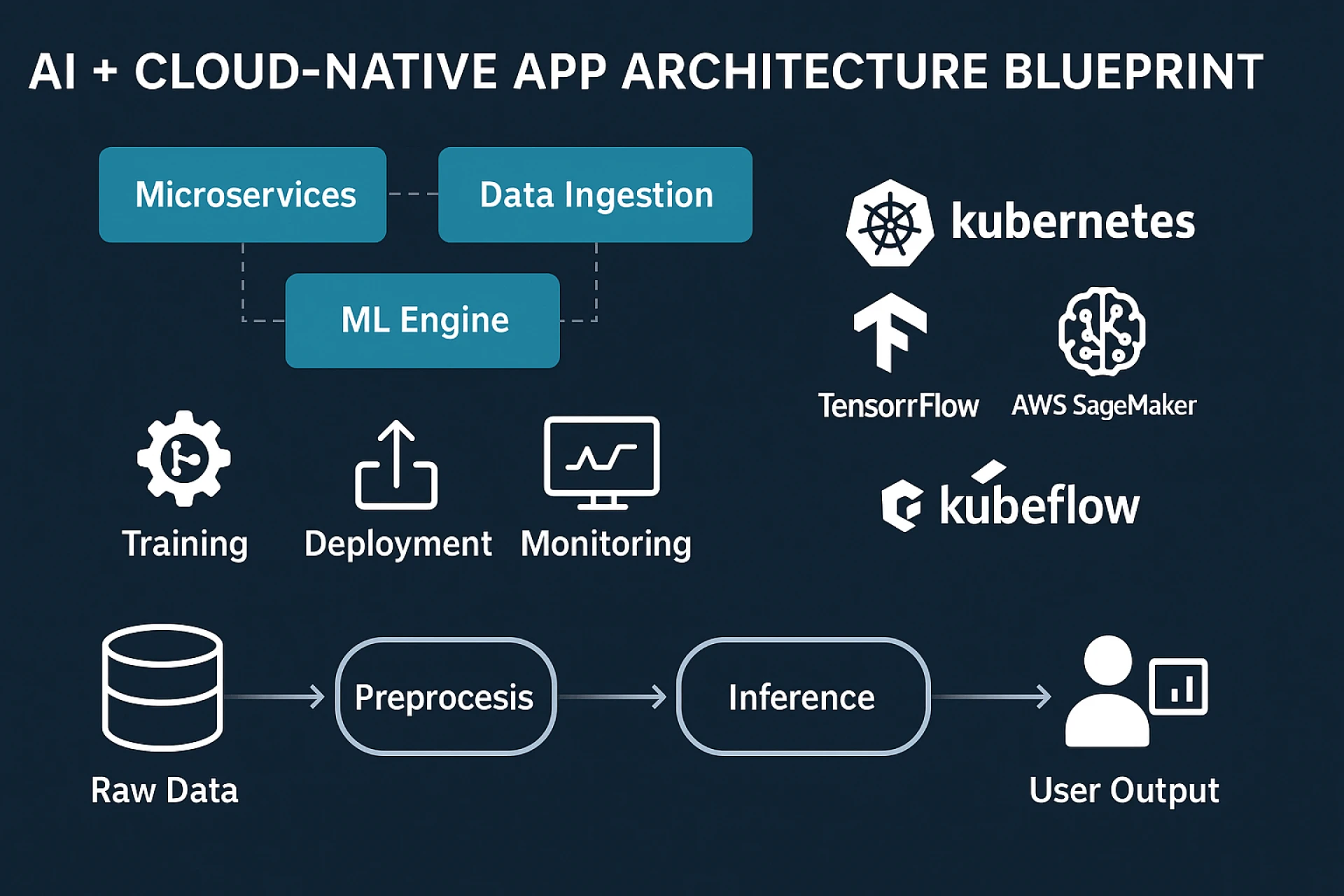
Each service handles a distinct AI task like data ingestion, preprocessing, inference, or post-processing—managed independently via Kubernetes.
✅ Event-Driven Architectures
Using Kafka or AWS EventBridge, apps can process real-time events and run AI models on-the-fly—for fraud detection or dynamic pricing.
✅ Serverless AI Deployments
Functions-as-a-Service (e.g., AWS Lambda, Azure Functions) enable rapid AI inference without managing servers.
✅ API-First Design & Data Mesh
APIs enable seamless integration with third-party AI services, while data mesh helps decentralize access to datasets for federated AI development.
These patterns are the foundation of any intelligent application built by a top-tier AI development company.
AI/ML Tools & Frameworks for Cloud-Native Development
Here’s a breakdown of tools commonly used by teams offering AI development services:
🧠 AI/ML Frameworks:
- TensorFlow, PyTorch – Deep learning
- Scikit-learn, XGBoost – Classical ML
- HuggingFace – Natural Language Processing
- ONNX – Model portability across platforms
☁️ Cloud-Native Tools:
- Kubernetes, Docker – Containerization and orchestration
- Knative – Serverless on Kubernetes
- Istio – Service mesh for microservices
- Helm – Kubernetes package manager
☁️ Cloud AI Services:
- AWS: SageMaker, Lambda, Comprehend
- Azure: ML Studio, Bot Framework, Functions
- Google Cloud: Vertex AI, AutoML, Cloud Run
To leverage this stack effectively, you need to hire ML developers who know both sides of the equation—AI modeling and scalable deployment.
DevOps and MLOps for AI in Cloud-Native Apps
Cloud-native AI apps require robust automation for:
- Continuous Integration/Continuous Delivery (CI/CD): For data pipelines and models
- Model lifecycle management: Retraining, versioning, deployment
- Monitoring: Model drift detection, performance alerts
Tools like Kubeflow, MLflow, and Seldon are key to implementing MLOps, ensuring your models stay relevant and performant.
An experienced AI development company integrates MLOps into your DevOps workflows for smooth production-grade delivery.
Security & Compliance
Embedding AI in cloud-native systems adds another layer of complexity:
- Data Privacy: Protect PHI, PII with encryption and anonymization
- Bias & Fairness: Use explainable AI models and audits
- Regulations: Ensure compliance with HIPAA, GDPR, and SOC2
When you hire AI developers, ensure they follow security-by-design principles and understand industry-specific regulations.
Emerging Trends in AI-Powered Cloud-Native Development
Let’s look ahead at some game-changing innovations:
🌐 AI + Edge Computing
Smart cloud-native apps now run AI models at the edge (e.g., on IoT devices) for low latency in healthcare, automotive, and manufacturing.
🤖 AIOps
AI algorithms manage infrastructure monitoring, log analysis, and incident responses—making DevOps smarter.
🔀 Multi-Cloud & Hybrid AI
Models trained on one cloud (e.g., GCP) are now deployed across AWS, Azure, or on-prem using open standards like ONNX and Kubernetes.
🎨 Generative AI for Backend Logic
Tools like Codex and Gemini are automating backend tasks like testing, documentation, and even API generation.
Forward-thinking businesses hire ML developers who stay ahead of these trends to keep their cloud-native apps future-proof.
Why You Should Hire AI Developers for Cloud-Native Projects
Developing intelligent, cloud-native apps demands a multi-disciplinary approach. You need developers who:
- Understand AI algorithms and distributed systems
- Can integrate MLOps into DevOps workflows
- Know how to deploy ML models in real-time environments
- Are familiar with compliance, observability, and scaling challenges
Whether you're building from scratch or optimizing an existing stack, a reliable AI development company can provide full-cycle AI development services—from research and architecture to deployment and support.
Conclusion
Cloud-native development and AI are a powerful duo. Together, they enable the creation of apps that are scalable, intelligent, and capable of transforming entire industries.
If you're planning to build such apps, now is the time to hire AI developers and ML specialists with hands-on experience in cloud-native ecosystems. Collaborate with a forward-thinking AI development company like HourlyDeveloper.io to bring intelligent innovation to your business.