
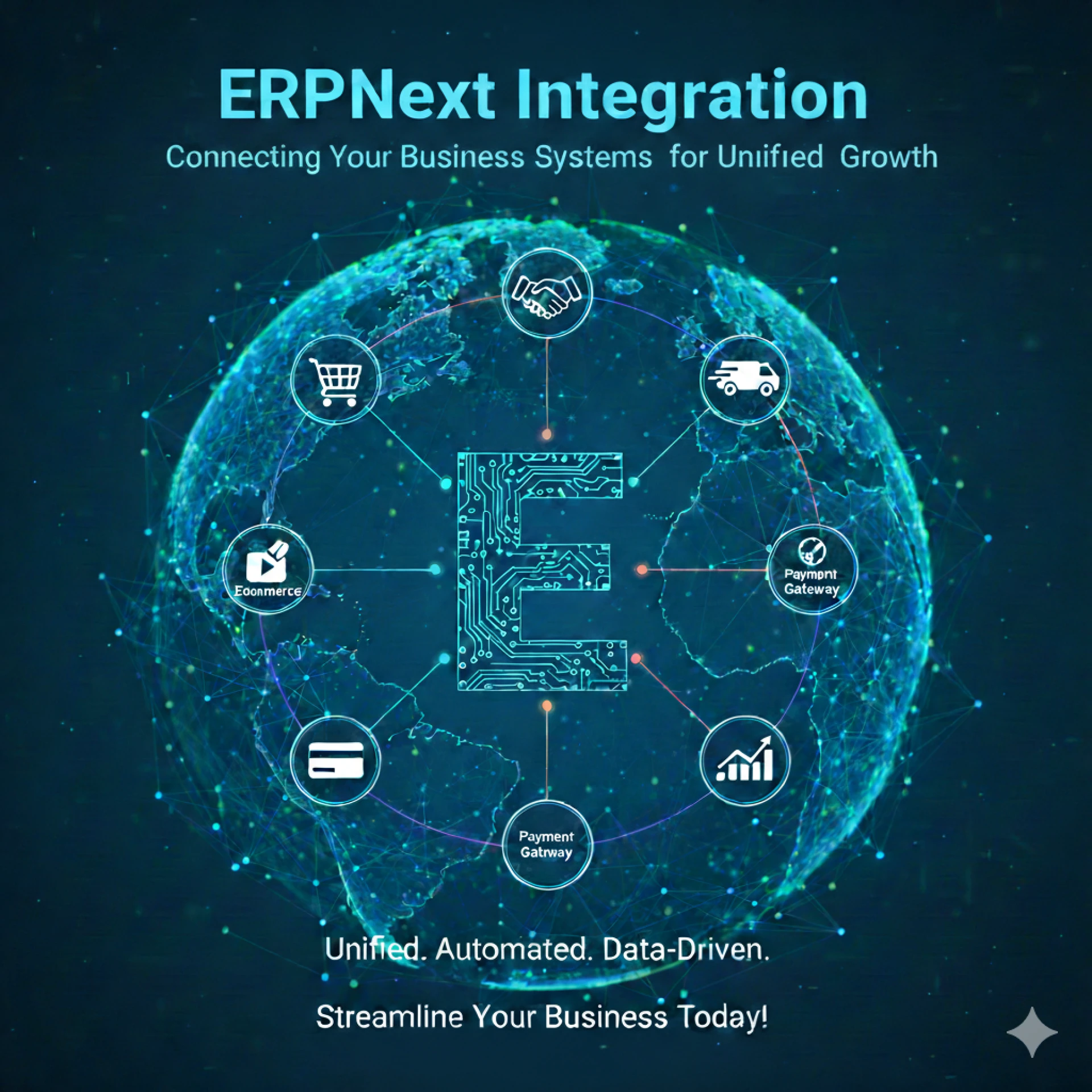
In today’s digital-first economy, businesses are not running independent operations any longer. Accounting software, CRM systems, eCommerce sites, payment systems, logistics management tools, and analytics platforms must work in a fully integrated manner. Unless they are able to do so, the business is forced to work in a siloed manner.
This is where ERPNext integration plays a critical role.
The integration of ERPNext helps businesses integrate their ERPNext systems with other third-party applications to design a ‘unified’, ‘automated’, and ‘data-driven’ business environment. The integration of ERPNext with third-party applications could be seen more as a strategic shift in business systems than merely being ‘technical’ in nature.
This document describes what ERPNext integration is, its significance, its uses, different ways it is integrated, its challenges, and its best practices for successful implementation.
What Is ERPNext Integration?
ERPNext Integration
The process of integrating ERPNext with other software systems to allow the flow of data between the integrated systems in real-time is known as ERPNext integration. Unlike in independent scenarios where separate systems are used, integrations work together.
Integration with ERPNext can assist companies in removing duplicate data, eliminating errors, and maintaining a single data source.
Common ERPNext Integration Options Include:
ERPNext eCommerce integration
ERPNext CRM integration
ERPNext payment gateway integration
ERPNext logistics and shipping integration
ERPNext accounting and banking integration
ERPNext BI and reporting integration
ERPNext custom or legacy system integration
With the implementation of ERPNext system integration, consistency and effectiveness are attained across all aspects within the organization.
Why ERPNext Integration Is Critical for Growing Businesses
As companies expand their operations, disconnected systems will eventually become their most significant operational obstacle. The process of entering information multiple times by hand together with the presence of incorrect data and slow reporting capabilities and insufficient system visibility will create operational hindrances that prevent the company from achieving its growth objectives and result in decreased operational performance.
ERPNext integration can solve these problems by bringing all these systems into harmony under one workflow.
Key Benefits of ERPNext Integration
1.Centralized Data Management
By using the ERPNext integration service, it’s possible to eliminate data silos since all customer data, inventory, financial documents, and other business information are stored in a single system.
2. Process Automation
ERPNext Integrations deliver automated solutions for repetitive tasks which include order synchronization, invoice generation, payment reconciliation, and inventory control activities to reduce time requirements and decrease the likelihood of human mistakes.
3. Real-Time Business Visibility
Integration is done in a manner that allows real-time analysis of sales, finance, and operations.
4. Enhanced Customer Experience
The accurate inventory information and the faster order fulfillment process and the billing functions work together to improve customer satisfaction and trust.
Common ERPNext Integration Use Cases
ERPNext eCommerce Integration
The advantages of ERPNext integration with eCommerce platforms include real-time synchronization of:
Product data and pricing
Inventory availability
Customer orders
Customer information
This ensures accurate stock levels, faster fulfillment, and unified reporting across online and offline sales channels.
ERPNext CRM Integration
The ERPNext CRM integration establishes a connection between sales and marketing functions and all financial and operational business processes. The system receives leads, opportunities, and quotations together with customer interactions which help maintain accurate revenue projections and track customer relationship progress.
ERPNext Payment Gateway Integration
ERPNext payment gateway integration automates:
Online payment confirmation
Invoice settlements
Refund processing
Financial reconciliation
The process creates accurate financial records while delivering immediate cash flow information.
ERPNext Logistics and Shipping Integration
The ERPNext system connects with logistics providers to create automated shipment tracking and delivery confirmation processes which require less manual work and result in faster order processing times.
ERPNext Accounting and Banking Integration
ERPNext integration with banking systems and accounting tools enables:
Automatic transaction synchronization
Bank reconciliation
Tax calculation
Compliance-ready financial reporting
ERPNext Integration Methods
ERPNext offers flexible and scalable integration methods suitable for businesses of all sizes.
API-Based ERPNext Integration
ERPNext provides REST APIs for secure, scalable, and real-time third-party integration.
Webhooks
ERPNext webhooks trigger automated workflows when specific events occur, such as order creation or payment confirmation.
Middleware Integration
Middleware platforms handle intricate ERPNext integrations which require connection to multiple systems and support for unconventional operational procedures.
The integration process for ERPNext faces multiple challenges which organizations can overcome through effective implementation strategies.
The system will show performance problems and data accuracy issues when organizations execute ERPNext integration in an incorrect manner. The system displays00 more than 10000 common use cases which require system users to implement specific procedures. challenges include:
Incorrect data mapping
Lack of validation and error handling
Security vulnerabilities
Inadequate testing
How to Prevent Integration Issues:
Clearly define ERPNext integration goals
Use standardized APIs and data structures
Implement logging and validation mechanisms
Perform thorough testing before deployment
Best Practices for Successful ERPNext Integration
To maximize ROI from ERPNext integration services, businesses should follow these best practices:
Start with high-impact ERPNext integrations
Maintain clean and standardized master data
Implement role-based access control
Monitor integration performance continuously
Work with experienced ERPNext integration partners
Choosing the Right ERPNext Integration Partner
ERPNext integration requires technical skills yet serves as a fundamental business transformation project. The appropriate ERPNext integration partner possesses knowledge about workflow operations, compliance standards, systems expansion requirements, and the organization's future business objectives.
A Professional ERPNext Integration Partner Helps You:
Design future-ready integration architecture
Avoid costly delays and system failures
Implement secure and scalable ERPNext integrations
Align ERPNext integration with business growth objectives
Conclusion: ERPNext integration enables businesses to create a unified operational platform which connects all their processes through ERPNext. The integration of ERPNext with eCommerce systems and CRM systems and payment gateway systems and logistics systems and banking systems enables businesses to operate more efficiently while maintaining better operational visibility and achieving sustainable growth.
The competitive environment of digital markets requires businesses to implement ERPNext integration as their fundamental business requirement The organizations which spend resources on strategic ERPNext integration development acquire essential business capabilities to navigate current market conditions.