
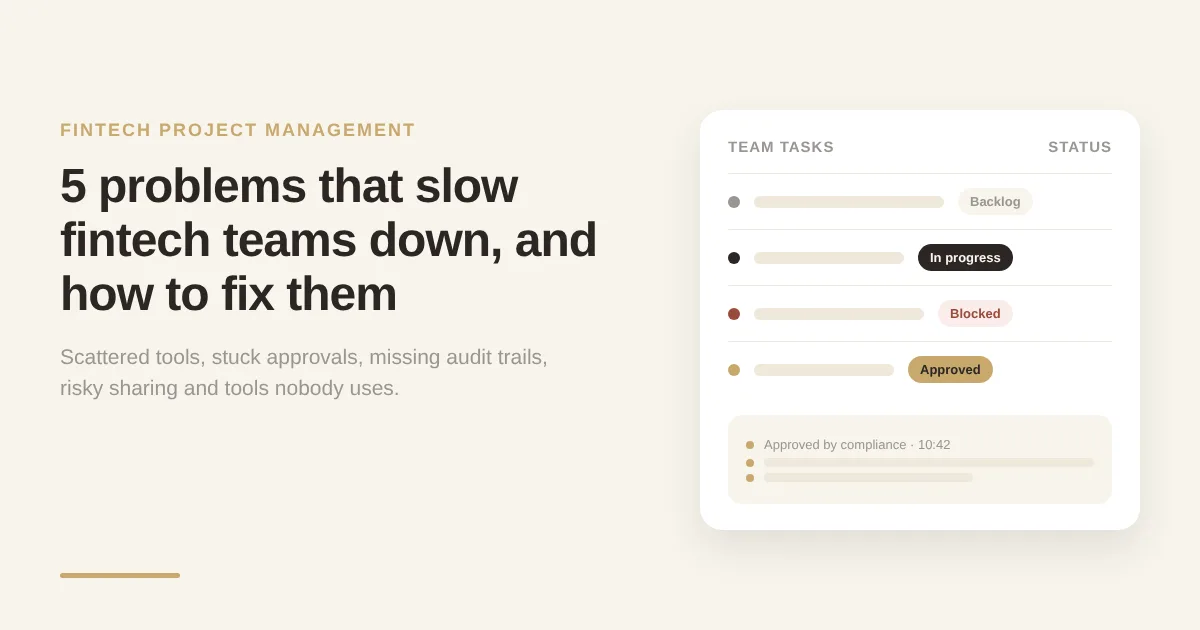
Overuse of tools, stuck decisions, poor documentation, dangerous third party access, and costly adoption hurt the efficiency of fintech project management. Here is the research findings on these challenges and what can be done to address each of them.
The compliance officer of a UK payments provider is asked a simple question during one of the reviews – who has approved the decision to change merchant fees last quarter and when? The answer to this question is somewhere among the email thread, chat and Excel table where three people have input data. Finding the answer takes up most of an afternoon.
In comparison to other industries, the management of fintech projects is more difficult. Teams are fast in their actions; however, there are strict regulations according to which all the decisions must be documented, systems must be resilient and third parties need to be controlled. The article will discuss five challenges which make fintech project management inefficient and how to deal with them.
1. Too many tools, and too much switching between them
Today, most knowledge workers tend to divide their working hours among many different applications. The study carried out by Asana under the name of “Anatomy of Work Index 2023” involving 9,615 knowledge workers from the US, UK, Australia, France, Germany and Japan has shown that they use on average 8.8 applications and spend 58% of their day doing work related to “work about work”.
Switching costs can be quantified. A research study featured in Harvard Business Review tracked 137 participants on 20 different teams from three Fortune 500 companies for five weeks. Participants switched apps and websites almost 1,200 times a day and spent less than four hours per week reorienting after switching, representing about 9% of their work time, or five working weeks per year. (Canadian Underwriter, summarising the HBR study).
For a fintech team, switching comes with an additional price. If a task is started with an email, discussed in the chat, and documented in the spreadsheet, then there will be no single source to reference what happened.
The switching of tools presents another problem for the fintech team. There is no record of the process when a request appears in an email, is discussed via chat and managed by a spreadsheet.
Action items
1. List all the places where the current project works are stored – inboxes, chats, spreadsheets, and file sharing.
2. Single source of truth for tasks, requests, and decisions should be picked out among those places. Chat and email may be retained, but all the actionable things go into one and only one.
3. Come to agreement within the team – if it is not in the project management software – it does not exist.
2. Approvals that wait in inboxes
Approvals are constant in financial services: pricing changes, vendor onboarding, product releases, policy updates and access requests. When they travel by email, they are easy to miss and hard to track. Nobody can see what is waiting, for how long, or on whom.
The same Asana research found knowledge workers believe better processes could save them 4.9 hours a week, and that unnecessary meetings take up 2.8 hours a week, rising to 3.6 hours for senior leaders (Asana, via Business Wire). . Many of those meetings exist only to find out the status of decisions.
What to do
- Turn every approval into a tracked item with one named approver and a due date.
- Use a small set of clear stages, such as Draft, In Review, Approved and Rejected, so status is visible without asking.
- Keep comments and file versions on the item itself, so the approved version is never in doubt.
Review anything that has been “In Review” for more than a few days at a short weekly check, rather than chasing approvals one by one.
3. Records that can’t show who did what, and when
Regulated firms operating in the UK are supposed to maintain records regarding their operations and organisational structure according to the FCA guidelines in SYSC 9 (FCA Handbook, SYSC 9, see also Global Relay summary). There are even higher expectations for operational resilience rules. By 31 March 2025, regulated firms in scope, such as banks, payment institutions, and e-money firms, were required to be able to deliver their critical business services within the given impact tolerances, with the help of mapping and testing (FCA, Operational Resilience).
It is hard to do when the entire history of the project resides in personal inboxes. It becomes a challenge to recover the history of the decision-making process, which is time-consuming and incomplete.
What to do
1. Select tools that are capable of automatically logging actions, including who created, edited, commented on, and approved a particular document or message.
2. Make approval an action that changes the status of the decision instead of sending a message.
3. Test how easy it is to recover the entire history of the decision. If it takes more than a few minutes, the process needs to be improved.4. Third-party access that is hard to control
FinTech applications usually extend beyond a single firm. Access is required for the bank partner, auditor, subcontractor, technology supplier, and customer at some point in time. This access is increasingly becoming a risk factor. According to the Verizon's Data Breach Investigations Report, third-party participation in data breaches doubled to 30% in 2025.
Regulators have also become more aware of third parties. The Digital Operational Resilience Act (DORA) is now in force within the EU from 17 January 2025, and this act mandates that all in-scope financial institutions keep a record of their contractual arrangements with the ICT third party service providers (European Banking Authority). The fintech team working within the EU must be aware of who is able to access their systems.
What systems and data can outside individuals access?
What needs to be done
1. Provide outsiders with access to those particular projects they work on and not to the entire working environment.
2. Determine at the outset who should see and who should approve.
3. Make sure their access rights end when the project is completed.
4. Conduct a brief check every month of who has access to what, starting from projects containing client or financial data.5. Tools that the team stops using
Last but not least, there is the issue of adoption. Once the project managers are the only ones keeping the tool up to date, the tool becomes yet another outdated piece of information. Given that the knowledge workers are already using close to nine tools, any additional tool needs to be appealing enough to avoid being substituted with email.
It is particularly true for fintech when compliance, finance and operations colleagues, who are not necessarily tech-savvy, need to have their decisions recorded.
What to do
1. Select the task management tool your non-tech colleagues will be able to use following the quick introduction.
2. Work on the single most real workflow, e.g., handling client requests or approvals, but don't try to move everything at once.
3. Keep the configuration minimum: just a few statuses and fields needed in reality.
4. Evaluate the effectiveness through the change in behavior: after two weeks, do people update the tool on their own?A checklist for choosing a fintech project management tool
In lieu of the checklist, try out the shortlisted fintech project management tools on how well they address the following problems:
• Tasks, tickets, requests, and approvals - do they exist in one place, with one owner each and a status?
• Take care of approval stages that are in line with how your team signs off work.
• Does activity log happen automatically with names and timestamps, making history easily retrievable?
• Do you get the capability to limit external users to certain projects, and make access expire?
• Are your non-tech co-workers going to continue using it without further assistance?
There are quite a few project management tools available that take into account these problems. Take Clopad as an example - it is a project and ticket management space specifically for fintech teams, which has activity logs and role-based access for both internal and external users. In any case, the best way to see if a tool is suitable is to conduct a trial on one project in two weeks.Conclusion
The research clearly leads us to one conclusion: time spent on tool switching, approval processes that go unnoticed, poor record keeping, unregulated third-party use, and unused tools are the biggest causes of unnecessary delays and potential risks associated with fintech ventures. All you need to do is create a single place where all the work related to the project takes place.
Sources