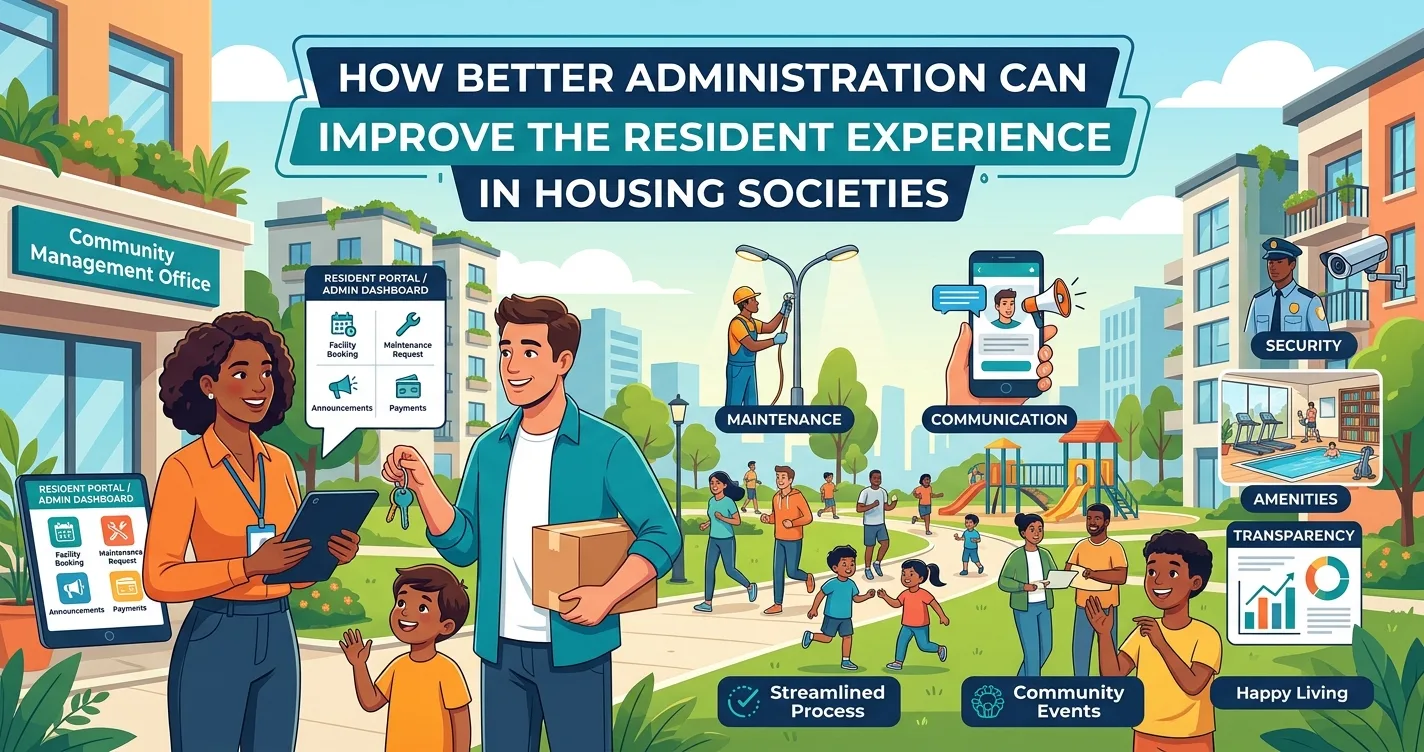
A housing society is not simply a group of buildings. It is a community where hundreds of people may share common facilities, infrastructure, services, security arrangements, and administrative systems.
The quality of society administration can have a direct impact on residents' daily lives. A delayed repair, inaccurate maintenance bill, missed announcement, unresolved complaint, or poorly managed vendor can quickly become a source of frustration.
Good administration helps prevent these problems by creating organized processes and clear responsibilities. With the right combination of people, procedures, and technology, housing societies can become more efficient and provide residents with a better living experience.
Why Administration Matters
Society administration covers a wide range of activities.
These may include:
- Financial management
- Maintenance coordination
- Resident communication
- Complaint handling
- Vendor management
- Record keeping
- Compliance
- Security coordination
- Community activities
When these functions work properly, residents may barely notice the administration behind them. When they fail, however, the problems become immediately visible.
Effective society administration can improve transparency, reduce disputes, support compliance, and increase resident satisfaction.
Start With Organized Records
Good administration begins with accurate records.
A society should maintain updated information about members, maintenance payments, vendors, assets, meetings, expenses, and important documents.
Paper records can be useful, but relying entirely on them makes information harder to access and manage.
Digital records can make it easier for authorized committee members to find information when required. They can also help ensure that important information is not lost when committee members change.
Make Maintenance Payments Convenient
Residents expect payment processes to be simple.
If residents have to repeatedly contact the committee to confirm bills or payment status, both residents and administrators lose valuable time.
Automated billing and online payment options can simplify the process.
A digital system can help generate bills, track payments, identify outstanding dues, and send reminders.
This also benefits the committee because payment records can be organized automatically rather than maintained through multiple spreadsheets.
Communicate Before Problems Occur
One of the easiest ways to improve resident satisfaction is to communicate proactively.
If an elevator is scheduled for maintenance tomorrow, residents should ideally know today. If water supply will be interrupted, residents should receive a clear notice in advance.
Proactive communication gives people time to prepare.
Research and industry guidance on apartment communities emphasizes timely communication as an important factor in improving transparency and reducing misunderstandings.
Provide a Clear Complaint Channel
Residents should know exactly where to report a problem.
If one resident calls the secretary, another sends a WhatsApp message, and another tells a security guard, the committee may struggle to track everything.
A centralized complaint system provides a clearer process.
The complaint can be recorded, assigned, monitored, and closed after resolution.
This is especially important for larger communities where dozens of complaints may be active at the same time.
Use Professional Support Where Necessary
Managing a large housing society can become overwhelming for volunteer committee members.
They may have limited experience with accounting, compliance, vendor management, or administrative procedures.
This is where professional assistance can provide value. Housing society management services can help communities handle administrative responsibilities in a more structured manner, allowing committee members to focus on governance and important decisions.
Professional support can be particularly helpful when a society is dealing with complex financial records, compliance requirements, multiple vendors, or a large resident base.
Improve Financial Visibility
Residents want confidence that their maintenance contributions are being used responsibly.
Financial transparency can be improved through accurate accounting, regular reporting, and appropriate sharing of information.
Committees can provide periodic summaries showing income, major expenses, outstanding dues, and significant projects.
Guidance for housing society financial management recommends regular monitoring of expenses, accurate accounting, maintenance tracking, and clear financial reporting.
Greater visibility can also encourage residents to pay their dues on time because they can see how the community is being managed.
Manage Vendors Professionally
The quality of external service providers has a major impact on residents.
A poorly performing security agency can create safety concerns. Delayed lift maintenance can inconvenience hundreds of residents. Inefficient housekeeping can affect the appearance and hygiene of common areas.
Vendor performance should therefore be monitored systematically.
The society can maintain records of contracts, service schedules, payment details, complaints, and renewal dates.
Regular performance reviews can help committees identify whether a vendor is meeting expectations.
Plan Preventive Maintenance
Waiting for equipment to break before repairing it can create unnecessary costs and inconvenience.
Preventive maintenance involves checking important systems regularly so that potential problems can be identified earlier.
Areas that may require regular attention include:
- Elevators
- Water pumps
- Electrical systems
- Fire safety equipment
- Generators
- Plumbing
- Common-area lighting
Regular maintenance planning can improve reliability and reduce unexpected breakdowns.
Encourage Resident Participation
Residents are more likely to support society initiatives when they feel involved.
Committees can encourage participation through surveys, feedback sessions, community events, and structured discussions.
Resident engagement can improve communication and help management understand what residents actually need.
For example, before spending money on a new recreational facility, a committee might survey residents about what facilities they would actually use.
This makes decision-making more community-oriented.
Keep Meetings Productive
Committee meetings should have clear objectives.
Instead of spending hours discussing unrelated complaints, meetings can follow an agenda covering:
- Previous action items
- Financial updates
- Maintenance issues
- Vendor performance
- Resident complaints
- Upcoming projects
- Compliance matters
- New proposals
Meeting minutes should record important decisions and assigned responsibilities.
This makes follow-up easier and reduces the chance that tasks will be forgotten.
Use Technology Carefully
Technology can support nearly every area of society administration, but committees should choose tools based on actual needs.
Useful features may include:
- Automated maintenance billing
- Online payment tracking
- Digital notices
- Complaint management
- Document storage
- Financial reporting
- Visitor management
- Resident directories
- Notifications
Modern society management guidance increasingly identifies these digital functions as useful for improving operational efficiency and resident communication.
The goal should be simplicity. A system that is difficult for residents or committee members to use may create more problems than it solves.
Protect Resident Information
Digital administration also creates a responsibility to protect personal information.
Societies should consider who has access to resident records and ensure that confidential information is not unnecessarily shared.
Access should be limited according to roles and responsibilities. Important digital records should also be backed up.
Technology should improve convenience without compromising privacy.
Measure Administrative Performance
Good management should be measurable.
A society can monitor indicators such as:
- Average complaint resolution time
- Maintenance collection rate
- Number of overdue complaints
- Vendor performance
- Pending maintenance work
- Resident participation
- Financial reporting frequency
Tracking these indicators can help committees identify recurring problems.
For example, if complaint resolution consistently takes too long, the committee can investigate whether the issue is related to vendor response times, unclear responsibilities, or insufficient follow-up.
Focus on Long-Term Community Development
Society administration should not focus exclusively on today's problems.
Committees should also consider long-term issues such as infrastructure upgrades, sustainability, security improvements, reserve funds, and property maintenance.
Good records and organized financial management make long-term planning easier.
A society that understands its financial position and infrastructure requirements can plan major projects more responsibly instead of reacting to emergencies.
Creating a More Positive Community
Ultimately, better administration should create a better community.
Residents want to feel that their concerns are heard and that the society is being managed responsibly.
When communication is clear, payments are convenient, complaints are tracked, finances are transparent, and maintenance is proactive, everyday life becomes easier.
These improvements may seem small individually, but together they can significantly change how residents experience their community.
Conclusion
Effective housing society administration requires coordination across many different areas. Financial management, maintenance, communication, compliance, vendor coordination, record keeping, and resident engagement all contribute to the quality of a residential community.
Technology can make these responsibilities easier to manage, while professional support can reduce the administrative burden on volunteer committee members.
The most successful societies are not necessarily those with the most complicated systems. They are the ones that establish clear processes, communicate consistently, maintain accurate records, respond to residents, and use appropriate technology to support their goals.
By adopting a structured approach to administration, housing societies can reduce operational challenges, improve transparency, strengthen resident trust, and create a more comfortable and efficiently managed environment for everyone.