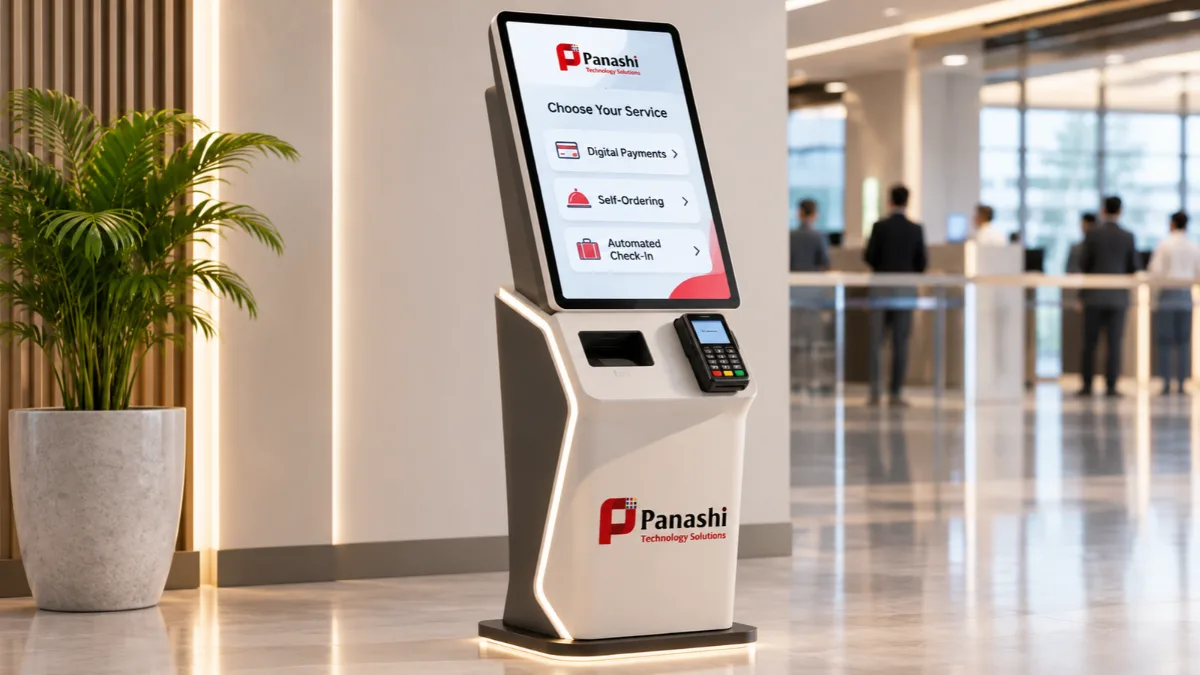
Businesses across Oman are modernising services as customers expect faster transactions, information and convenient access. A kiosk machine helps meet these expectations by letting people complete tasks independently while employees focus on work requiring personal attention. It can improve service consistency, reduce manual workload and support Oman’s digital transformation.
Where Can Kiosks Make the Biggest Difference?
The value of a kiosk depends on its task. In retail stores, customers can browse products, check availability and complete purchases. Restaurants can use a self ordering kiosk to display menus, support order customisation and send requests directly to kitchen systems. This reduces repeated order-taking and gives staff more time to serve customers.
Healthcare providers can streamline patient registration, appointment booking, doctor searches and bill payments. Banks and service centres can guide visitors, support form submission and help manage queues. Hotels, transport facilities and tourism operators can offer check-in, ticketing, directions and visitor information through an interface.
Government offices and utility providers can automate public services. A well-planned Kiosk system in Oman can make common transactions easier while helping organisations manage busy periods.
How Does Automation Improve Everyday Workflows?
Traditional counters require employees to repeat steps: collect details, verify information, enter requests and process payments. A self service kiosk transfers suitable parts of this process to a digital interface.
For example, a customer paying a bill can select the service, enter an account reference, review the amount and complete payment at the terminal. The transaction can connect with the organisation’s backend platform, reducing duplicate data entry. Staff remain available to resolve exceptions and assist customers.
Operational benefits include:
- Shorter queues during peak hours.
- More consistent customer information.
- Fewer manual entry errors in routine transactions.
- Extended access to services.
- Better visibility through transaction records and reporting.
These outcomes depend on reliable connectivity, clear workflows and maintenance. Automation should simplify a process, not reproduce unnecessary steps on a screen.
Why Must Accessibility Shape the Interface?
A kiosk is effective only when different users can operate it comfortably. Accessibility belongs in design, testing and installation rather than being added later.
Readable text, strong contrast, clear icons and intuitive navigation help users understand each step. Language options, including Arabic and English where appropriate, make instructions easier for Oman’s customer groups. Screen positioning should support seated and standing users, while reachable controls and uncluttered layouts reduce physical effort.
Interfaces should provide progress indicators, confirmation messages and simple ways to correct mistakes. Touch targets need sufficient size and spacing. For payments or personal information, screen angles should protect privacy. Businesses should test interfaces with users of different ages, abilities and levels of digital confidence.
What Should Businesses Consider Before Choosing a Kiosk?
Start by defining the service objective. Is the priority to accept payments, capture applications, issue tickets, support ordering or provide directions? The answer determines the screen, printer, scanner, card reader, cash module, camera and other peripherals required.
Hardware must suit its environment. Indoor terminals may prioritise appearance and compact design, while outdoor deployments need protection against heat, dust and humidity. In Oman, enclosure ratings, ventilation, component quality and placement deserve assessment.
Software is equally important. The kiosk should integrate with payment gateways, customer databases, enterprise platforms and operational systems. Secure data transmission, access controls, updates and transaction monitoring help protect service continuity. Confirm who handles installation, training, maintenance and technical support.
How Can Panashi Support Oman’s Requirements?
Panashi FZCO Pvt Ltd provides customised kiosk solutions for retail, hospitality, healthcare, banking, government, tourism and transportation. As a self service kiosk manufacturer in Oman, the company supports businesses with hardware, software integration, payment options and designs tailored to specific workflows.
Its solutions include patient check-in, bill payment, ticketing, wayfinding, employee services and restaurant ordering. A hospital terminal, for example, can bring registration, appointment search and payment into a guided process. Retail and hospitality deployments can connect customer selections with business systems.
Organisations comparing a Kiosk manufacturer in Oman should assess more than purchase price. Design, integration, usability, scalability and after-sales assistance influence long-term value. Panashi supports customised configurations so businesses can align each terminal’s appearance, components and interface with operating requirements.
Building Better Customer Experiences Through Practical Technology
A kiosk in Oman can do more than replace a queue. It can make services easier to navigate, give customers greater control and free employees to handle complex requests. Results come from matching technology to a defined need, designing for accessibility and connecting terminals reliably with existing systems.
For organisations planning digital upgrades, a kiosk machine in Oman offers a practical way to modernise everyday operations while keeping customer experience central. With suitable planning and ongoing support, kiosks can become a part of a responsive service environment.