Introduction
Every finance department eventually reaches the same crossroads: keep patching an aging on premise system, or move to the cloud. Soft Online Training has spent enough time inside this shift to notice something useful for students the companies making that move need people, and they need them now, not five years from now once someone's built a decade of experience.
That's actually good news if you're still in college or just graduated. Oracle Fusion Financials Online Training has become one of the more accessible doors into cloud ERP precisely because the demand is outpacing the supply of trained people. You don't need a finance degree or years on the job to start you need a clear grasp of the fundamentals, real hands on practice with the platform, and enough exposure to speak confidently about how it actually works in a business setting. Students who build that early often walk into their first job search already ahead of peers who waited until after graduation to start learning.
Why This Is a Smart Bet, Not Just a Trend
Cloud ERP adoption isn't a passing wave it's the direction the entire enterprise software industry has been heading for over a decade, and it's only accelerating as AI driven finance tools get layered on top of platforms like Oracle Cloud. For students entering now, that means:
- Consistent hiring demand across sectors, not a narrow niche
- Roles open across finance, healthcare, manufacturing, retail, and government
- Solid entry level pay relative to other fresh graduate options
- Skills that transfer across countries and industries
- A long runway for growth into consulting, analysis, and architecture roles
Start With the Finance Fundamentals
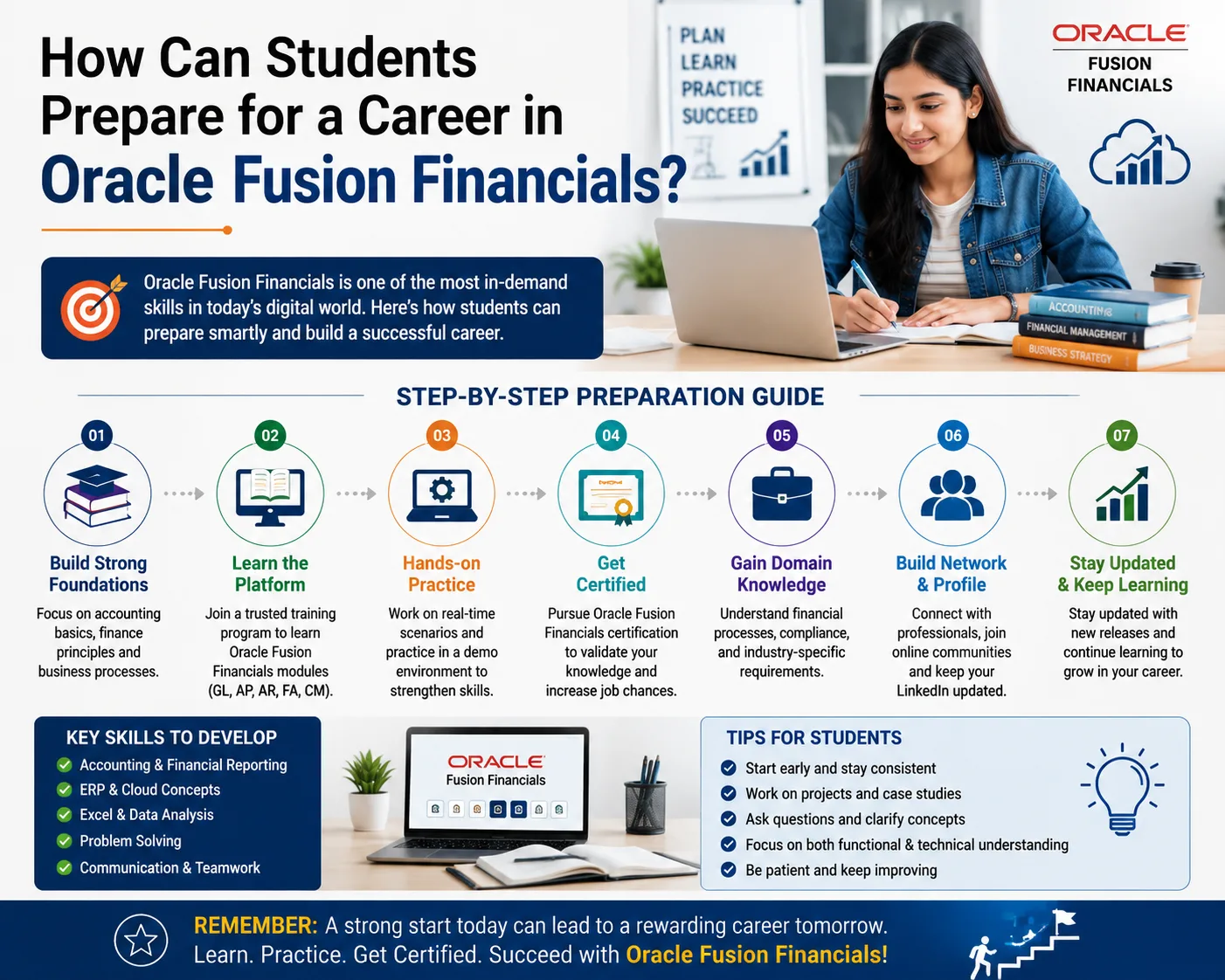
Before touching an Oracle Fusion Financials Course, spend time with the basics that everything else is built on: debits and credits, journal entries, the general ledger, trial balances, balance sheets, profit and loss statements, and how accounts payable and receivable actually function day to day. You don't need to be an accountant you need enough fluency that the software makes sense the first time you see it, instead of feeling like a foreign language.
Then, Understand Why ERP Exists at All
Oracle Fusion Financials only makes sense in context. Spend some time understanding what ERP systems are actually solving how they connect departments that used to operate in silos, why cloud beats on premise for most modern businesses, and how automation removes the manual busywork that used to eat up entire finance teams. Once that clicks, the software stops feeling abstract.
Choose Training That Actually Trains You
Not all courses are built the same. A genuinely useful Oracle Fusion Financials Online Training program should include live sessions with a real instructor, actual time inside Oracle Cloud (not just recorded slides), walkthroughs based on real implementation projects, assignments with real deadlines, and interview preparation woven into the program not bolted on at the very end as an afterthought.
Get Fluent in the Modules That Matter Most
Five modules show up in almost every entry level job posting:
- General Ledger (GL) chart of accounts, journals, periods, reporting
- Accounts Payable (AP) suppliers, invoices, approvals, payments
- Accounts Receivable (AR) customer billing, receipts, collections
- Cash Management (CM) bank reconciliation, cash positioning
- Fixed Assets (FA) asset lifecycle from creation to retirement
Get comfortable navigating each one, and most junior job descriptions stop sounding intimidating.
Practice Until It's Instinct, Not Memorization
Interviewers can tell within minutes whether someone has actually navigated Oracle Cloud or just memorized module names off a slide. Run through transactions, generate reports, work through implementation scenarios, and get comfortable with basic system testing and documentation the muscle memory matters more than the theory.
Soft Skills Aren't Optional
Oracle Fusion Financials professionals spend a huge chunk of their time translating between technical systems and non technical stakeholders. Communication, presenting clearly, staying organized under deadlines, and collaborating across teams aren't nice to haves here they're core to the job.
Build a Resume Around Substance
Skip the filler. List the specific modules you've worked with, real or simulated projects, certifications, and any internship exposure. Keep it tight and directly relevant to ERP work rather than padded with generic soft skill buzzwords.
Practice Interviews Before You Think You're Ready
Start rehearsing functional and scenario based questions early accounting basics, ERP concepts, and module specific problem solving. Mock interviews expose gaps that studying alone tends to hide.
Where the First Job Can Lead
Entry points typically include Functional Associate, ERP Support Executive, Cloud Financials Analyst, ERP Functional Trainee, and Business Process Associate roles each a reasonable stepping stone toward implementation consulting, business analysis, or solution architecture later on.
Why Soft Online Training
The program pairs live instruction from experienced Oracle professionals with hands on cloud practice, real implementation projects, resume support, mock interviews, and placement guidance designed to make students genuinely job ready, not just certificate holders.
The Learning Doesn't Stop After Graduation
Oracle rolls out cloud updates regularly, so staying sharp means following new releases, picking up advanced modules over time, earning additional certifications, and staying engaged with the broader ERP community.
Conclusion
Students who start early gain a real, measurable edge in a competitive job market. Understanding finance fundamentals, ERP logic, and getting genuine hands on Cloud practice builds a foundation that actually holds up in interviews. Through a well structured Oracle Fusion Financials Online Training program and a thorough Oracle Fusion Financials Course, students can build the technical and functional skills employers are actively hiring for and with mentoring and career support from Soft Online Training, landing that first Oracle Cloud ERP role becomes a near term goal, not a distant hope.