
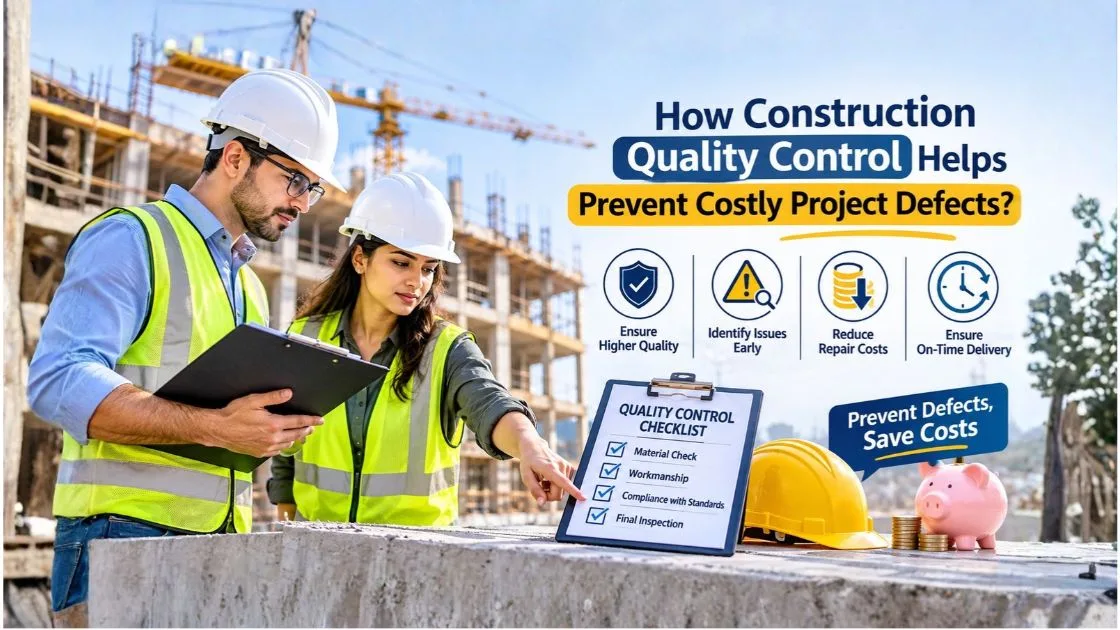
Summary - Construction quality control helps prevent costly project defects by identifying material failures, workmanship issues, testing problems, and construction errors before they become difficult and expensive to repair. Material testing, site inspections, concrete quality checks, reinforcement inspections, NDT, documentation, and corrective actions help reduce rework, delays, material waste, safety risks, and long-term maintenance costs.
A construction defect rarely becomes expensive overnight. A small material issue, incorrect reinforcement placement, poor curing practice, or workmanship problem can remain unnoticed until it affects another stage of the project.
That is why construction quality control needs to happen throughout the project, not just during the final inspection.
Regular material testing, site inspections, quality documentation, and timely corrective action help project teams identify problems while they are still manageable. The result is less rework, fewer delays, better durability, and greater confidence in the finished structure.
What Is Construction Quality Control?
Construction quality control is the systematic process of checking materials, workmanship, construction activities, and completed work against approved drawings, specifications, standards, and project requirements.
In simple terms, quality control asks:
“Is the work being constructed correctly, using the right materials, and does it meet the required performance criteria?”
It can involve:
- Construction material testing
- Concrete and steel testing
- Soil and aggregate testing
- Site inspections
- Reinforcement checks
- Dimensional and workmanship inspections
- Non-destructive testing
- Structural assessments
- Test reports and documentation
- Non-conformance reporting
- Corrective-action verification
Quality control works best when these activities are planned before problems occur rather than being used only after a defect is discovered.
Why Do Construction Defects Become So Costly?
The biggest problem with construction defects is that their repair cost usually increases as the project progresses.
Consider a concrete quality issue discovered immediately after testing. The affected work can be investigated before subsequent activities cover it.
Now consider discovering the same problem after plastering, flooring, electrical installation, painting, and other finishing activities have been completed. Investigation may require demolition, material replacement, additional labour, and schedule changes.
The cost chain can look like this:
Quality issue → missed inspection → hidden defect → rework → material wastage → delay → additional labour → higher project cost
Quality control breaks this chain by identifying the problem earlier.
How Does Quality Control Prevent Construction Defects?
1. It Identifies Defective Materials Before Use
Construction materials directly influence the performance of a building or infrastructure project.
Cement, concrete, reinforcement steel, aggregates, bricks, blocks, tiles, adhesives, grout, bitumen, and other materials may need testing or verification before they are incorporated into the work.
For example, if a material does not meet the specified strength or physical requirements, identifying the problem before installation can prevent a much larger failure later.
Material certificates are useful, but for critical applications, project-specific testing may provide additional quality assurance.
2. It Helps Control Concrete Quality
Concrete defects can have significant consequences because concrete is used throughout foundations, columns, beams, slabs, retaining structures, pavements, and other structural elements.
Quality control may include checking concrete sampling, workability, curing, mix requirements, and compressive strength.
For example, unexpected concrete test results can alert engineers to investigate a potential issue before the affected structure progresses to later stages.
For a deeper explanation of the role of concrete testing.
3. It Verifies Reinforcement and Workmanship
A structurally adequate design can still perform poorly if reinforcement is incorrectly installed.
Quality inspections can verify:
- Bar diameter
- Reinforcement spacing
- Lap length
- Anchorage
- Concrete cover
- Bar positioning
- Formwork condition
- Construction joints
Where reinforcement is concealed, appropriate scanning or non-destructive techniques can help investigate existing conditions.
Finding an incorrectly positioned reinforcement bar before concrete placement is considerably easier than discovering the issue after the concrete has hardened.
4. It Detects Hidden Problems Through NDT
Not every defect is visible from the surface.
Non-destructive testing can provide valuable information about existing concrete and structural elements without unnecessarily damaging them.
Depending on the investigation, methods may include:
- Rebound hammer testing and Ultrasonic Pulse Velocity
- Core testing
- Rebar scanning
- Crack investigation
- Concrete condition assessment
The appropriate method depends on the suspected problem, structure, material, and required information. NDT should not be treated as a one-size-fits-all solution.
5. It Controls Workmanship Before Finishes Hide Problems
Many construction defects are related to execution rather than material quality alone.
Poor compaction, inadequate curing, improper surface preparation, incorrect alignment, poor joint treatment, and unsuitable installation practices can create problems that become difficult to identify later.
Inspection checkpoints allow supervisors and quality teams to verify important work before the next activity begins.
This is especially important when one construction layer will permanently cover another.
What Are the Most Common Defects Quality Control Can Help Prevent?
| Potential Defect | Possible Cause | Quality-Control Measure |
| Concrete cracking | Poor curing, mix or workmanship | Concrete testing and inspection |
| Low concrete strength | Mix, material or curing issues | Compressive strength testing |
| Honeycombing | Poor compaction | Workmanship inspection and NDT |
| Reinforcement problems | Incorrect placement or cover | Reinforcement inspection/scanning |
| Tile debonding | Poor adhesive or surface preparation | Material and installation checks |
| Water leakage | Poor waterproofing/application | Material and site inspection |
| Road deterioration | Poor material or compaction | Road material testing |
| Structural distress | Material, design or execution issues | Structural investigation/testing |
The objective is not to eliminate every possible construction problem. It is to identify controllable risks early enough that corrective action remains practical.
How Does Quality Control Reduce Rework and Project Costs?
Rework is one of the clearest financial consequences of poor quality.
When completed work must be removed and reconstructed, the project pays for the original work and the replacement work. There may also be costs associated with labour, equipment, material disposal, testing, supervision, and schedule disruption.
A simple example is flooring.
If an adhesive or grout problem is identified before installation, the material can be reviewed or replaced. If widespread debonding appears after the flooring is completed, removing tiles, preparing the surface again, replacing material, and restoring finished areas can become significantly more expensive.
Quality control therefore acts as a cost-control mechanism, not merely an inspection activity.
What Is Construction Material Testing in PCMC and Why Does It Matter?
Building Material Testing Services in PCMC are particularly relevant because the Pimpri-Chinchwad region includes residential developments, industrial facilities, commercial buildings, infrastructure projects, warehouses, and redevelopment work.
The purpose is not simply to obtain a laboratory report. Testing helps determine whether construction materials meet the requirements specified for their intended application.
Depending on the project, testing may involve:
- Soil and aggregates
- Cement
- Concrete
- Reinforcement steel
- Bricks and blocks
- Tiles
- Adhesives and grouts
- Bitumen and road materials
- Other project-specific construction materials
For projects in PCMC and elsewhere in India, the testing requirements should be established according to the project specification, applicable standards, material type, and intended use.
This approach is more reliable than selecting tests simply because they are commonly performed.
When Should Quality Control Checks Be Performed?
Quality control should be integrated into different stages of construction.
Before Construction
- Review drawings and specifications
- Identify testing requirements
- Approve materials
- Establish inspection procedures
- Prepare quality documentation
A practical material review before work starts can help project teams identify important tests and approvals. This material testing checklist can be useful when planning those requirements.
During Foundation and Structural Work
- Check excavation and soil conditions
- Inspect reinforcement
- Verify formwork
- Check concrete placement
- Monitor curing
- Review test results
During Finishing Work
- Check waterproofing
- Inspect flooring and tile installation
- Verify adhesives and grouts
- Check surface preparation
- Inspect workmanship
Before Handover
- Complete final inspections
- Verify corrective actions
- Review test records
- Document outstanding defects
- Confirm required quality documentation
What Is an Inspection and Test Plan in Construction?
An Inspection and Test Plan (ITP) defines what needs to be inspected or tested, when the activity should occur, what acceptance criteria apply, and who is responsible for verification.
A useful ITP may identify:
- Inspection stages
- Testing frequency
- Applicable standards
- Acceptance criteria
- Hold points
- Witness points
- Required records
- Responsible personnel
The advantage is simple: important quality checks are planned before the work reaches the stage where a missed inspection becomes expensive.
For a broader explanation of project quality planning.
How Does Quality Control Improve Long-Term Building Performance?
The value of quality control does not end when a project receives completion approval.
Better control of materials and workmanship can contribute to:
- Improved durability
- Fewer recurring defects
- Lower maintenance requirements
- Reduced water ingress
- Better structural reliability
- Longer service life
- Fewer repair interventions
For example, controlling concrete quality and curing during construction can be much more effective than attempting to manage widespread cracking or deterioration years later.
Quality Control vs Quality Assurance: What Is the Difference?
Although the terms are often used together, they have different purposes.
Quality control (QC): focuses on checking actual materials, workmanship, and completed activities to identify non-conformities.
Quality assurance (QA): focuses on the processes and systems established to prevent quality problems from occurring.
A simple way to remember it is:
QA establishes the system. QC checks the work.
Strong construction projects generally need both. A well-designed quality system becomes much more effective when supported by consistent testing and inspection.
How Can Contractors Improve Construction Quality Control?
A practical quality-control strategy can start with a few straightforward steps:
- Define quality requirements early. Do not wait until construction begins to identify testing requirements.
- Prepare an Inspection and Test Plan. Establish inspection points, tests, standards, and acceptance criteria.
- Approve materials before use. Review specifications, certificates, and required laboratory results.
- Maintain traceability. Record batch numbers, test samples, suppliers, and relevant site information.
- Use appropriate testing methods. Select tests according to the material, application, and project requirement.
- Record non-conformities. Document defects instead of relying on verbal communication.
- Verify corrective actions. Closing an NCR should involve checking that the problem was actually resolved.
- Review recurring defects. Repeated problems may indicate a process issue rather than an isolated mistake.
Why Does NABL Accreditation Matter for Construction Testing?
For projects where accredited laboratory testing is required, the laboratory's accreditation status can be an important consideration.
However, NABL accreditation is scope-specific. A laboratory being NABL accredited does not automatically mean that every test it performs is covered by its accreditation.
The relevant test, parameter, and method should fall within the applicable accreditation scope when accredited testing is specifically required by the project.
This NABL accreditation guide provides additional context on accreditation and construction material testing.
Construction Quality Control Checklist
Before considering a major construction activity complete, project teams can ask:
- Are the required materials approved?
- Have specified material tests been completed?
- Are test results within acceptance criteria?
- Has reinforcement been inspected?
- Has concrete quality been verified?
- Are curing requirements being followed?
- Have workmanship checks been completed?
- Are required NDT or structural investigations complete?
- Have non-conformities been recorded?
- Have corrective actions been verified?
- Are test reports and inspection records traceable?
A checklist cannot replace engineering judgment, but it can prevent important routine checks from being overlooked.
Prevent the Defect Before It Becomes a Repair Bill
Construction quality control is most valuable when it happens before a defect becomes expensive. A concrete test, reinforcement inspection, material verification, or workmanship check may seem like a small step during construction, but it can prevent much larger costs later.
For contractors, developers, consultants, and project teams, the practical approach is to identify critical materials and activities early, establish clear acceptance criteria, use appropriate testing and inspection methods, and document the results throughout the project.
If you are planning a residential, commercial, industrial, or infrastructure project in PCMC, Pune, Mumbai, Navi Mumbai, or elsewhere in India, start by identifying which materials and construction stages require independent testing or inspection. Discuss the required parameters, applicable standards, and testing scope with a qualified construction-material testing laboratory before critical work progresses.
Early quality control is not an additional project burden—it is one of the most practical ways to prevent avoidable defects, protect the construction budget, and deliver work that performs as expected.
Frequently Asked Questions
How does construction quality control prevent defects?
It prevents defects by checking materials, workmanship, construction processes, and completed work against defined requirements. Early testing and inspection allow problems to be corrected before they become more expensive.
How does quality control reduce construction costs?
It reduces rework, material waste, labour duplication, project delays, repair expenses, and long-term maintenance caused by avoidable defects.
What is the most important part of construction quality control?
There is no single universal check. Effective QC combines material testing, inspections, process control, documentation, appropriate testing methods, and timely corrective action.
Why is material testing important in construction?
Material testing helps verify whether construction materials have the required physical, mechanical, and performance characteristics for their intended application.
What is the difference between QA and QC in construction?
QA focuses on establishing processes that support consistent quality, while QC focuses on inspecting and testing actual materials and construction work.
When should construction materials be tested?
Testing may be required before material approval, during procurement and quality control, before or during installation, or when a project specification requires verification.