Nonprofit organizations depend on donations, grants, sponsorships, CSR contributions, and other funding sources to support their programs and social initiatives. Managing these funds effectively requires accurate tracking, transparent reporting, proper budgeting, and strong financial controls.
When fund management relies on spreadsheets, manual records, and disconnected accounting systems, nonprofits can face problems such as inaccurate fund balances, delayed reporting, difficulty tracking restricted funds, budget overruns, and limited visibility into how money is being utilized.
This is where ERP software for nonprofit fund management can make a significant difference.
An ERP system connects fund management with accounting, donations, grants, expenses, procurement, projects, reporting, and compliance in one centralized platform. This helps nonprofit organizations improve financial visibility, strengthen accountability, and make better decisions about how their resources are allocated.
What Is Nonprofit Fund Management?
Nonprofit fund management is the process of tracking, controlling, allocating, and reporting funds received by an organization.
Unlike conventional businesses, nonprofits often manage multiple funding sources with different purposes and restrictions. Funds may come from individual donors, government grants, CSR programs, foundations, corporate sponsors, membership contributions, or fundraising campaigns.
Each funding source may have specific requirements regarding how the money can be spent and reported.
Effective nonprofit fund management therefore involves:
- Tracking donations and funding sources
- Managing restricted and unrestricted funds
- Monitoring budgets
- Recording expenses
- Tracking grants and programs
- Managing fund utilization
- Preparing financial reports
- Maintaining audit trails
- Ensuring compliance
- Providing transparency to donors and stakeholders
An integrated ERP can bring these activities together and provide a centralized view of financial resources.
Why Nonprofits Struggle With Fund Management
Nonprofit organizations often manage multiple programs, donors, grants, projects, and funding restrictions simultaneously. When these activities are managed through spreadsheets or separate systems, maintaining accurate financial information becomes difficult.
Common challenges include:
1. Fragmented Fund Records
When donations, grants, expenses, and accounting information are maintained in different systems, nonprofit teams may struggle to determine the current balance and utilization of individual funds.
2. Difficulty Tracking Restricted Funds
Restricted funds can only be used for specific purposes defined by the donor or grant provider. Without proper tracking, organizations may accidentally allocate funds to inappropriate expenses.
3. Manual Budget Tracking
Monitoring program budgets manually can make it difficult to identify overspending or unused funds before corrective action can be taken.
4. Delayed Financial Reporting
Nonprofits often need to prepare reports for donors, grant providers, management, auditors, and regulatory authorities. Manual data consolidation can make reporting slow and error-prone.
5. Limited Fund Utilization Visibility
Management may know how much money was received but have limited visibility into how much has been spent, where it was spent, and how much remains available.
6. Compliance and Audit Challenges
Nonprofits need reliable records and supporting documentation to demonstrate responsible use of funds. Disconnected systems can make audit preparation more difficult.
How ERP Improves Nonprofit Fund Management
An ERP system provides a centralized platform for managing nonprofit funds from receipt through allocation, expenditure, and reporting.
Here are the major ways ERP improves nonprofit fund management.
1. Centralizes Fund Information
ERP brings financial information from different funding sources into one centralized system.
Organizations can track:
- Donor contributions
- Grant funding
- CSR funds
- Program budgets
- Fund allocations
- Expenses
- Payments
- Available balances
- Fund utilization
This provides nonprofit management with a clearer view of the organization's financial position.
Instead of maintaining separate spreadsheets for every donor, grant, or project, teams can work with connected financial information.
2. Improves Donor Fund Tracking
Donor transparency is an important part of nonprofit financial management.
ERP can connect donor information with donations, receipts, fund allocations, and related expenses. This helps organizations understand where contributions came from and how they are being utilized.
For example, a donation received for an education program can be linked to the appropriate fund, project, expenses, and financial reports.
This creates a clearer connection between:
Donor → Donation → Fund → Program → Expense → Impact
3. Manages Restricted and Unrestricted Funds
Nonprofits often receive both restricted and unrestricted funding.
Restricted funds may need to be used for a specific program, project, geographic location, or purpose, while unrestricted funds can generally be allocated according to organizational priorities.
ERP can help organizations maintain separate fund records and monitor how each funding source is being utilized.
This reduces the risk of accidentally using restricted funds for unrelated expenses.
4. Improves Budget Management
Budget control is essential for nonprofit organizations because resources must be allocated carefully.
ERP allows organizations to create budgets for different:
- Programs
- Projects
- Departments
- Grants
- Funding sources
- Activities
Actual expenses can then be compared with planned budgets.
This helps management identify budget variances and take corrective action before spending moves significantly beyond approved limits.
5. Tracks Grant Funding and Expenses
Grant-funded programs often require detailed financial tracking.
ERP can help organizations monitor grant amounts, approved budgets, expenses, project activities, and remaining balances.
For example, a nonprofit receiving a grant for a healthcare program can track the grant against expenses such as medical supplies, personnel, transportation, and program activities.
This creates greater visibility into grant utilization and makes financial reporting easier.
6. Automates Fund Allocation
Manual fund allocation can create errors and delays.
With ERP, organizations can establish structured workflows for allocating funds to specific programs, projects, departments, or activities.
Once funding is allocated, related transactions can be recorded against the appropriate fund.
This creates a more organized process for managing financial resources.
7. Improves Expense Tracking
Every nonprofit expense should be associated with the appropriate financial purpose.
ERP allows organizations to record and categorize expenses while connecting them with relevant funds, projects, grants, departments, or programs.
This helps management understand:
- Where money was spent
- Which program incurred the expense
- Which fund financed the activity
- How much budget remains
- Whether spending is aligned with the approved plan
Better expense visibility supports stronger financial control.
8. Provides Real-Time Fund Balances
Manual fund tracking often requires employees to calculate balances using multiple spreadsheets and accounting records.
ERP can provide real-time information about available funds, committed amounts, actual expenses, and remaining budgets.
Management can therefore quickly answer questions such as:
How much funding is available?
How much has already been spent?
Which programs are approaching their budgets?
Which grants still have unused funds?
This improves financial decision-making.
9. Strengthens Financial Transparency
Transparency is essential for building trust with donors, grant providers, boards, and other stakeholders.
ERP maintains structured financial records that show how funds move through the organization.
Organizations can use these records to demonstrate:
- Funds received
- Funds allocated
- Expenses incurred
- Program spending
- Remaining balances
- Financial transactions
This makes it easier to provide accurate and consistent financial information to stakeholders.
10. Simplifies Financial Reporting
Nonprofits often need different reports for different audiences.
Management may require internal budget reports, while donors and grant providers may need fund utilization reports. Auditors may require detailed transaction records and supporting documentation.
ERP can generate reports based on fund, donor, project, program, grant, department, or accounting information.
This reduces the need to manually consolidate data from multiple spreadsheets.
11. Supports Audit Trails
A reliable audit trail helps nonprofits demonstrate how financial transactions were created, approved, and recorded.
ERP maintains transaction histories and provides greater visibility into financial activities.
Organizations can track changes and transactions related to:
- Donations
- Fund allocations
- Expenses
- Payments
- Purchases
- Transfers
- Adjustments
This can simplify audit preparation and improve financial accountability.
12. Connects Fund Management With Accounting
Fund management should not operate separately from accounting.
ERP connects nonprofit fund information with accounts payable, receivables, general accounting, purchasing, payments, and financial reporting.
This means financial transactions can flow through connected processes instead of being manually entered into multiple systems.
For example:
Donation Received → Fund Updated → Allocation Recorded → Expense Incurred → Payment Processed → Financial Report Updated
This creates a more connected financial workflow.
13. Improves Program-Level Financial Management
Nonprofits often operate several programs simultaneously.
ERP can help organizations monitor the financial performance of individual programs by connecting program budgets with actual expenses and funding sources.
Management can identify which programs are within budget, which require additional resources, and where spending patterns need attention.
This supports more effective resource allocation.
14. Helps Manage CSR Funds
Corporate Social Responsibility funding can involve specific projects, budgets, timelines, and reporting requirements.
ERP can help nonprofits track CSR contributions from receipt through allocation and utilization.
Organizations can connect CSR funding with specific programs and expenses, making it easier to demonstrate how corporate contributions were used.
15. Enables Data-Driven Fund Management
ERP transforms financial transactions into useful insights.
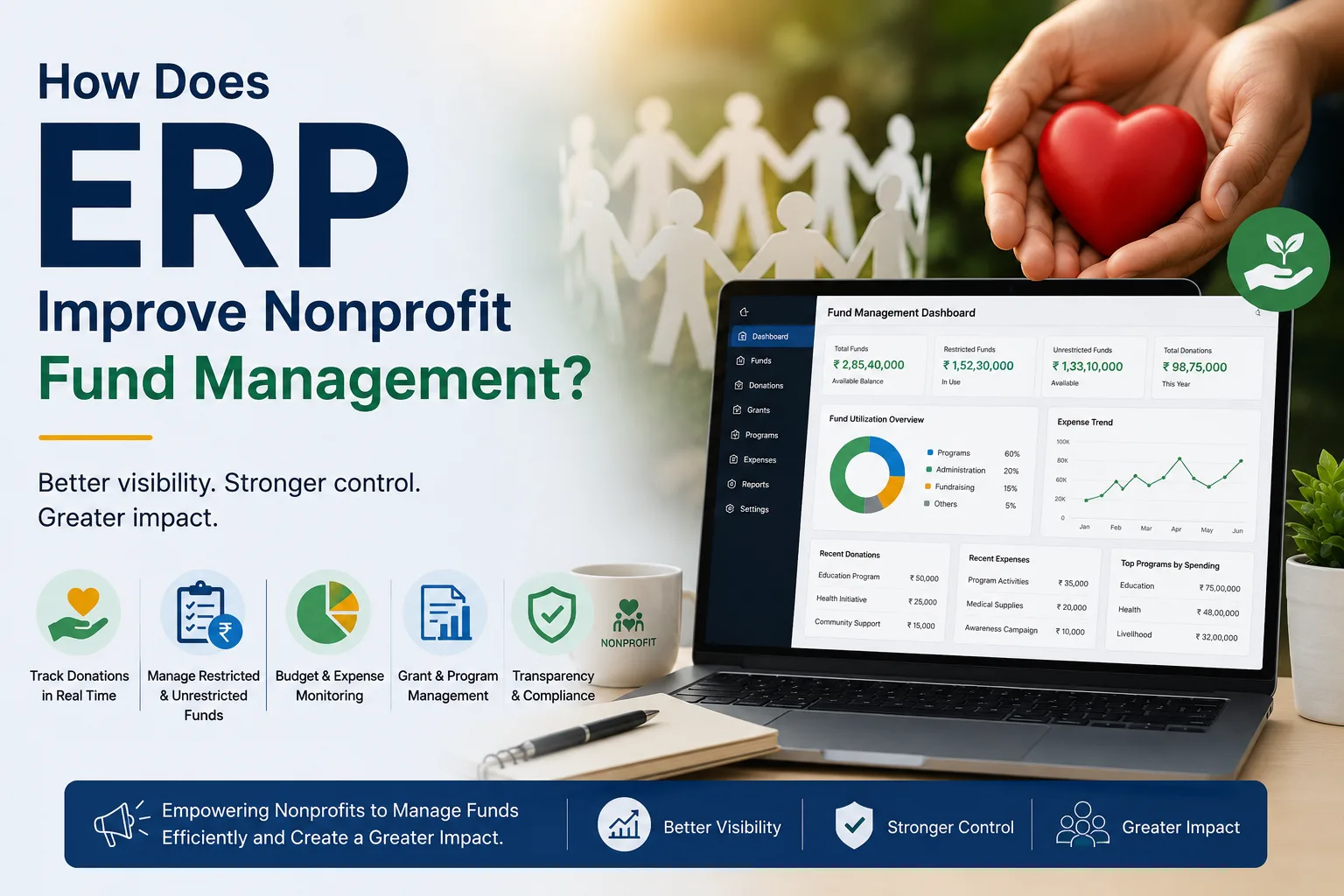
Management can use dashboards and reports to monitor:
- Total funds received
- Fund utilization
- Program expenses
- Grant balances
- Budget performance
- Donor contributions
- Outstanding payments
- Expense trends
- Available resources
These insights help nonprofit leaders make informed decisions about funding and program priorities.
Key Benefits of ERP for Nonprofit Fund Management
ERP helps nonprofit organizations create a more structured approach to financial management by improving visibility, reducing manual work, strengthening fund tracking, and simplifying reporting.
The biggest benefits include better control over restricted funds, improved donor transparency, more accurate budget monitoring, faster financial reporting, stronger audit readiness, and better resource allocation.
Most importantly, ERP allows nonprofit organizations to spend less time consolidating financial information and more time focusing on their programs and social mission.
What Should Nonprofit Fund Management ERP Include?
When selecting nonprofit fund management software, organizations should consider features such as:
- Donor and donation management
- Fund accounting
- Restricted and unrestricted fund tracking
- Grant management
- Program and project management
- Budget management
- Fund allocation
- Expense tracking
- Financial reporting
- Audit trails
- Payment management
- Procurement integration
- Accounting integration
- Real-time dashboards
- Role-based access
- Compliance reporting
- Multi-fund management
- Custom reports
- Mobile access
- Third-party integrations
The exact requirements will depend on the nonprofit's funding structure, programs, reporting requirements, and operational complexity.
Why ERPNext Can Be Suitable for Nonprofit Fund Management
ERPNext provides integrated capabilities across accounting, purchasing, projects, inventory, human resources, and other business processes. For nonprofit organizations, these capabilities can provide a foundation for connecting financial management with operational activities.
With appropriate configuration and customization, ERPNext can support workflows around donations, funds, grants, projects, expenses, accounting, reporting, and organizational operations.
However, nonprofit organizations should evaluate their specific fund structures, compliance requirements, donor reporting needs, and program workflows before selecting and implementing an ERP system.
How Matiyas Helps Nonprofit Organizations
Matiyas helps nonprofit organizations implement and customize ERP solutions around their operational and financial requirements.
The solution can connect:
Donors → Funds → Programs → Expenses → Accounting → Reporting
Matiyas can support nonprofit workflows such as donor management, fund tracking, grant management, program management, accounting, budgeting, inventory, procurement, reporting, compliance, and financial dashboards.
The goal is to provide nonprofit organizations with a centralized system that improves financial visibility while reducing manual administrative work.
Conclusion
Effective fund management is essential for nonprofit organizations because every contribution must be used responsibly, transparently, and in alignment with its intended purpose.
ERP software helps nonprofits centralize fund information, track donations and grants, manage restricted funds, monitor budgets, record expenses, simplify reporting, and maintain stronger financial controls.
By connecting funds, donors, programs, expenses, accounting, and reporting in one system, ERP can give nonprofit leaders better visibility into their financial resources and help them make more informed decisions.
For organizations managing multiple donors, grants, programs, and funding requirements, a properly configured ERP can become a central platform for improving fund transparency, accountability, and operational efficiency.