Asset tokenization is becoming one of the most practical applications of blockchain technology. From real estate and commodities to private equity, funds, and collectibles, businesses are exploring ways to represent real world assets digitally and make ownership easier to manage.
But building a successful tokenization platform is not simply a matter of creating tokens and putting them on a blockchain. A professional solution needs the right combination of blockchain technology, asset management, investor experience, security and regulatory compliance.
This guide explains how to approach Asset Tokenization Platform Development in 2026, including its essential features, development process, technology considerations, and estimated cost.
What Is an Asset Tokenization Platform?
An asset tokenization platform development is a blockchain-based application that allows businesses to represent ownership rights or economic interests associated with real-world assets through digital tokens.
For example, consider a commercial property valued at $10 million. Instead of structuring ownership around a single investor, a business may create a legally compliant fractional ownership model where eligible investors can hold smaller interests represented digitally.
The platform can manage the asset throughout its lifecycle—from onboarding and token issuance to investor management, transfers, reporting, and administration.
Why Build an Asset Tokenization Platform in 2026?
The growing interest in real-world asset tokenization is encouraging businesses to explore blockchain-based infrastructure for traditional markets.
A well-designed platform can provide several advantages:
- Fractional ownership: High-value assets can potentially be divided into smaller investment units.
- Greater transparency: Blockchain provides a verifiable record of transactions.
- Automation: Smart contracts can automate predefined token-related processes.
- Efficient administration: Digital workflows can simplify investor and ownership management.
- Improved accessibility: Depending on regulations and the asset structure, tokenization can broaden participation.
- Programmable ownership: Tokens can include rules governing transfers, eligibility, and other conditions.
The real opportunity lies in connecting traditional assets with a digital infrastructure that is easier to manage and scale.
Key Features of an Asset Tokenization Platform
A professional Asset Tokenization Platform Development project should focus on functionality that serves both platform operators and investors.
1. Asset Onboarding
The platform should allow administrators to register assets and maintain information such as ownership documents, asset valuation, asset category, token supply, and supporting records.
2. Token Creation and Issuance
Token issuance is the core function of the platform. Administrators should be able to define token parameters, supply, ownership rights, and issuance conditions based on the underlying legal structure.
3. Investor Onboarding
Investors need a straightforward registration process that can include identity verification, eligibility assessment, and other required compliance checks.
4. KYC and AML Integration
Compliance should be built into the platform rather than treated as an afterthought. KYC and AML integrations can help verify investors and support required monitoring procedures.
5. Digital Wallet Integration
Users need secure wallets to receive, hold, and transfer their eligible tokens. The platform can support custodial, non-custodial, or third-party wallet models depending on its business structure.
6. Smart Contract Management
Smart contracts can automate token issuance, transfers, distribution rules, and other predefined operations.
7. Investor Dashboard
An intuitive dashboard can allow investors to view their token holdings, transaction history, asset information, and relevant documents.
8. Admin Dashboard
Platform operators need complete visibility into assets, investors, token supply, transactions, compliance status, and platform activity.
9. Transfer Management
If the token is subject to transfer restrictions, the platform should be capable of checking investor eligibility before allowing a transaction.
10. Reporting and Analytics
Reports can provide information about ownership, transactions, investor activity, asset performance, and compliance operations.
How to Build an Asset Tokenization Platform
Building a tokenization platform requires a structured development strategy.
Step 1: Define the Business Model
Start by answering some fundamental questions:
- What assets will be tokenized?
- Who are the target investors?
- Which countries will the platform serve?
- What rights will token holders receive?
- Will the platform support primary issuance only or secondary trading as well?
These decisions influence the legal structure, technology stack, and overall platform architecture.
Step 2: Analyze Legal and Regulatory Requirements
This is one of the most important stages.
A token may be treated differently depending on what it represents and where it is offered. Therefore, businesses should obtain appropriate legal advice and determine applicable securities, financial-services, AML/KYC, tax, data-protection, and other regulatory obligations.
The platform architecture should then reflect those requirements.
Step 3: Choose the Blockchain
There is no single blockchain that is perfect for every tokenization project.
Selection should consider:
- Transaction speed
- Network fees
- Security
- Smart-contract capabilities
- Ecosystem maturity
- Interoperability
- Institutional requirements
- Long-term scalability
The blockchain should support the asset and business model rather than being selected simply because it is popular.
Step 4: Design the Token Model
The next step is defining what the token actually represents.
The token could represent an ownership interest, economic rights, debt exposure, revenue participation, or another legally structured interest.
This stage should align the token's technical behavior with its legal and commercial purpose.
Step 5: Develop Smart Contracts
Developers can then create smart contracts for token issuance and management.
Depending on the token structure, contracts may include functions for:
- Minting
- Burning
- Transfers
- Ownership tracking
- Whitelisting
- Transfer restrictions
- Distribution mechanisms
- Administrative controls
Smart contracts should undergo thorough testing and security review before production deployment.
Step 6: Build the User and Admin Interfaces
The front end should make a technically complex system easy to use.
Investors may need to register, complete verification, review assets, purchase eligible tokens, manage wallets, and track holdings.
Administrators need tools for asset onboarding, token issuance, investor management, compliance monitoring, transaction oversight, and reporting.
Step 7: Integrate Security and Compliance
Security should be implemented across the entire platform.
Important areas include:
- Multi-factor authentication
- Role-based access control
- Secure wallet management
- Encryption
- Smart-contract auditing
- Transaction monitoring
- KYC/AML integration
- Data protection
- Activity logging
Step 8: Test and Launch
Before launch, the platform should go through functional testing, smart-contract testing, security assessment, performance testing, and user acceptance testing.
A controlled launch can help identify operational issues before the platform is opened to a larger audience.
Technology Stack for Asset Tokenization
The technology stack depends on the platform's requirements, but a typical architecture can include:
Blockchain Layer: Ethereum, Polygon, BNB Chain, Avalanche, or another suitable network
Smart Contracts: Solidity or another blockchain-compatible smart-contract language
Backend: Node.js, Python, Java, or similar technologies
Frontend: React, Angular, Next.js, or comparable frameworks
Database: PostgreSQL, MongoDB, or another appropriate database
Wallets: Custodial or non-custodial wallet infrastructure
Security: Encryption, access controls, monitoring, and smart-contract audits
The final technology stack should be selected based on scalability, security, integrations, and business requirements rather than following a fixed template.
How Much Does Asset Tokenization Platform Development Cost in 2026?
The cost varies considerably because tokenization platforms can range from a relatively focused issuance platform to a full ecosystem with compliance, custody, trading, and multi-chain functionality.
A broad estimate can look like this:
Platform TypeEstimated CostBasic Tokenization Platform$25,000 – $50,000Standard Platform$50,000 – $100,000Advanced Platform$100,000 – $200,000+Enterprise-Grade Platform$200,000+These figures are indicative rather than fixed prices.
The final Asset Tokenization Platform Development Cost depends on factors such as:
- Number of features
- Blockchain selection
- Smart-contract complexity
- UI/UX requirements
- KYC/AML integrations
- Wallet infrastructure
- Asset-management functionality
- Secondary-market requirements
- Multi-chain support
- Security auditing
- Third-party integrations
- Regulatory and legal requirements
- Development team location and expertise
How Long Does Development Take?
Development timelines also depend on the platform's complexity.
A basic MVP may take a few months, while a feature-rich enterprise platform can require significantly longer.
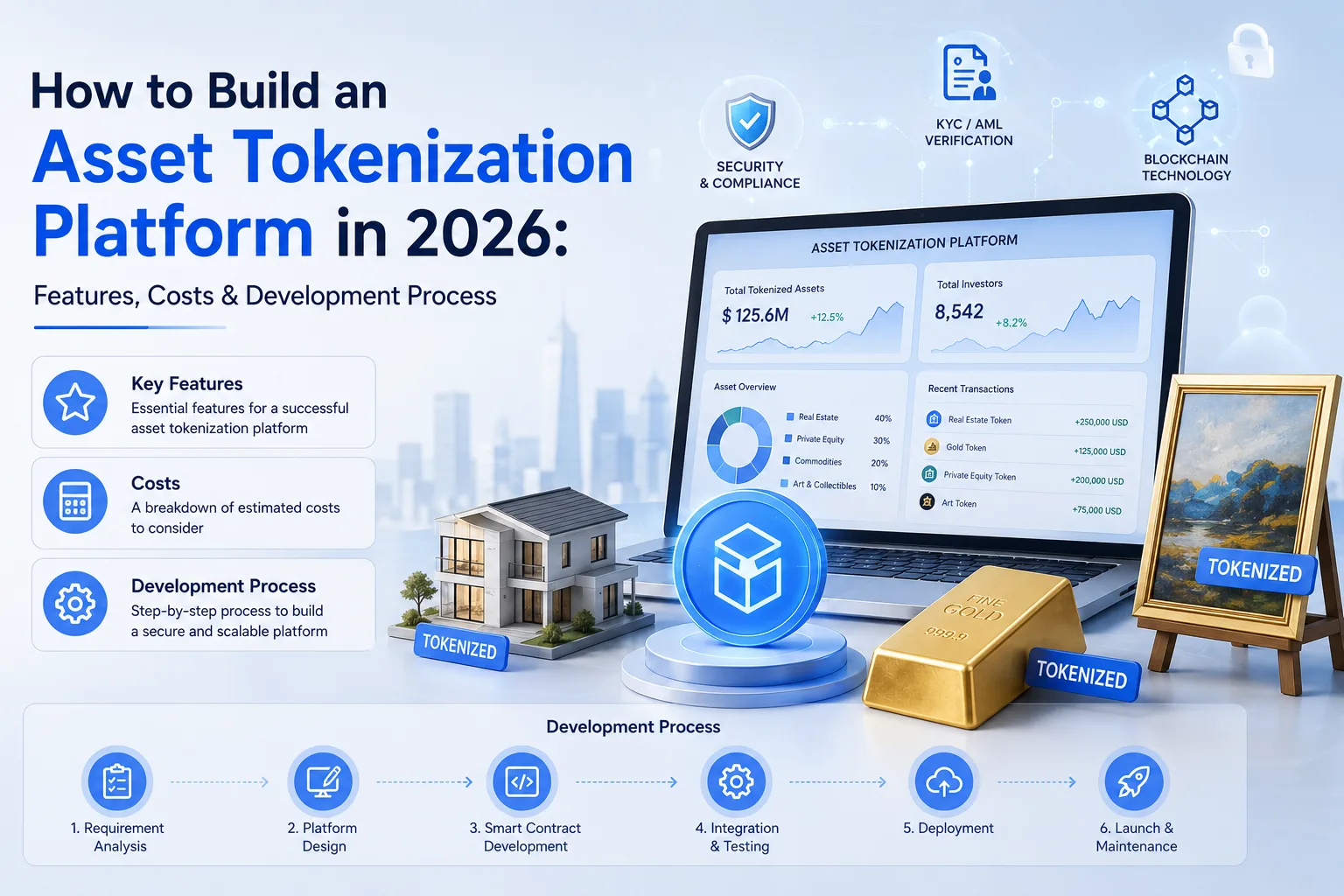
A typical development cycle includes:
Planning & Research → UI/UX Design → Architecture → Smart Contracts → Backend → Frontend → Integrations → Testing → Security Audit → Deployment
Rushing the development process can create unnecessary security and compliance risks, so businesses should prioritize quality over simply targeting the shortest possible timeline.
Common Mistakes to Avoid
Businesses entering tokenization often focus heavily on blockchain and overlook the broader ecosystem.
Some common mistakes include:
Ignoring Regulatory Requirements
A technically functional token may still create serious problems if its legal structure is not properly established.
Building Without a Clear Asset Model
The platform should be designed around the rights associated with the underlying asset.
Treating Security as an Add-On
Smart-contract vulnerabilities or poor wallet security can undermine the entire platform.
Creating a Complicated User Experience
Investors should not need blockchain expertise to navigate the platform.
Choosing a Blockchain Without Long-Term Planning
Network selection should consider future scalability, integrations, liquidity, and business expansion.
What to Look for in an Asset Tokenization Development Company
Choosing the right development partner can significantly affect the success of the project.
Look for a company with experience in:
- Blockchain development
- Smart-contract development
- Token standards
- KYC/AML integrations
- Wallet infrastructure
- Asset-management systems
- Security testing
- Multi-chain development
- Enterprise application development
More importantly, the development team should understand that tokenization is a combination of technology, finance, legal structure, and user experience.
The Future of Asset Tokenization in 2026 and Beyond
Asset tokenization is evolving from an experimental blockchain use case into a broader digital-asset infrastructure opportunity.
As businesses become more comfortable with blockchain-based ownership and settlement, tokenization can potentially support new approaches to investment, asset management, and financial-market infrastructure.
The platforms that succeed will not necessarily be those that simply issue the most tokens. They will be the ones that combine strong technology, practical asset models, regulatory awareness, security, and a smooth investor experience.
Conclusion
Building an asset tokenization platform in 2026 requires much more than blockchain development. Businesses need a well-defined asset model, appropriate regulatory strategy, secure smart contracts, investor-focused interfaces, and scalable infrastructure.
From asset onboarding and token issuance to KYC/AML, wallet management, compliance controls, and reporting, every component contributes to the platform's long-term success.
With a professional approach to Asset Tokenization Platform Development, businesses can create a scalable digital ecosystem designed to bring traditional assets into the evolving blockchain economy.