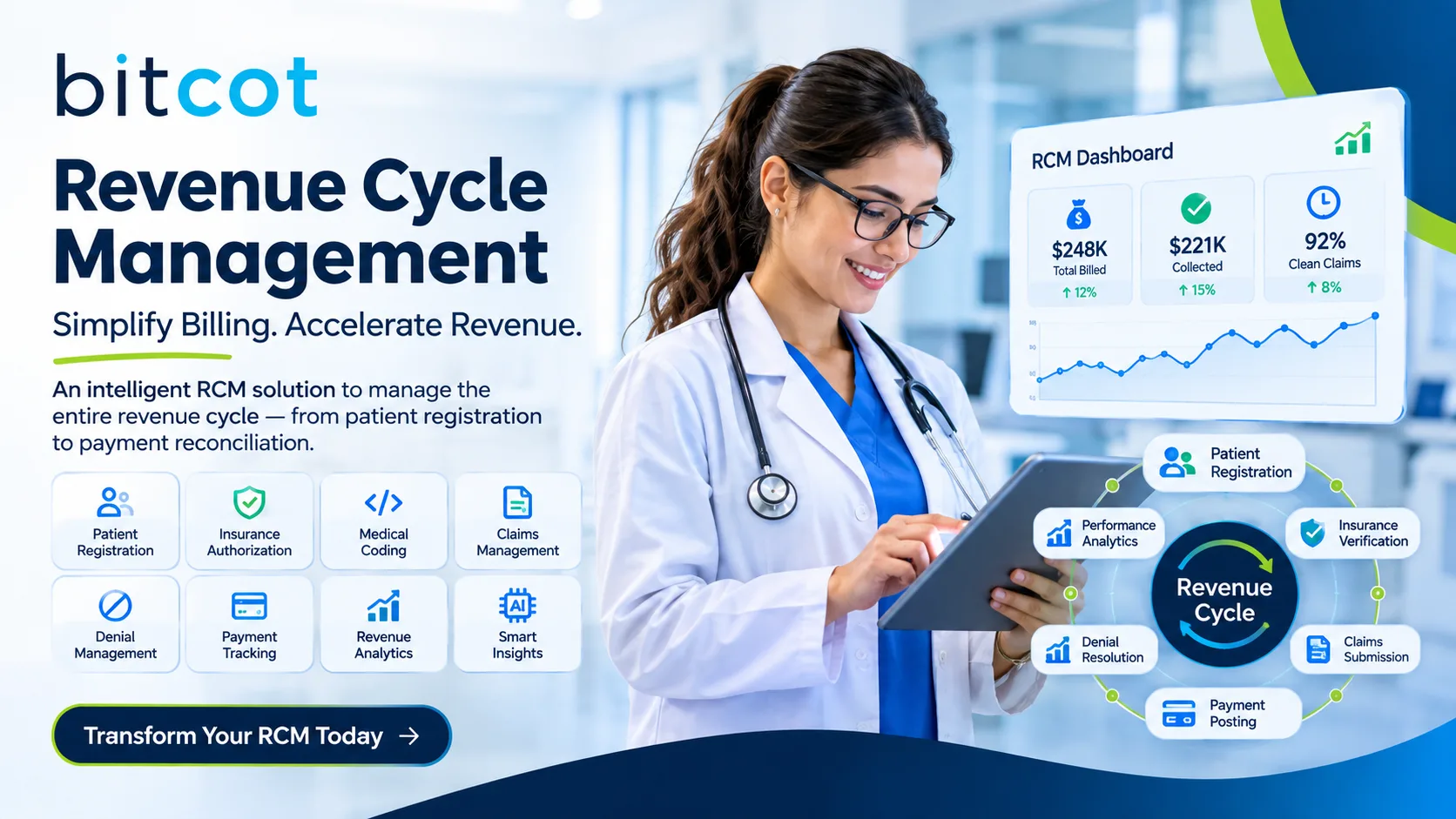
Healthcare billing involves several connected processes, including patient registration, insurance verification, medical coding, claims processing, payment tracking, and denial management. Managing these activities through disconnected systems can create administrative challenges and limit financial visibility.
For outpatient healthcare practices across the United States, modern Revenue Cycle Management (RCM) software offers a way to organize billing operations, improve workflow coordination, and monitor the financial performance of healthcare services.
Common Challenges in Healthcare Revenue Cycle Management
Revenue cycle management connects patient-facing administrative activities with the financial operations of a healthcare organization. When information is distributed across multiple systems, billing teams may face difficulties tracking claims, identifying errors, and following up on outstanding payments.
Common challenges include incomplete patient registration, insurance eligibility issues, prior authorization delays, medical coding inconsistencies, claim rejections, and limited visibility into unpaid or denied claims.
An integrated RCM platform can help healthcare organizations address these challenges through centralized workflows and better information management.
Essential Features of Modern RCM Software
An effective RCM solution should support the complete billing lifecycle.
1. Patient Registration and Insurance Management
Accurate patient registration is the foundation of efficient billing. Software should support patient demographics, insurance information, and authorization records while providing visibility into eligibility and authorization statuses.
2. Medical Coding and Encounter Management
Medical coding workflows should support ICD-10 diagnosis codes and CPT/HCPCS procedure codes. Connecting encounter documentation with billing activities can help reduce inconsistencies before claims are prepared.
3. Automated Claims Processing
Claim management tools can organize claims across different stages, including draft, submission, acceptance, rejection, denial, and payment. Configurable validation rules can identify missing or incorrect information before submission.
4. Denial and Payment Management
Centralized denial tracking helps billing teams review rejection reasons, prioritize follow-ups, and monitor outstanding claims. Payment tracking and aging reports also provide better visibility into revenue collection.
5. Revenue Analytics and Reporting
Real-time dashboards can help administrators monitor claim performance, outstanding balances, payment activity, and overall billing operations.
How Artificial Intelligence Supports RCM Operations
Artificial intelligence is creating new opportunities to improve healthcare administration. Within RCM platforms, AI-assisted capabilities can support medical coding suggestions, claim risk assessment, denial-pattern analysis, and billing workflow optimization.
For example, coding assistance can recommend relevant diagnosis and procedure codes for professional review. Similarly, denial analytics can help identify recurring billing issues and highlight opportunities to improve claim validation.
Human oversight remains important, particularly when AI-generated suggestions involve sensitive billing or patient information.
Developing Multi-Tenant RCM Software for Healthcare Practices
Healthcare organizations often require software that accommodates different facilities, user roles, and operational workflows.
Bitcot developed a Revenue Cycle Management platform that evolved from a specialty-specific prototype into a multi-tenant billing application designed for outpatient healthcare practices.
The implementation covered six major functional areas:
- Foundation: Authentication, role-based access control, session management, and audit logging.
- Front Desk: Patient registration, demographics, insurance details, and authorization records.
- Provider: Patient encounters, diagnosis and procedure coding, and authorization checks.
- Billing: Claim creation, validation, payment tracking, and denial management.
- Administration: Revenue dashboards, user management, notifications, and configurable claim-scrubbing rules.
- Patient Portal: Balance visibility, online card payments, and digital receipts.
The platform also incorporates organization-level data separation, server-side permission checks, and database Row-Level Security (RLS) to help protect patient information.
Its technology stack includes Next.js, React, TypeScript, Supabase, PostgreSQL, Drizzle ORM, and AI-assisted workflows.
Healthcare organizations interested in these capabilities can explore this Revenue Cycle Management software solution for an example of how integrated billing workflows can support outpatient practices.
Choosing the Right RCM Software
Before selecting or developing an RCM platform, healthcare organizations should evaluate several important factors:
- Compatibility with existing outpatient workflows.
- Secure patient and organizational data separation.
- Role-based permissions and audit capabilities.
- Claims, denials, and payment tracking functionality.
- Financial reporting and analytics.
- Human oversight of AI-assisted features.
- Scalability for future operational requirements.
Healthcare providers in San Diego and across the USA should also consider how well a platform can adapt to their specific administrative and billing requirements.
Final Thoughts
Revenue Cycle Management software plays an important role in modernizing healthcare billing operations. Integrating patient registration, insurance management, medical coding, claims processing, denial tracking, and payment analytics can help healthcare organizations improve workflow coordination and financial visibility.
As healthcare practices continue adopting digital solutions, flexible architecture, secure data management, responsible AI assistance, and integrated billing workflows will remain essential components of effective RCM systems.