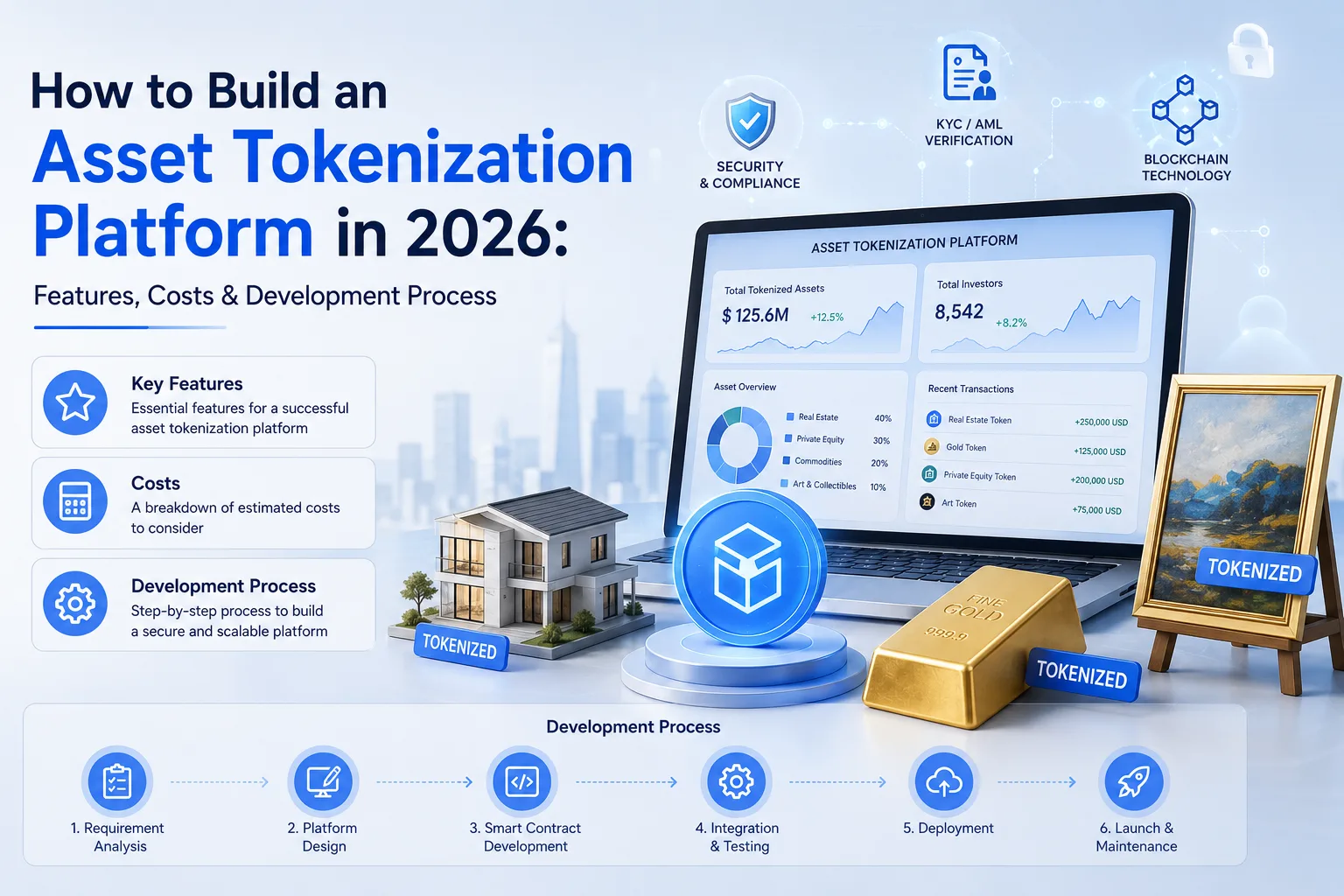
Asset tokenization is becoming one of the most practical applications of blockchain technology. From real estate and commodities to private equity, funds, and collectibles, businesses are exploring ways to represent real world assets digitally and make ownership easier to manage.
But building a successful tokenization platform is not simply a matter of creating tokens and putting them on a blockchain. A professional solution needs the right combination of blockchain technology, asset management, investor experience, security and regulatory compliance.
This guide explains how to approach Asset Tokenization Platform Development in 2026, including its essential features, development process, technology considerations, and estimated cost.
What Is an Asset Tokenization Platform?
An asset tokenization platform is a blockchain-based application that allows businesses to represent ownership rights or economic interests associated with real-world assets through digital tokens.
For example, consider a commercial property valued at $10 million. Instead of structuring ownership around a single investor, a business may create a legally compliant fractional ownership model where eligible investors can hold smaller interests represented digitally.
The platform can manage the asset throughout its lifecycle—from onboarding and token issuance to investor management, transfers, reporting, and administration.
Why Build an Asset Tokenization Platform in 2026?
The growing interest in real-world asset tokenization is encouraging businesses to explore blockchain-based infrastructure for traditional markets.
A well-designed platform can provide several advantages:
- Fractional ownership: High-value assets can potentially be divided into smaller investment units.
- Greater transparency: Blockchain provides a verifiable record of transactions.
- Automation: Smart contracts can automate predefined token-related processes.
- Efficient administration: Digital workflows can simplify investor and ownership management.
- Improved accessibility: Depending on regulations and the asset structure, tokenization can broaden participation.
- Programmable ownership: Tokens can include rules governing transfers, eligibility, and other conditions.
The real opportunity lies in connecting traditional assets with a digital infrastructure that is easier to manage and scale.
Key Features of an Asset Tokenization Platform
A professional Asset Tokenization Platform Development project should focus on functionality that serves both platform operators and investors.
1. Asset Onboarding
The platform should allow administrators to register assets and maintain information such as ownership documents, asset valuation, asset category, token supply, and supporting records.
2. Token Creation and Issuance
Token issuance is the core function of the platform. Administrators should be able to define token parameters, supply, ownership rights, and issuance conditions based on the underlying legal structure.
3. Investor Onboarding
Investors need a straightforward registration process that can include identity verification, eligibility assessment, and other required compliance checks.
4. KYC and AML Integration
Compliance should be built into the platform rather than treated as an afterthought. KYC and AML integrations can help verify investors and support required monitoring procedures.
5. Digital Wallet Integration
Users need secure wallets to receive, hold, and transfer their eligible tokens. The platform can support custodial, non-custodial, or third-party wallet models depending on its business structure.
6. Smart Contract Management
Smart contracts can automate token issuance, transfers, distribution rules, and other predefined operations.
7. Investor Dashboard
An intuitive dashboard can allow investors to view their token holdings, transaction history, asset information, and relevant documents.
8. Admin Dashboard
Platform operators need complete visibility into assets, investors, token supply, transactions, compliance status, and platform activity.
9. Transfer Management
If the token is subject to transfer restrictions, the platform should be capable of checking investor eligibility before allowing a transaction.
10. Reporting and Analytics
Reports can provide information about ownership, transactions, investor activity, asset performance, and compliance operations.