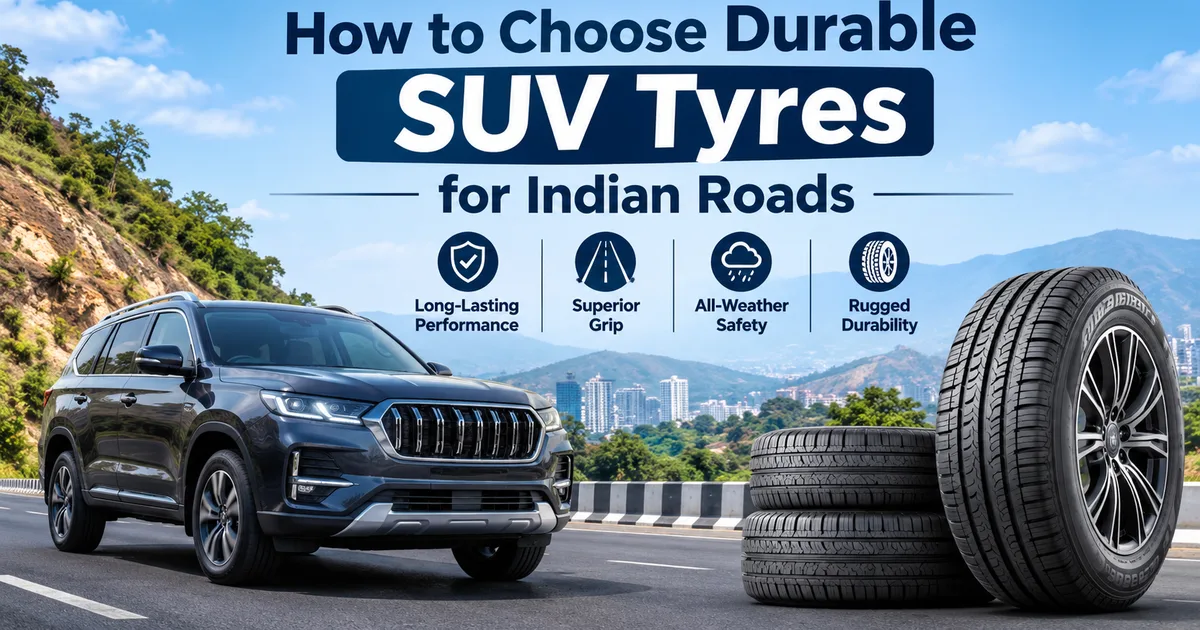
A durable SUV tyre for Indian roads is one that carries your SUV's full weight without strain, has a tread built for the surfaces you actually drive, and has a published tyre life result behind it. Start with the size, load index and speed rating your car maker specifies, then pick the tread for your routes: a road tyre for city and highway, an on and off-road tyre if broken village roads and trails are part of your week.
Among Michelin's SUV tyres in India, the MICHELIN LTX Trail has the strongest longevity result: it lasted 41% longer than the leading competitor tyre in a TÜV Rheinland treadwear test on a Toyota Fortuner. For SUVs that stay on tarmac, the MICHELIN Primacy SUV+ had a 10% longer estimated life than premium competitors in tests by CATARC.
What Indian roads do to an SUV tyre
Durability printed on a spec sheet is one thing, but real-world durability on a long Pune-to-Goa drive is a completely different story. Indian driving conditions test rubber in brutal ways, directly cutting tyre life short if you do not know what to watch out for.
- Potholes and broken tarmac edges are the fastest route to tyre damage. Slamming into a sharp ditch at speed can easily pinch the sidewall into an ugly bulge or knock your wheel alignment off-center, which then quietly eats your tread away from one side. To protect against this, stick to a sensible sidewall profile rather than ultra-low-profile setups, keep cold pressures accurate, and always get your alignment inspected after a rough impact.
- Speed breakers deliver repeated physical jolts straight through the tyre carcass into your suspension. The fix here is as much about driving discipline as it is about rubber: look for tyres with compliant sidewalls that absorb sharp thuds, and make it a habit to crawl over breakers straight-on instead of diagonally or at speed.
- Gravel tracks and rural detours introduce loose, jagged stones that chew right through soft rubber. Over time, this causes noticeable chipping and chunking across the tread surface. If your weekend plans or daily commutes involve rough patches, seek out all-terrain or reinforced patterns specifically engineered with cut-and-chip-resistant tread compounds.
- Blistering summer heat on expressways accelerates tyre wear drastically. High ambient temperatures combined with fast cruising build intense internal heat. Running under-inflated tyres makes this significantly worse because the constant flexing generates even more friction. Dialing in the correct pressure before setting out is non-negotiable for keeping running temperatures safe.
- Full family road trips with luggage push vehicle weight right to the limit. Overloading forces excessive structural stress onto the tyres, driving up heat and dramatically increasing the odds of a high-speed blowout. Whenever you replace your tyres, make sure their load index rating either matches or strictly exceeds the vehicle manufacturer's baseline specification.
- Monsoon downpours and standing water show no mercy to worn rubber. The very first sign of a degrading tyre on wet asphalt is a sudden, scary increase in braking distance. When picking your next set, look past just day-one grip and check for verified wet-braking performance on worn tyres so you stay safe deep into the monsoon season.
The four things that decide how long an SUV tyre lasts
1. Load index matched to the SUV
An SUV with seven people and luggage is far heavier than a hatchback, and the tyre carries that weight on every kilometre. The load index on the sidewall is a code for the most weight one tyre can carry at the right pressure. On Michelin's chart, an index of 91 means 615 kg per tyre; a tyre marked 94 can carry up to 670 kg. Fit a load index equal to or higher than the one your SUV's maker specifies.
"Reinforced", now marked XL (Extra Load), does not mean pothole-proof. It means the tyre can carry more weight at a higher pressure. If your SUV calls for XL tyres, fit XL. If it does not, an XL tyre adds stiffness and a little rolling resistance without making the tyre last longer.
2. A tread built for your routes
A tyre wears fastest when it is used for a job it was not designed for. A road tyre on gravel every day loses tread blocks to cuts; an off-road tread on an SUV that never leaves the expressway gives away quietness for no gain.
- Mostly city and highway: a road SUV tyre such as the Primacy SUV+.
- Highway plus broken rural roads and light trails: an on and off-road tyre such as the LTX Trail. Michelin designed its tread blocks to resist cutting and chipping on rougher terrain, and it is marked M+S.
- Compact SUV on 16 or 17-inch wheels: the MICHELIN Primacy 5, tested in India on a Hyundai Creta.
3. Sidewall height
On many Indian SUVs the same model comes on 17 or 18-inch wheels. The 17-inch tyre has a taller sidewall, which rides over potholes and broken patches more softly. The 18-inch tyre steers a little more precisely but feels firmer over sharp edges. If your roads are rough and you have the choice, the taller sidewall is the more forgiving one.
4. Performance that holds as the tyre wears
A tyre that lasts a long time is only worth it if it still stops well near the end. Look for results measured on worn tyres, not just new ones.
Michelin's published tyre life results for SUVs
When tyre makers make durability claims, the numbers matter most when backed by verified third-party testing. Here is how Michelin’s key SUV patterns performed in published tyre life benchmarks:
- The LTX Trail delivered standout longevity in independent trials conducted by TÜV Rheinland in Thailand back in 2021. Tested on a Toyota Fortuner running 265/65 R17 tyres, it lasted an impressive 41% longer than the leading competitor tyre in the segment. This massive margin makes it an easy pick for SUV owners clocking heavy miles on rough, unpaved surfaces.
- For highway-focused mid-to-large SUVs, the Primacy SUV+ was evaluated in 2021 by CATARC using a Honda CR-V on 225/65 R17 rubber. The results showed an estimated 10% longer tread life compared to rival premium brands, giving drivers prolonged comfort without giving up tyre lifespan.
- Most relevant for modern compact SUV drivers is the Primacy 5. Tested on Indian road conditions by Applus+ IDIADA in 2026 using a Hyundai Creta on 205/65 R16 wheels, it showed an 8% longer projected tyre life over its predecessor, the Primacy 4 ST. That steady compound upgrade means Creta owners get even more running life out of Michelin's premier touring tyre on local roads.
The worn-tyre results matter as much. Worn to 2 mm, the Primacy SUV+ stopped 5.26 m shorter on a wet road than the premium tyres it was compared with, and the LTX Trail stopped 4.6 m shorter. The Primacy 5, worn to 2 mm, stopped from 80 to 20 km/h in 37.6 m against an average of 46.5 m for three competitor tyres.
Which durable Michelin tyre fits popular SUVs
Finding the right rubber for your SUV comes down to wheel size and the kind of driving you do every day. Here is how Michelin’s durable lineup maps across India’s most popular SUVs:
- For the Toyota Fortuner, which typically runs on 265/65 R17 or larger 265/60 R18 wheels, you have two strong options depending on your terrain. The Michelin LTX Trail is the go-to if you frequently tackle broken backroads and need all-terrain toughness, while the Primacy SUV+ delivers a quieter, more composed highway ride.
- If you drive a Mahindra XUV700, your tyre match depends on the variant trim. The lower and mid variants running 235/65 R17 wheels can be fitted with either the rugged LTX Trail or the touring-focused Primacy SUV+. If you own the higher AX7 or AX7 L trims with 235/60 R18 alloys, Michelin offers the Primacy SUV+ for plush daily comfort or the Pilot Sport 4 SUV if you want sharper high-speed grip and sportier handling dynamics.
- For the Tata Harrier and Safari, which ride on 235/65 R17 setups, the recommendations are identical to the standard XUV700. Pick the LTX Trail if you want extra sidewall strength for rural trails and potholed stretches, or opt for the Primacy SUV+ if your priority is effortless, quiet highway cruising with the family.
- The Mahindra Scorpio N runs a chunky 245/65 R17 profile. For this size, the Michelin Primacy SUV+ is the standout match, striking a great balance between solid road manners, dependable wet braking, and the durability needed to carry the Scorpio's ladder-frame bulk.
- Finally, for the Hyundai Creta, whether your variant sits on standard 205/65 R16 wheels or larger 215/60 R17 rims, Michelin's Primacy 5 is the primary fit. It is tailored for urban and expressway duty, offering a silent cabin, long tread life, and consistent braking on wet tarmac.
NOTE: Confirm the size on your own sidewall or in the owner's manual before you buy.
Habits that add life to any SUV tyre
- Check pressure once a month, cold, against the label inside the driver's door, and use the full-load figure when the SUV is full.
- Rotate the tyres about every 8,000 to 10,000 km so all four wear evenly.
- Have the alignment checked after a hard pothole hit or at the first sign of wear on one edge.
- Slow down for potholes and speed breakers, and cross speed breakers straight on.
- Avoid fast starts and hard braking. Both take tread off.
- Clean tyres with mild soap and a soft brush. Products with petroleum or alcohol can make rubber crack sooner.
Frequently asked questions
Which tyre lasts longest on Indian roads for an SUV?
Among Michelin's SUV tyres sold in India, the LTX Trail has the strongest published result: it lasted 41% longer than the leading competitor tyre in a TÜV Rheinland treadwear test on a Toyota Fortuner. For SUVs that stay on tarmac, the Primacy SUV+ had a 10% longer estimated life than premium competitors.
Are all-terrain tyres more durable than road tyres?
They resist cuts and chipping better on rough ground, which is where they earn their keep. On an SUV that only drives city roads and highways, a road tyre gives a quieter, more comfortable ride and still lasts well. Choose by where the SUV goes every week.
Do XL or reinforced tyres last longer on potholed roads?
No. XL means the tyre can carry a heavier load, not that its sidewall is tougher. Fit the load index your SUV's maker specifies, and keep the pressure right, because an under-inflated tyre is more exposed to road damage.
How many kilometres should an SUV tyre last in India?
There is no fixed figure. Replace a tyre when its tread reaches the wear indicators at 1.6 mm, or 10 years after it was made, whichever comes first, and have it checked by a professional every year from 5 years of use.
Does the Michelin warranty cover pothole damage?
No. The Michelin warranty covers defects in material or workmanship for 5 years from purchase, or until the tread reaches the legal minimum, whichever comes first. Road hazard damage such as impacts, cuts and punctures is not covered.
Making a new set last on Indian roads
Most of the life of a tyre is decided by small habits, not by one big decision. Check the pressure once a month with the tyres cold, and again before any long drive. Slow right down for speed breakers and potholes rather than braking on top of them, because the hit to the tyre comes from the speed at impact. When you park, stop short of the kerb instead of rolling into it, since kerb scrapes are a common cause of sidewall cuts. Keep a note in your phone of when the tyres were fitted and when they were last rotated, so you are not guessing at the next service. And if the SUV starts to pull to one side after a hard hit, get the alignment checked that week, before the uneven wear sets in.