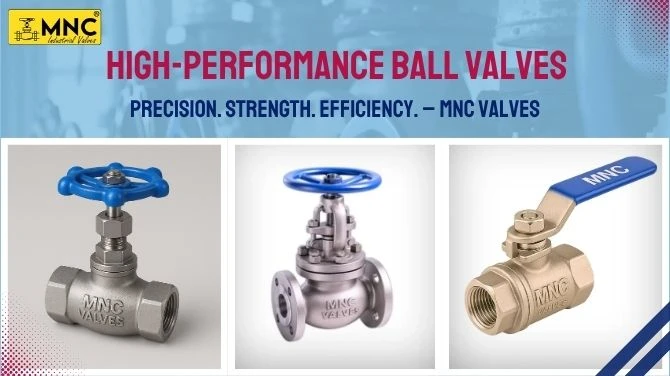
For industrial plants all throughout India, choosing the appropriate ball valve is a crucial choice. A ball valve has a direct impact on process efficiency, leakage control, plant safety, and lifetime cost in a variety of industries, including oil and gas, chemicals, pharmaceuticals, food processing, HVAC, power plants, and water treatment networks. Durable, accurate, and corrosion-resistant valves that function dependably under a range of pressures, temperatures, and service conditions are required due to India's industrial boom, particularly in Gujarat.
Understanding How Ball Valves Work
A ball valve regulates fluid flow by means of a rotating ball with a bore. The bore lines up with the pipeline when the handle or actuator rotates the ball at a 90-degree angle, enabling complete flow. Complete shut-off is achieved by rotating the hole back until it is perpendicular to the pipe.
Key performance drivers:
- Quarter-turn operation ensures fast response.
- Low torque requirement, ideal for automation.
- Bubble-tight shut-off, suitable for Class VI leakage standards.
- Minimal pressure drop due to full-bore design.
This makes ball valves a preferred choice in industries requiring high reliability, zero leakage, and rapid flow control.
Types of Industrial Ball Valves
1. By Body Construction
- Single-Piece Ball Valve
- Compact, economical, suitable for low-pressure utility lines.
- Two-Piece Ball Valve
- Widely used in industrial plants; easy maintenance.
- Three-Piece Ball Valve
- Preferred where frequent cleaning/overhauling is needed (CIP/SIP, pharma, food, chemicals).
2. By Port Design
- Full Port (Full Bore)
- No flow restriction; ideal for pumping, slurry, and high-flow systems.
- Reduced Port
- Compact and cost-effective where high flow is not mandatory.
3. By Operation
- Manual (Lever operated)
- For standard pipeline applications.
- Gear-operated
- Used for large-diameter valves requiring higher torque.
- Pneumatic/Electric Actuated Ball Valves
- Essential for automation in oil & gas, pharma, chemical, and power plants.
4. By Configuration
- 2-Way Ball Valves – Standard on/off.
- 3-Way / 4-Way Ball Valves – L-port and T-port mixing/diverting duties.
Material Selection for Indian Industrial Conditions
India’s temperature, humidity, and varying fluid characteristics demand correct MOC (Material of Construction).
WCB (Carbon Steel) Oil & gas, steam, refinery, power plants
CF8 / SS304 Water, pharma, food processing, mild chemicals
CF8M / SS316 Corrosive chemicals, seawater, high-purity applications
Duplex / Super Duplex Offshore, desalination, chloride-rich environments
Indian industries often face hard water scaling, abrasive slurries, and fluctuating temperatures, making SS316 and WCB the most widely deployed materials across Gujarat and India.
Pressure Ratings & Standards
Industrial ball valves in India must align with global norms:
- 150#, 300#, 600#, 800# – ASME pressure classes
- PN10, PN16, PN25, PN40 – European/Indian standard ratings
- API 607 Fire-Safe, BS 5351, ISO 5211 mounting standards for automation
For refineries, chemical plants, and steam lines, Class 300 & 600 are commonly preferred. HVAC, water treatment, and food processing typically use PN16 or 150#.
End Connections – Which One Should You Choose?
1. Flanged Ends (FE)
- Standard for pipelines above 1”
- Excellent sealing reliability
- Ideal for high-pressure and critical service applications
2. Screwed / Threaded Ends
- Used in low-pressure utility lines
- Common in compressed air and small water lines
3. Socket Weld / Butt Weld
- Leak-proof, permanent joints
- Preferred in high-temperature, high-pressure setups
4. Wafer / Tri-Clamp
- Popular in pharma, biotech, and food plants for hygienic service
Key Selection Criteria for Industrial Ball Valves
1. Identify the Process Medium
Hot water? Steam? Acids? Oils? Solvents?
This governs MOC, seat material (PTFE/RPTFE/NBR/EPDM), and trim selection.
2. Pressure & Temperature Conditions
Higher pressure demands higher class ratings and stronger body materials.
3. Line Size & Flow Requirement
For critical flow systems, always choose full port.
4. Automation Requirements
For SCADA/PLC integrated systems, choose:
- Actuator-ready ISO 5211 pad
- Pneumatic/electric actuators
- Limit switches, positioners, solenoid valves
5. Maintenance Cycle & Clean ability
Pharma, food, and chemical industries prefer three-piece valves due to their service-friendly design.
6. Certifications & Compliance
Check for:
- API 607 / Fire Safe approvals
- ATEX for hazardous zones
- Hydrostatic & pneumatic test certificates
Industry-Specific Insights
Oil & Gas
Requires fire-safe, high-pressure Class 600+ valves with metal seats and anti-blowout stems.
Chemical & Petrochemical
SS316/CF8M with PTFE or R-PTFE seats for corrosion resistance.
Pharma & Food Processing
Tri-clamp ends, mirror-polished internals, CIP/SIP compatibility, FDA-approved seats.
Water Treatment
Economical WCB/SS304 ball valves for raw water, RO systems, and distribution pipelines.
Power Plants
High-temperature resistant materials with gear or actuated mechanisms.
HVAC & Building Services
PN16 butterfly/ball valves with low torque and high cycle life.
Maintenance Tips for Longer Valve Life
- Conduct periodic torque checks.
- Inspect seals and replace worn PTFE seats.
- Avoid over tightening lever/gear assemblies.
- Clean internals periodically in slurry/chemical pipelines.
- Use correct gland packing to prevent stem leakage.
A well-maintained industrial ball valve can deliver 10–15 years of dependable service.
Leading Ball Valve Manufacturers in Ahmedabad – Focus on MNC VALVES
Ahmedabad has emerged as a major industrial hub for valve manufacturing. Among the key players, MNC VALVES stands out for:
- Precision-engineered 2-way, 3-way, and 4-way ball valves
- WCB, CF8, CF8M, Duplex, and high-performance material options
- ISO 5211 actuator-ready designs
- CNC-machined components ensuring tight tolerances
- High cycle life suitable for aggressive Indian plant conditions
- Fast delivery and strong aftermarket service
With installations across oil & gas, water treatment, chemicals, pharma, HVAC, and OEM machinery, MNC VALVES Ahmedabad is a preferred supplier for engineering-led industries across India.
FAQs
1. Which ball valve is best for chemical industries?
SS316/CF8M three-piece full-bore valves with PTFE/RPTFE seats.
2. Can ball valves handle high temperature?
Yes. WCB and alloy steel valves can handle temperatures up to 250–300°C depending on seat material.
3. What is the difference between L-Port and T-Port valves?
L-Port: Diverts flow between two outlets.
T-Port: Mixes or distributes flow across three lines.
4. When should I choose an actuated ball valve?
For automation, remote control, safety interlocks, and continuous operation.
Strong Call to Action
For reliable, high-performance industrial ball valves engineered for Indian conditions, MNC VALVES Ahmedabad provides a complete range from 2-way, 3-way, 4-way, manual, gear-operated, and actuated ball valves across all pressure classes.
📞 Contact: +91 8851787886
Optimize your plant performance—Choose precision-built ball valves from MNC VALVES today!