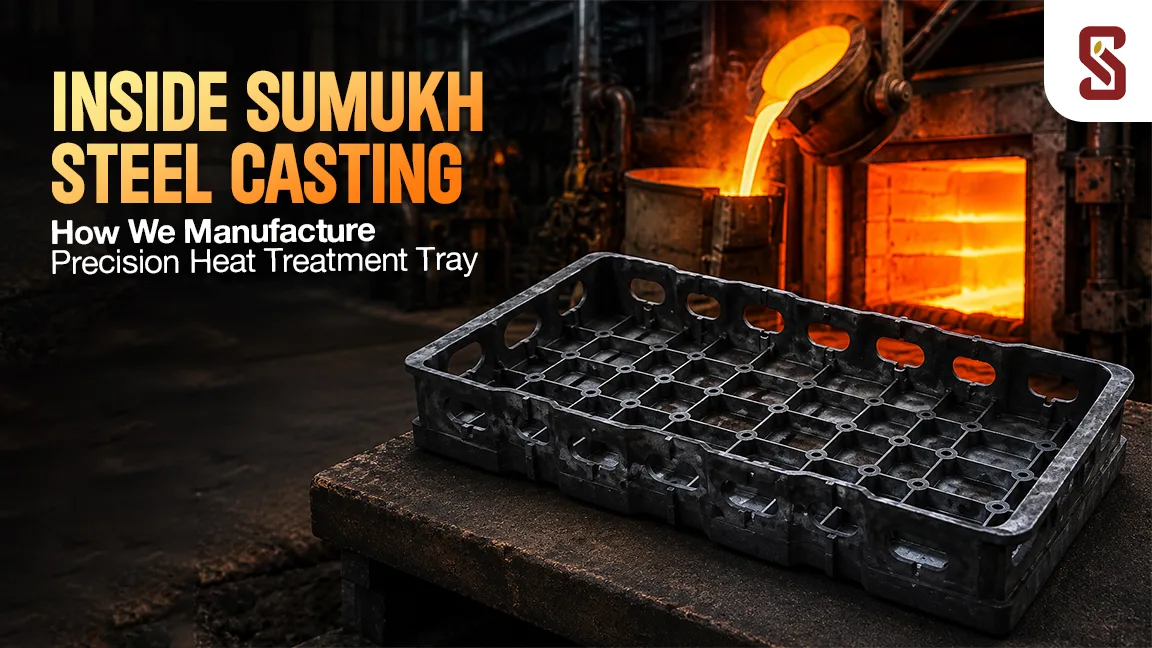
When a furnace load fails mid-cycle because a tray warped, sagged, or cracked, the cost isn't just the tray — it's downtime, scrap, and a broken production schedule. That's the problem precision-cast heat treatment trays are built to solve, and it's a problem we've spent years engineering around at Sumukh Steel Casting.
Founded in 2009 and based in Gokul Shirgaon MIDC, Kolhapur, Sumukh Steel Casting Pvt Ltd has grown into a trusted supplier of heat-resistant and high-temperature castings for industries ranging from automotive and defense to pumps, valves, and industrial machinery. Heat treatment trays are one of our core product lines, and they demand a level of precision and material science that off-the-shelf fabrication simply can't match.
Here's a look at how we actually make them — from raw pattern to furnace-ready tray.
Why Heat Treatment Trays Need Specialized Manufacturing
Heat treatment trays aren't just metal containers. They're structural components that repeatedly cycle through extreme temperatures — often 800°C to 1100°C or higher — while carrying heavy, unevenly distributed loads. Over hundreds of cycles, ordinary steel will warp, sag, or crack under this kind of thermal and mechanical stress.
That's why tray manufacturing starts with material selection, not fabrication. Heat- and creep-resistant alloys — typically high-chromium or high-nickel steel grades — are chosen specifically for their ability to hold dimensional stability at sustained high temperatures. Getting this step wrong is the single biggest reason trays fail early in the field.
Our Manufacturing Process, Step by Step
1. Pattern and Mould Design: Every tray begins with a pattern engineered to the customer's furnace dimensions, load capacity, and cycling requirements. Wall thickness, rib placement, and corner geometry are all designed to reduce stress concentration points — the areas most likely to crack under repeated thermal expansion and contraction.
2. Alloy Selection and Melting: Based on the operating temperature and application, we select the appropriate heat-resistant alloy composition. Raw materials are melted and chemistry-tested before pouring to ensure the alloy meets the required specification — this is critical, since even small compositional deviations affect high-temperature performance.
3. Casting: Molten metal is poured into the prepared moulds under controlled conditions. Careful control of pouring temperature and cooling rate at this stage directly affects grain structure, which in turn determines how well the finished tray will resist thermal fatigue.
4. Fettling and Finishing: Once cooled and de-moulded, castings go through fettling — removing risers, gates, and surface irregularities — followed by grinding and finishing to the required dimensional tolerances.
5. Heat Treatment of the Trays Themselves: Ironically, heat treatment trays often undergo their own heat treatment (normalizing or stress-relieving) before dispatch, to stabilize the internal grain structure and reduce the risk of distortion once the tray goes into service.
6. Quality Inspection: Before any tray leaves our facility, it's checked for dimensional accuracy, surface defects, and material soundness. This step exists for one reason: a tray that looks fine but has an internal casting flaw will fail expensively in a customer's furnace, not in our factory.
What This Process Means for You
A tray built this way holds its shape over more thermal cycles, resists sagging under load, and reduces the frequency of costly replacements. It's a more deliberate — and more expensive to produce — process than simply fabricating a tray from sheet steel. But for manufacturers running continuous or high-volume furnace operations, that upfront precision is what prevents unplanned downtime later.
This same casting discipline extends across our broader product range — from grate plates and valve bodies to defense and automotive components — because in high-temperature and high-stress applications, there's no substitute for getting the metallurgy and casting process right the first time.
Ready to Source Precision Heat Treatment Trays?
If you're evaluating suppliers for heat treatment trays or other heat-resistant castings, we'd be glad to discuss your furnace specifications and load requirements. Contact our team for a custom quote.
Frequently Asked Questions
1. What materials are used to manufacture heat treatment trays?
Heat treatment trays are typically cast from heat- and creep-resistant alloy steels, often high-chromium or high-nickel grades, chosen for their ability to maintain strength and shape at sustained high temperatures.
2. How long do cast steel heat treatment trays typically last?
Service life depends on operating temperature, load, and cycling frequency, but properly cast and heat-treated trays generally significantly outlast fabricated sheet-steel trays because they better resist warping and thermal fatigue.
3. Can heat treatment trays be custom-made for specific furnace sizes?
Yes. Trays are typically manufactured to match a customer's furnace dimensions, load capacity, and temperature cycle, rather than sold only in standard sizes.
4. What temperature range can cast heat treatment trays withstand?
Depending on the alloy used, cast heat treatment trays can generally withstand sustained temperatures in the range of 800°C to 1100°C or higher.
5. Why do some heat treatment trays crack or sag after repeated use?
Cracking and sagging are usually caused by an unsuitable alloy for the operating temperature, poor casting quality, or repeated overloading — all of which is why alloy selection and casting control matter more than tray thickness alone.