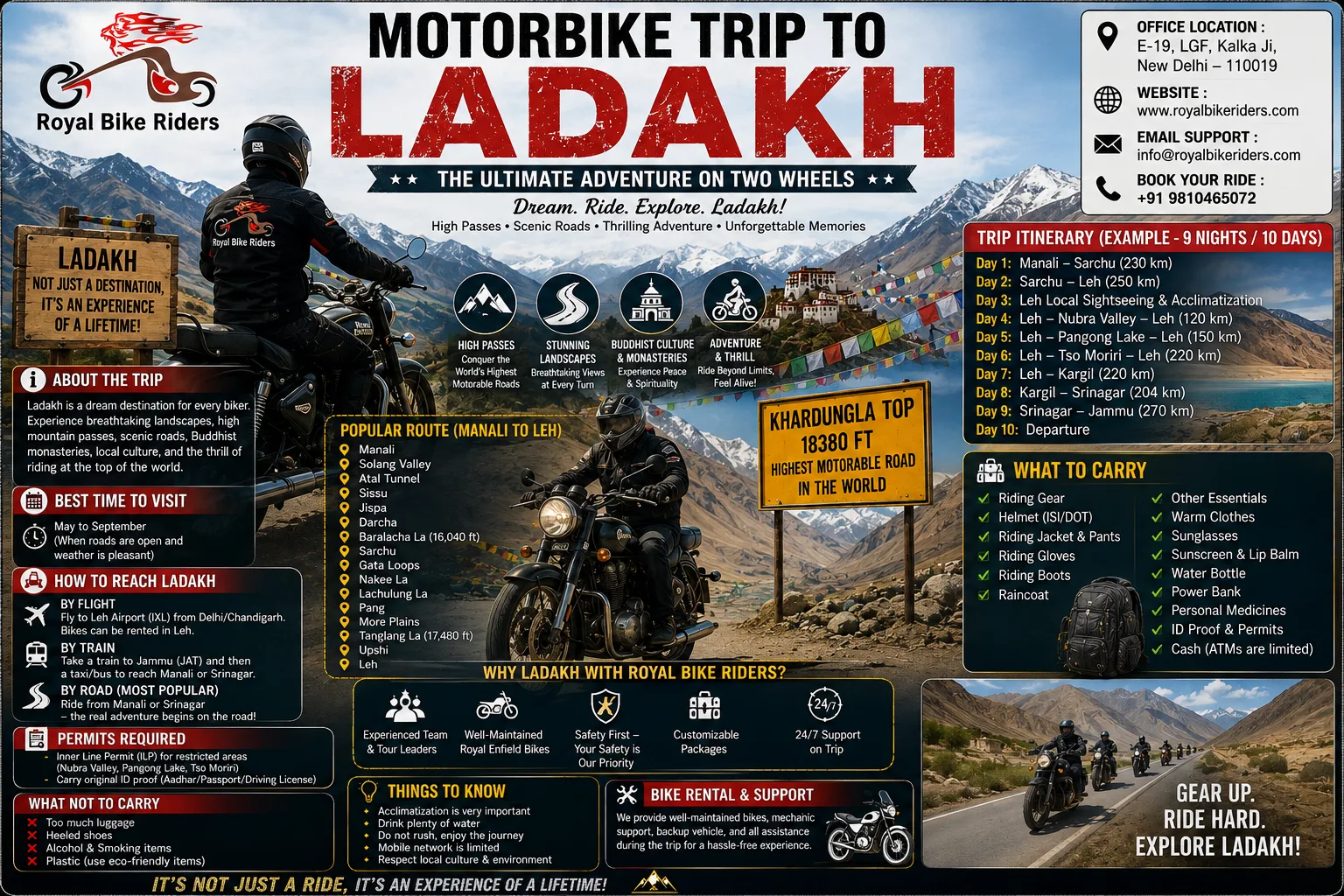
A Motorbike Trip to Ladakh is one of those journeys where the road becomes as important as the destination. You are not simply travelling toward a lake, monastery, valley, or mountain pass. You are riding through a landscape where altitude, weather, terrain, culture, and isolation can change the character of the journey within a few hours.
For a motorcycle enthusiast, this is what makes Ladakh special.
The excitement begins long before reaching Leh. It starts while selecting the motorcycle, preparing riding gear, understanding the route, checking weather conditions, planning fuel stops, and learning how to deal with high-altitude roads. Once the motorcycle enters the Himalayan landscape, every turn brings a different view and every difficult section becomes part of the story.
Planning such a journey with Royal Bike Riders can make the experience more organised because the focus is not only on sightseeing but also on the practical requirements of a motorcycle expedition.
This detailed guide explains what riders should know before planning a Ladakh motorcycle journey, how to prepare, what the route can involve, what mistakes to avoid, and how to make the experience safer and more enjoyable.
What Makes a Motorbike Trip to Ladakh So Special?
Ladakh is often called the Land of High Passes, but the real attraction is the combination of landscapes found within one region.
A single motorcycle journey can take you through:
- High mountain passes
- Cold desert landscapes
- Green river valleys
- Remote villages
- Buddhist monasteries
- High-altitude lakes
- Rocky mountain roads
- Open Himalayan plateaus
- Sand dunes in Nubra
- Traditional settlements
- Dramatic sunrise and sunset viewpoints
The official Ladakh Tourism website describes the region as a combination of culture, nature and adventure, with destinations such as Pangong Lake, Nubra Valley, Turtuk, Umling La, Hemis and Thiksey among its major experiences.
For a rider, however, the destination list is only half of the experience.The road connecting these places is what creates the adventure.
Motorbike Trip to Ladakh: What Should You Expect?
A Ladakh motorcycle tour should not be compared with an ordinary highway road trip.
At lower elevations, you may ride comfortably for hours. As you climb higher, the motorcycle, rider, and environment behave differently.
You may encounter:
- Reduced oxygen levels
- Strong winds
- Cold temperatures
- Sudden weather changes
- Loose gravel
- Broken road sections
- Water crossings
- Sharp bends
- Steep climbs and descents
- Long isolated stretches
- Limited fuel availability
Ladakh's official tourist advisory specifically recommends careful planning for motorcycle trips, including awareness of altitude sickness, vehicle checks and fuel planning because petrol stations are limited in remote regions.
This is why preparation should begin several weeks before the ride.
Choosing the Right Motorcycle for Ladakh
The best motorcycle for Ladakh is not necessarily the most powerful motorcycle.
What matters more is reliability, rider familiarity, comfort, serviceability and suitability for mixed road conditions. A motorcycle should be comfortable enough for long riding days and capable of handling rough surfaces, climbs and changing road conditions. Before departure, riders should check:
Engine
The engine should be running smoothly without unusual noise, overheating or oil leakage.
Brakes
Brake pads, discs and brake-fluid levels should be inspected carefully.
Tyres
Tyres are extremely important because the route can move between paved roads, gravel and rough surfaces.
Check:
- Tread depth
- Air pressure
- Cuts
- Punctures
- Sidewall condition
Chain and Sprockets
A worn chain or sprocket can become a serious problem during a remote journey.
Battery
Cold temperatures and repeated starting can put additional stress on the battery.
Lights and Electrical System
Headlights, indicators, brake lights, horn and charging systems should all work correctly.
Suspension
A motorcycle carrying luggage over uneven roads needs properly functioning suspension.
Royal Bike Riders positions its Ladakh motorcycle experience around organised riding support and motorcycle assistance, which can be particularly useful when travelling through remote Himalayan terrain.
Understanding the Ladakh Route Before You Ride
One of the biggest mistakes first-time riders make is looking only at the total kilometres. Distance alone does not explain the difficulty of a Himalayan route.
A 100-kilometre mountain section may take significantly longer than 100 kilometres on a flat highway because of bends, road conditions, altitude and frequent stops. Therefore, a good itinerary should consider:
Distance + altitude + road condition + weather + rest + fuel + daylight.
This is much more important than trying to cover the maximum number of kilometres every day.
Delhi to Ladakh: How the Journey Can Begin
For riders starting from Delhi or nearby northern Indian cities, the traditional road journey toward Ladakh can involve the Himalayan gateway routes through places such as Chandigarh, Manali, Jispa, Sarchu and Leh, depending on the chosen itinerary and current road conditions.
Another classic approach is through Srinagar and Kargil before reaching Leh. Both approaches have their own character.
The Manali side is known for dramatic high-altitude terrain and demanding mountain riding.
The Srinagar side offers a different transition, moving through greener Himalayan landscapes before entering the more arid environment around Ladakh.
The exact route should always be confirmed according to the season, current road conditions and official advisories.
Why Acclimatization Is One of the Most Important Parts of the Trip
This is an area where riders should never take shortcuts. Leh sits at roughly 3,500 metres above sea level, meaning the body needs time to adjust to reduced oxygen availability.
The current official Ladakh Tourism advisory says tourists arriving in Leh should undergo at least 48 hours of complete rest for acclimatization before travelling to higher-altitude areas.
That means arriving in Leh and immediately riding toward Pangong or a very high pass is not a good plan.
A better approach is:
Arrival in Leh → Rest → Hydration → Easy activity → Monitor symptoms → Gradual progression.
During acclimatization:
- Avoid heavy exercise
- Avoid alcohol
- Drink water regularly
- Eat light meals
- Sleep properly
- Pay attention to symptoms
- Do not ignore unusual breathlessness or severe headache
The official advisory identifies headache, nausea, dizziness, fatigue and sleep problems among possible mild AMS symptoms and warns that severe symptoms can indicate more dangerous high-altitude conditions.
If symptoms become serious, do not continue climbing simply because the itinerary says you should.
Riding Technique at High Altitude
Riding at altitude requires a different mindset.
You should not try to win a race against the mountain.
Ride Smoothly
Smooth acceleration and braking help maintain motorcycle control on unpredictable surfaces.
Avoid Sudden Overtaking
Mountain roads frequently have blind corners.
Use Engine Braking
On descents, appropriate engine braking can help reduce excessive dependence on the brakes.
Maintain Distance
Dust, gravel and sudden braking by another rider can create hazards.
Slow Down Before Corners
Do not enter blind bends at excessive speed.
Watch the Road Surface
A beautiful view can distract you, but gravel, potholes and water can appear unexpectedly.
The official Ladakh advisory also recommends pre-trip vehicle checks because high-altitude travel can place additional demands on the vehicle.
Leh: More Than Just a Rest Stop
Leh deserves time.
Instead of treating it only as the place where you collect your motorcycle and immediately leave, use it as the point where you understand the region.
Possible experiences around Leh include:
- Leh Palace
- Shanti Stupa
- Local markets
- Traditional architecture
- Nearby monasteries
- Cafés and local food
- Views across the Indus Valley
Ladakh Tourism highlights monasteries, heritage, local culture and adventure as important parts of the region's tourism experience.
The cultural side also gives the motorcycle trip more depth. You are not just crossing mountains; you are travelling through communities that have adapted to one of the world's most demanding environments.
Khardung La: More Than a Famous Motorcycle Photograph
Khardung La has become one of the most recognisable names in Ladakh motorcycle tourism.
For riders, reaching a high pass can feel like a personal achievement.
But the important point is not simply reaching the summit.
The ride toward the pass teaches you how quickly the environment can change.
Temperature drops.
Wind increases.
The landscape becomes increasingly barren.
The road becomes more demanding.
At high altitude, even a short stop can feel physically different from stopping at a normal highway viewpoint.
Take photographs, enjoy the scenery, but avoid unnecessary physical exertion.
Nubra Valley: The Cold Desert of Ladakh
Nubra is one of the most interesting places to include in a motorcycle itinerary because the landscape changes dramatically.
The valley combines rugged mountains with greener areas around settlements and the famous cold-desert environment.
The Hunder region is particularly well known for its sand dunes and Bactrian camels, which create a landscape that looks completely different from what many travellers expect from the Himalayas.
For motorcycle travellers, Nubra is also a reminder that Ladakh is not simply a land of rocks and snow.
There are villages, agricultural areas, rivers, monasteries and unique local traditions.
Spend some time exploring instead of treating the valley as a quick overnight stop.
Pangong Lake: Why Every Rider Wants to Reach It
Pangong Lake is one of the most recognisable landscapes in Ladakh.
Its blue water, enormous mountain surroundings and remote location make it a natural highlight of a motorcycle expedition.
But the real satisfaction comes from the journey.
After hours of mountain riding, arriving beside a vast high-altitude lake creates a completely different feeling.
The best way to experience Pangong is to slow down.
Watch the changing light.
Walk only as much as your body comfortably allows.
Take photographs.
Enjoy the silence.
And remember that this is a fragile high-altitude environment.
Tso Moriri and Other Routes Beyond the Standard Circuit
Experienced riders may want to explore routes beyond the most common Leh–Nubra–Pangong circuit.
Depending on permissions, road conditions, season and the current operating situation, areas around Tso Moriri, Hanle, Changthang and other remote landscapes can offer an even deeper experience. However, remote does not mean better for everyone.
The farther you travel from Leh, the more important preparation becomes.
Medical infrastructure can be limited in remote areas, and fuel and connectivity can also become less predictable. The official Ladakh advisory specifically warns that medical facilities are concentrated in Leh and are limited in remote regions. Therefore, these routes should be planned carefully rather than added to an itinerary at the last minute.
Fuel Planning for a Ladakh Motorcycle Trip
Fuel management is one of the most practical parts of Himalayan riding.
In cities, riders rarely think about fuel because petrol pumps are frequent.
Ladakh is different. Official tourist guidance warns that petrol stations are limited in remote areas and recommends planning refuelling carefully.
Before starting a remote section:
Fill the tank.
Understand the expected distance.
Know the next reliable refuelling point.
Consider the motorcycle's real-world range.
Avoid assuming that a fuel station will always be operational.
Carry only fuel containers that are legal, safe and appropriate for the journey.
Fuel planning becomes especially important when the itinerary includes long remote stretches.
Mobile Network and Internet Connectivity
Do not expect continuous connectivity throughout Ladakh.
The Ladakh Police tourist safety information notes that mobile connectivity is more reliable in Leh and limited in rural areas, and that post-paid connections are generally the practical option because prepaid connections from outside the region may not work reliably.
Before leaving Leh:
- Download offline maps
- Share your itinerary
- Inform someone about your route
- Keep emergency numbers saved
- Charge your phone
- Carry a power bank
- Avoid depending completely on mobile internet
A phone is useful, but it should not be your only navigation or emergency resource.
What to Pack for a Motorbike Trip to Ladakh
Packing should be practical rather than excessive.
Riding Gear
Carry:
- Certified helmet
- Riding jacket
- Riding gloves
- Riding trousers
- Knee protection
- Riding boots
- Waterproof layer
- Warm inner layers
Clothing
Mountain weather can change quickly, so use layers.
A practical combination includes:
- Thermal innerwear
- Fleece
- Warm jacket
- Waterproof outer layer
- Woollen socks
- Gloves
- Cap or balaclava
Personal Essentials
Also consider:
- Sunglasses
- Sunscreen
- Lip balm
- Personal toiletries
- Reusable water bottle
- Power bank
- Charging cables
- Identification documents
- Copies of important documents
- Small first-aid kit
Motorcycle Essentials
Depending on your motorcycle and tour arrangement:
- Puncture repair kit
- Basic tools
- Spare fuses
- Cable ties
- Bungee cords
- Chain lubricant
- Emergency torch
If your tour operator provides technical backup, coordinate with them before carrying bulky mechanical equipment.
Medicines and Health Preparation
Do not create your medical kit based only on random internet lists.
Carry your regular prescribed medicines and speak to a qualified doctor about altitude-related medication if appropriate for you.
The official Ladakh Tourism advisory discusses altitude sickness prevention and emergency response and recommends consulting medical professionals when necessary.
A personal kit may include commonly used first-aid supplies such as:
- Bandages
- Antiseptic
- ORS
- Basic pain-relief medication
- Personal prescription medicines
- Motion-sickness medicine if medically suitable
- Any medication specifically advised by your doctor
The most important medicine in Ladakh is not a tablet. It is proper acclimatization.
Weather: Why You Should Never Trust Only a Calendar
Ladakh's weather is one of the reasons the journey can be unpredictable.
Even during the commonly preferred travel season, mornings, afternoons and nights can feel dramatically different.
The official Ladakh Tourism website identifies May–September as the primary summer period for activities such as biking, while also noting distinct spring, autumn and winter experiences.
Before every riding day, check:
- Weather
- Road conditions
- Pass status
- Local advisories
- Expected temperature
- Wind conditions
Never assume that because yesterday's road was open, today's conditions will be identical.
Accommodation During the Motorcycle Journey
Accommodation can vary from comfortable hotels in Leh to simpler stays in remote areas.
The purpose of a remote-night stay is not luxury. It is recovery. After a long riding day, the most important things are:
- Warmth
- Clean bedding
- Food
- Water
- Safe motorcycle parking
- A comfortable place to rest
A well-designed motorcycle itinerary should balance sightseeing with sufficient recovery time.
Food on the Road
Do not underestimate the importance of food during a motorcycle trip. Long riding days consume energy. Local food can also become an important part of the experience.
Depending on the location, you may find dishes influenced by Tibetan, Himalayan and North Indian culinary traditions.
Try local food when appropriate, but avoid experimenting excessively with unfamiliar foods immediately before a difficult riding day.
A simple breakfast, adequate carbohydrates, fluids and moderate meals can make long riding days easier.
How Royal Bike Riders Can Fit Into the Experience
A professional motorcycle tour is not simply about providing a bike.
The real value is coordination. A well-organised tour can help bring together:
Motorcycle + Route + Accommodation + Meals + Road Support + Technical Assistance + Group Coordination.
This can be particularly valuable in Ladakh because the journey involves more variables than an ordinary road trip.
Royal Bike Riders is positioned around motorcycle-focused Himalayan travel, giving riders an organised framework for exploring Ladakh instead of having to independently manage every element.
For someone visiting Ladakh for the first time, this can reduce logistical stress and allow more attention to be placed on riding and experiencing the landscape.
What Makes a Good Ladakh Tour Operator?
Before booking any motorcycle expedition, riders should ask practical questions.
Ask About the Motorcycle
Which motorcycle will be provided?
What is included?
How is maintenance handled?
Ask About Support
Is a backup vehicle available?
Is technical assistance included?
What happens if a motorcycle breaks down?
Ask About Accommodation
Where do riders stay?
Are remote-night stays included?
Ask About Food
Are meals included?
Are vegetarian options available?
Ask About Emergency Procedures
What happens if a rider becomes seriously unwell?
How is evacuation handled?
Ask About Route Changes
What happens if the weather closes a pass?
A professional operator should be able to explain these issues clearly.
Common Mistakes Riders Make in Ladakh
Mistake 1: Riding Too Fast
Mountain roads are not race tracks.
Mistake 2: Skipping Acclimatization
This is one of the most serious mistakes.
Mistake 3: Carrying Too Much Luggage
Heavy luggage makes motorcycle handling more difficult.
Mistake 4: Ignoring Weather
Mountain weather can change rapidly.
Mistake 5: Forgetting Fuel Planning
Remote fuel availability is limited.
Mistake 6: Riding After Exhaustion
Fatigue reduces reaction time.
Mistake 7: Ignoring Minor AMS Symptoms
A mild problem can become serious if you continue ascending.
Mistake 8: Travelling Without Offline Navigation
Connectivity is not guaranteed.
Mistake 9: Littering
Ladakh is an environmentally sensitive region.
Mistake 10: Treating the Mountain Like a Challenge to Conquer
The Himalayas should be approached with respect, not ego.
Responsible Motorcycle Tourism in Ladakh
The experience becomes more meaningful when riders protect the place they came to explore.
The Ladakh administration has issued guidance concerning single-use plastics and litter prevention, reflecting the region's environmental sensitivity. As a responsible rider:
- Carry your waste back.
- Avoid unnecessary plastic.
- Do not disturb wildlife.
- Stay on appropriate roads.
- Respect monasteries.
- Ask before photographing local people.
- Avoid loud behaviour near villages.
- Support local businesses.
- Do not damage natural formations.
- Use reusable bottles where practical.
Your motorcycle should leave tyre tracks, not trash.
A Practical Daily Riding Routine
A disciplined routine can make the entire journey easier.
Before Riding
Wake up early.
Check the weather.
Check motorcycles.
Have breakfast.
Drink water.
Wear protective gear.
Confirm the route.
During Riding
Take regular breaks.
Drink water.
Eat light snacks.
Monitor your energy.
Avoid unnecessary speed.
Stay with the group.
After Riding
Inspect the motorcycle.
Refuel if required.
Charge devices.
Eat dinner.
Prepare clothing for the next day.
Sleep properly.
This simple routine prevents small problems from becoming major ones.
Photography Stops Without Compromising Safety
Ladakh offers countless photography opportunities, but riders should select safe stopping locations.
Never stop in the middle of a blind corner.
Avoid parking near cliff edges.
Do not block traffic.
If the group is travelling together, wait at designated safe areas rather than creating sudden roadside stops.
A good tour leader can help identify suitable locations for breaks and photographs.
Who Should Avoid Rushing Into a Ladakh Motorcycle Tour?
Ladakh is not a place where physical confidence should replace preparation.
Anyone with concerns about high-altitude travel, heart or respiratory conditions, or other significant medical issues should speak with a qualified doctor before planning the journey.
The Ladakh Police also identifies altitude sickness as one of the biggest challenges for tourists and recommends appropriate acclimatization.
The goal is not to prove that you can tolerate altitude.
The goal is to enjoy the journey safely.
How Many Days Should You Keep?
There is no single perfect number of days because the duration depends on:
- Starting city
- Route
- Number of rest days
- Number of sightseeing days
- Road conditions
- Weather
- Destinations included
- Whether the motorcycle is transported or ridden from home
A rushed itinerary can turn an amazing motorcycle expedition into an exhausting schedule.
For first-time riders, additional buffer days are valuable.
They provide flexibility when weather, road conditions or health require changes.
An Ideal Mindset for the Journey
The most important preparation is mental.
You need patience.
You need flexibility.
You need respect for altitude.
You need the ability to accept that a planned route may change.
You need to understand that sometimes the best decision is to stop.
A successful Ladakh rider is not necessarily the person who rides the fastest.
It is the person who knows when to accelerate, when to slow down, when to rest and when to turn back.
Why the Journey Stays With You
After returning home, you may not remember every kilometre.
You may not remember every meal.
But you will remember the first time the mountains appeared around you.
You will remember the cold wind at a high pass.
You will remember seeing your motorcycle surrounded by enormous Himalayan landscapes.
You will remember the silence near Pangong.
You will remember the roads through Nubra.
You will remember the conversations with fellow riders after a difficult day.
And you will probably remember the feeling of starting the engine every morning without knowing exactly what the next mountain road would bring.
That is the real attraction of a Motorbike Trip to Ladakh.
Final Word: Prepare for the Road, Not Just the Destination
A Ladakh motorcycle expedition should never be planned as a simple checklist of tourist attractions.
It should be planned as a complete riding experience.
The motorcycle needs preparation.
The rider needs preparation.
The route needs preparation.
Fuel needs planning.
Weather needs monitoring.
Altitude needs respect.
And the itinerary needs enough flexibility to adapt to the mountains.
Official Ladakh guidance continues to emphasise acclimatization, health precautions, vehicle preparation, fuel planning and responsible travel for visitors. This is where an experienced motorcycle-tour operator can add real value.
With Royal Bike Riders, riders can approach the journey as an organised Himalayan motorcycle adventure rather than trying to solve every logistical challenge independently.
From the first turn toward the mountains to the final ride back toward home, Ladakh offers something that few destinations can provide: the feeling that the road itself is the destination.
If you are ready for cold mornings, high passes, changing terrain, remote valleys, long riding days and unforgettable Himalayan landscapes, a Motorbike Trip to Ladakh with Royal Bike Riders can become far more than a holiday.
It can become one of those journeys you continue talking about long after the motorcycle is parked back at home.
Royal Bike Riders
E-19, LGF, Kalka Ji, New Delhi – 110019
Website: https://www.royalbikeriders.com/
Email: [email protected]
Phone: +91 9810465072
Important: Route availability, permits, road conditions, pass status and local rules can change. Always confirm the latest information before departure and follow official Ladakh advisories.